There is an area of photography which concerns itself with documents of British folkloric rituals and costumes. A starting point for such things is Sir Benjamin Stone’s work in the late 19th and early 20th century, when he photographed British traditional customs, collected in book form in A Record of England: Sir Benjamin Stone and the National Photographic Record Association 1897 -1910, which was published in 2007.
The people, times and places in Benjamin Stone’s photographs seem as though they belong to somewhere now impossibly distant from our own times.
The physiognomy of those portrayed, their stances and very being have gained layers of difference and otherliness as the years have gone by. There is a sense at times of them being photographs not from Benjamin Stone’s land of birth but rather of them being documents of rituals in exotic foreign lands.

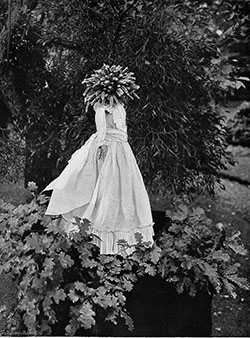
Alongside this they can also possess an air of surreality: in one photograph a stuffed figure is shown as if it is floating in the air amongst the foliage of a tree; dressed in a white flowing dress its face and hands are completely obscured or replaced by what appear to be harvest crops.
As an image it brings to mind more a sense of being from a fairy tale rather than 19th century reality captured via documentary photography.
Other photographs contain numerous stag’s antlers worn as part of ritual costume. This, along with the challenging stance and stares of their subjects, lend them a folk horror aspect, almost as though they are a glimpse forwards and backwards to the transgressive rituals of the villagers in 1970 Play for Today television drama Robin Redbreast.

Benjamin Stone’s work is an early point in a lineage that leads to more recent books which document British folkloric tradition, ritual and costume such as Homer Sykes Once a Year: Some Traditional British Customs (1977), Sarah Hannant’s Mummers, Maypoles and Milkmaids: A Journey Through the English Ritual Year (2011), Merry Brownfield’s Merry England – the Eccentricity of English Attire (2012) and Henry Bourne’s Arcadia Britannica: A Modern British Folklore Portrait (2015).

As a starting point, Homer Sykes Once a Year is a collection of photographs from seven years of journeying around Britain and was reissued in 2016 by Dewi Lewis Publishing.
As with sections of Benjamin Stone’s work, some of the photographs in Once a Year have a genuinely eerie or unsettlingly macabre air, particularly the cover photograph of the original edition which features the custom of burning tar barrel-carrying in Allendale, Northumberland.
This presents a sense of a ritual that feels considerably separate to mainstream contemporary society and mores, whether at its original time of publication or today and although it is a documentary photograph, as with some of Stone’s photographs, seems to hint at or lean more towards the fictional worlds and tropes of folk horror rather than the real world.
Alongside which Once a Year also acts as a document of period 1970s detail and style, while also capturing the way traditional customs existed in amongst such things.
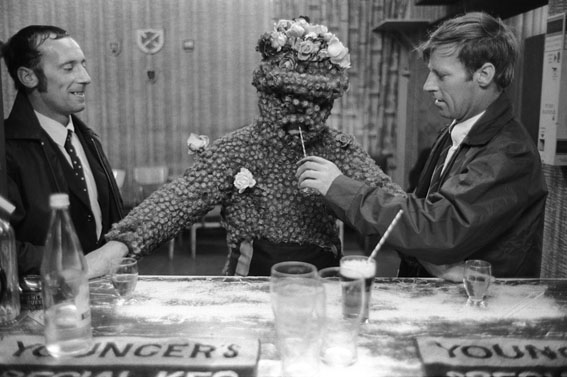
One of the key images in the book is of somebody completely enclosed in a Burry Man folkloric costume, which is made from sticky flower or seedheads, in a pub who is being helped to drink through a straw. It is a precise distilling and capturing of a particular moment in British life, full of subtle signifiers of a way of life which, while only being a few decades ago and not yet as inherently distant as the world captured by Benjamin Stone’s photographs, still seems to belong to a world very far apart from our own.

In a number of ways Sarah Hannant’s Mummers, Maypoles and Milkmaids is similar to Once a Year in that both books are documentary photography social histories of the ongoing observance and enactment of British folk rituals.
Although Hannant’s photographs are in colour, some of the photographs could almost be exchanged from one book to the other, although they are set apart by subtle period signifiers and details.
As with Once a Year one intriguing aspect of this book is the way that these sometimes-arcane rites and rituals are pictured alongside and in contrast to symbols of modern-day life.

In Sarah Hannant’s book this positioning and juxtaposing is shown in photographs which, for example, picture somebody dressed in a straw bear folkloric costume next to a local metro supermarket and a fluorescent-clad safety officer next to carnival float queens.
It is also given expression in her book through more subtle details such as a digital camera next to people whose faces have been blackened as part of a folkloric ritual, the modern eye wear of a traditional jester as he wanders down a country lane and possibly in the modern-day physiognomy and clothing of the observers of burning tar barrel carrying.
Often the rituals pictured have a playful, dressing up, knockabout air but just once in a while something else seems to creep into the photographs, in particular in one photograph where the blackened faces of those who, as mentioned above, are engaged in and wearing the costume of folkloric rituals peer and appear through a pub window.
As with Once a Year, such photographs suggest the tropes of folk horror rather than being purely documentary photographs and they begin to hint at or conjure up an otherly Albion, slithers of a view through the portal as it were.

Alongside Once a Year and Mummers, Maypoles and Milkmaids, Merry Brownfield’s Merry England is a book which utilises documentary photography via its photographs of its subjects in real world settings.
At first glance and from the book’s cover, which features somebody dressed in traditional green man folk costume, it appears to be another book in this lineage, one which directly focuses on folkloric traditions and photographs of people in traditional folk costume forms the heart of the book with sections titled “Straw Bear”, “The Castleton Garland Day”, “Holly Man”, “Mummer’s Plays” and “Morris Dancers”.
However, it also travels considerably further afield to encompass pop culture tribes and styles such as mod and people who appear to have tumbled from the pages of the humorously eccentric vintage lifestyle magazine The Chap in “The Tweed Run” and “Vintage Style” sections.
Alongside which it also documents the city-based London East End tradition of pearly kings and queens, the comic convention- esque costumes of attendees to the World Darts Championship, traditional Billingsgate fish market bobbin hats and a number of possibly more contentious hunting and aristocratic areas.
Because of the way in which the book explores a breadth of different areas of traditional and celebratory wear it reminds me of Jeremy Deller and Alan Kane’s Folk Archive book and exhibition from 2005, being more a “from the people” view of things than specifically what could be considered folk aesthetics.

Henry Bourne’s Arcadia Britannica takes a different approach to the above books in that, as its subtitle suggests, the book contains more formal posed portraits of those in folkloric costume.
The photographs are described as being “shot in the wild” at various events and festivals but apart from the occasional appearance of grass beneath the feet of some of those in the photographs, due to the use of a blank white backdrop aesthetically they could be studio portraits.
The white backdrop removes those in the photographs from the wider world and accompanied by the capturing of detail which is enabled by the formal posing and controlling of light sources it lends the project the air of an almost scientific recording of its subjects; through these choices of technique the book represents and contains a precise documenting of a particular point in folkloric time archived for future generations.
While the book largely focuses on those wearing traditional folkloric costume, although less so than in Merry England it also branches out further to include Pearly King and Queen costumes, while also taking in practising witches and warlocks (and in an interconnected manner includes an introductory essay by Simon Costin, who is the director of the Museum of Witchcraft alongside being the founder and director of the Museum of British Folklore).

All the above books and photography focus on the British Isles but there are a number of books which carry out similar studies and documenting of folkloric rituals and costumes elsewhere in the world, one of which is Charles Fréger’s Wilder Mann: The Image of the Savage originally published in 2012. This takes as its theme:
“The transformation of man into beast [which] is a central aspect of traditional pagan rituals that are centuries old and which celebrate the seasonal cycle, fertility, life and death.”
Reflecting such transformations, generally the images in the book are of costumes where the human features of their wearers are no longer visible, being much more hidden than many British folkloric costumes.

Fréger travelled throughout Europe to document such rituals and while his project took him to the UK the costumes in his photographs seem to the untrained eye to largely be exotically foreign.
In British folklore-focused photography and books the sense of unsettling folk horror-esque undercurrents are more glimpses here and there; with Charles Fréger’s images such atmospheres are much more prevalent.
Many of the costumes in his photographs could well be escapees or prototypes for the 1970s British BBC costume and creature effect department in terms of their design. They could well be creatures from a forgotten Doctor Who episode from back then, possibly compatriots of the befurred yetis or abominable snowmen that had a nation’s children hiding behind the sofa.

One photograph in Wilder Mann pictures somebody smoking a cigarette, which should break the spell but it does not; the wearer’s masked white costume, makeup, walking stick, stance and the way they are staring at the camera makes it wander off into some very odd almost slasher film territory and more childhood nightmares. These could be creatures from the television series Sesame Street turned into monsters, ones which have crawled from under the bed and out of the cupboards and are wandering the landscape freely.

The images in Wilder Mann and the above books of British folkloric rituals often focus on documenting rurally-orientated or located events and customs. Axel Hoedt’s book Once a Year from 2013 shifts focus more exclusively to streets and towns, in particular the Swabian Alemannic carnival known as Fasnacht, Fastnacht or Fasnet, a custom in southwest Germany. The carnival is described in text which accompanies the book as being:
“When the cold and grim spirits of winter are symbolically hunted down and expelled. Every year around January and February processions of people make their way through the streets of Endingen, Sachsenheim, Kissleg, Singen,
Wilfingen and Triberg dressed up lavishly as demons, witches, earthly spirits and fearful animals to enact this scene of symbolic expulsion.”
The language used seems brutal and harsh; hunted down, expelled, expulsion, fearful and to view these photographs is to step in amongst the denizens of a land far from the twee fields of folklore and carnivalesque dressing up.

The creatures his photographs capture (that particular word is used somewhat appropriately and possibly hopefully) seem like the darker urban cousins of Wilder Mann.
The images put the viewer in mind of folklore as rethought by club kids (think 2003 film Party Monster), while sharing a sense of Wilder Mann’s 1970s Doctor Who-esque “How do we scare the heck out of people for relatively tuppence ha’penny?”.

While in Estelle Hanania’s Glacial Jubilé book (2013), some of the European folkloric costumes and creatures from Wilder Mann seem at points to reappear and breach the rural/urban divide, but this time they can seem like alien invaders as they are shown advancing in formation across the landscape and then appearing in urban streets and shopping centres.
Alongside the rural/urban division that is at times present in such folkloric-based photography work there could also be seen to be further separate but interlinked strands, themes, atmospheres and approaches.
As mentioned above there is the more documentary-like photography which focuses on British folklore and that can be found in the work of Benjamin Stone and the books Homer Sykes’ Once a Year, Sarah Hannant’s Mummers, Maypoles and Milkmaids, Henry Bourne’s Arcadia Britannica and Merry Brownfield’s Merry England.

Alongside these in a connected but parallel strand are the photography books and projects which focus more on European and non-UK folklore such as Charles Fréger’s Wilder Mann, his Yokainoshima – Island of Monsters (2016) which is a study of Japanese folkloric costume, Axel Hoedt’s Once a Year and Dusk (2015) which takes his folkloric/carnival photographic studies to Austria and Switzerland and Estelle Hanania’s Glacial Jubilé.
Both loose groupings of books and work are essentially photographic portraits and documenting of folkloric costume but just in different locations.
The European-focused books seem in part to be more a reflection of a fine art like take on photography and to be partly an expression of the photographer’s own creative intent and stories as well as being documentary in nature; although being photography projects which focus on the real world, within them is often a sense of an intention to create a particular atmosphere or personal narrative that at various points interacts with or even to a degree supersedes the documentary aspects.

This fine art, expressive intent is given full reign in Laura Thompson’s Senseless photography series from 2016 where she produced staged photographs of figures in the landscape dressed in costumes made from disposable man-made objects.
These photographs appear to recall European folkloric or mythical costume that may have appeared in say Charles Fréger or Estelle Hanania’s work but filtered as though via a story of outer space creatures who are lost and wandering the earth.