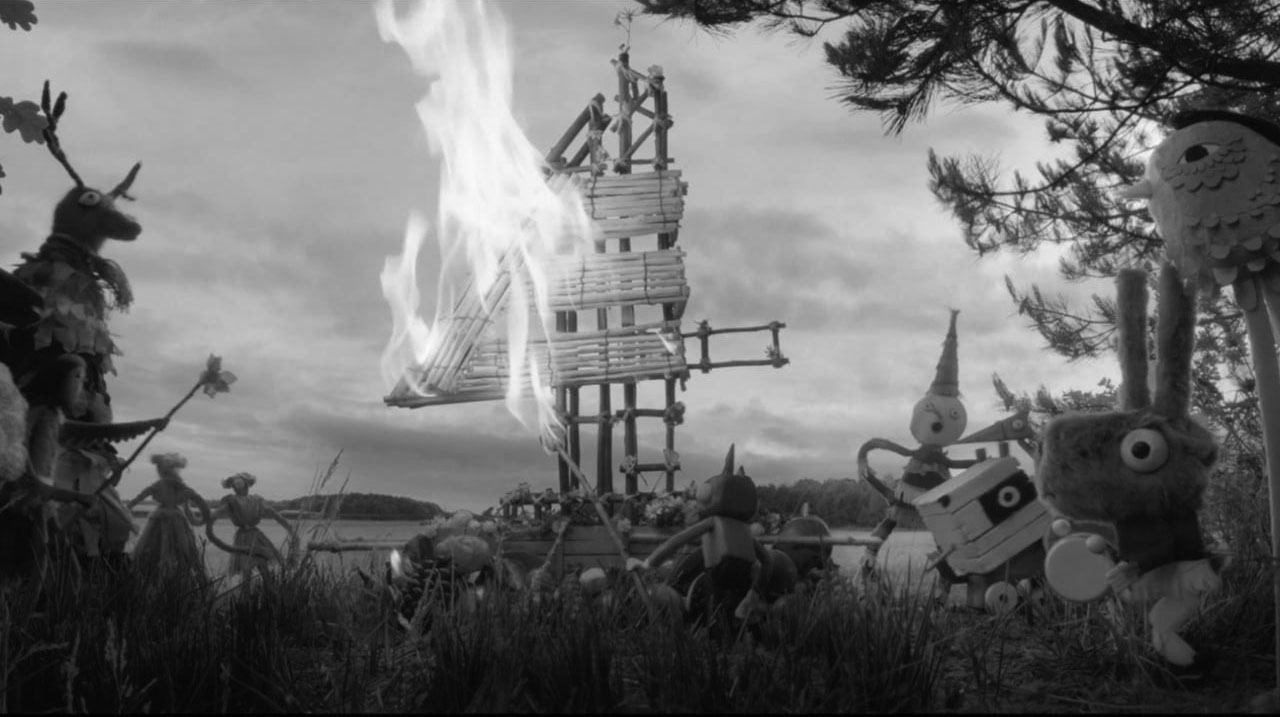
In terms of “Albion in the overgrowth”, the 2018 Wicker Man ident for British television’s Channel 4’s subsidiary channel E4 could well be grouped alongside the “Savage Party” trailer which I posted about in Wyrd Explorations 33.
It is an animated short film made by Parabella Animation Studio, which was founded by Mikey Please and Daniel Ojari, that was used as a link between programmes, and seems to variously be channelling 1960s or 1970s British children’s television animated series, lost Eastern European animation from an indefinable earlier decade, bucolic calm, folk rituals, folk art and folk horror – in particular, and not surprisingly considering the ident’s name, the previously mentioned iconic folk horror film The Wicker Man – all in a brief 30 seconds or so. It is the kind of thing that you could imagine being part of some semi-forgotten children’s television series originally broadcast back when that the esoteric archival record label Finders Keepers Records would release the soundtrack to.
The animation and figures that appear in the ident are at a notable remove from polished contemporary CGI based work, appearing (I assume) to have been done by hand and have a pleasingly handcrafted folk art-ish feel and seem to be made from materials such as fabric, wood etc. In terms of their handcrafted aesthetic and animation style, they recall the 1960s and 1970s Smallfilms animated children’s television work by Oliver Postgate and Peter Firmin, such as Bagpuss (1974) and Clangers (1969-1974), and like those series the ident seems to offer a glimpse or portal viewing of a magical self-contained world unto itself.
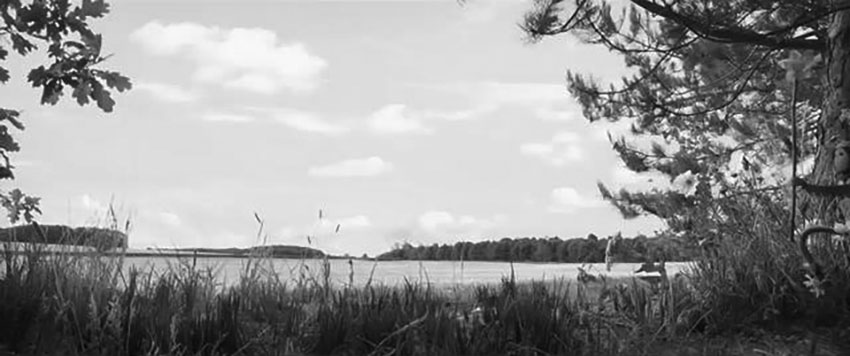
The ident opens on a view over a neatly recently harvested looking field, taking a viewpoint from the uncultivated edges of the field, which is where events take place as though to show that they are at a remove from the norms and orderliness of civilisation. Initially, a lone king-like figure walks onto the screen, wearing a cape and holding a flower by its stem as though it is a sceptre. He is vaguely human-like in shape but without facial features, has long thin bendy pipe cleaner-esque limbs and his body/fabric skin are green.
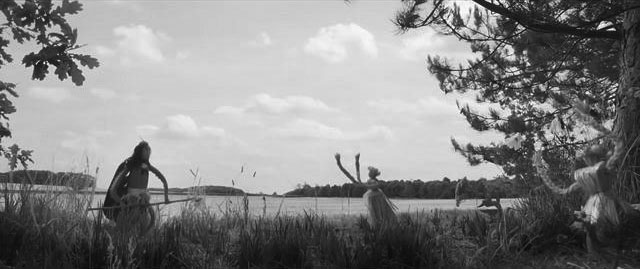
He is soon joined by other figures and creatures, who to varying degrees often have anthropomorphic human characteristics, and they begin folk ritual-esque revels and dancing. The other revellers include, amongst others, two frolicking corn dollies, a sheep that walks on its hind legs and is carrying a flag standard that bears the E4 logo, a strange tall folk ritual costume-esque pyramidical creature with a stag’s antlered head, a cockerel that only seems to consist of a blue head and unnaturally long stilt-like orange legs, a staring eyed blue-headed rabbit and a black and white creature, possibly a cow, made from layered wooden sections and that has a squared head. The soundtrack during this section mixes the stomp of the king walking, rural field recordings of birdsong etc and a free form seeming acoustic folk tune (loosely) played by the revellers.

A fox wearing human-style clothing, which also walks on its hind legs, and some kind of clown that is reminiscent of an unsettling, skewed memory of a Victorian child’s toy, wheel on a cart which contains a folk art-esque wicker structure that forms the E4 logo. Once this is in place at the centre of the revellers the day darkens and the fox sets fire to the wicker logo, and it is at this point that the ident begins to take a darker turn, and marking this the soundtrack quickly and briefly changes to a form of choral drone.

Night suddenly descends, the folk music resumes and the revels continue but now there is something, if not bacchanalian, then at least subtly frenzied about events as the participants dance around the burning wicker structure. The king sets light to one of the wicker dollies, which continues merrily dancing, and the clown also seems to be on fire but not making any attempt to halt this. The ident then ends but there is a sense that the revels and their transgressions will continue.

What it brings to mind is Mackenzie Crook’s reimagining of the rural magic realism children’s television series Worzel Gummidge (1979-1989), which in Crook’s version, that began to be broadcast in 2019, features a living scarecrow who befriends two visiting children and via preternatural means, and with the assistance of his fellow scarecrows, helps to mend the seasons which have gone out of joint, which has both light-hearted and humorous aspects but that also at points can seem like a friendly nightmare and contains an unsettling unpredictable atmosphere, which is emphasised by the scarecrows at points seeming unfettered by convention and even chaotic, especially when they meet and gather together.
E4’s Wicker Man ident has a not dissimilar sense of both playfulness and an unsettling air, and as at the end of the original The Wicker Man film, which as suggested above the ident seems to fairly directly draw from and interconnect with, there is a sense of a folkloric ritual orientated rural community having come adrift.

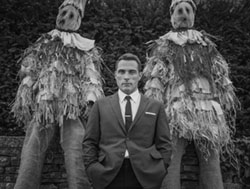
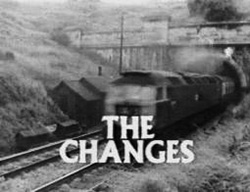
What both Mackenzie Crook’s Worzel Gummidge and E4’s Wicker Man ident both also bring to mind is the (possibly) accidental at times surprisingly dark or unsettling atmospheres of some sections of late 1960s and 1970s British children and young adult-orientated rurally set television drama series that have become hauntological and wyrd rural cultural mainstays – such as the drama series The Changes (1975), Children of the Stones (1976) and The Owl Service (1969-1970),and also possibly some public information films from that time – with the Wicker Manident sharing with them a sort of headshaking “What? What was that?” aspect.