For myself a particular touchstone for the “wyrd” sense of patterns beneath the plough and otherly landscapes is Alan Garner’s The Owl Service book from 1967 and its television adaptation that was broadcast in 1969-1970 and that has become one of the core touchstones of wyrd culture.

Very loosely and briefly, it is the tale of three teenagers who discover a mysterious set of owl and flower-patterned dinner plates in an attic and the magical ancient legend of the “Mabinogion” comes to life once again in their Welsh valley, with the story taking in supernatural fantasy, class struggle and adolescent permissiveness.

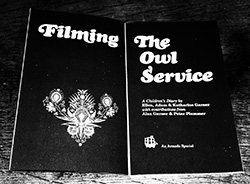
Accompanying the series was a book Filming the Owl Service (1970), which is long out of print and rare as hen’s teeth to find second hand, which is a shame as it is a fine companion piece to the series, full of rather lovely photographs, artifacts, anecdotes, background story, prop sheets and designs from the filming and the series itself.

The book is split into three parts; an “Introduction” by Alan Garner in which he discusses the making of the film, some of what inspired the original book, the coincidences around it and so on, “Our Diaries” by his children who took nine weeks off school while it was being made to be on and around its filming and “Making the Film” by its director Peter Plummer. Some of the points of interest from the book are discussed below.

1. The colours of the outfits of three of the main characters, Alison, Gwyn and Roger, were based on an older International Colour Code for electrical wiring (red, black and green); although it was initially broadcast in black and white, a decision was made that if it was going to be filmed in colour, they would use colour to hint at the power the three could unleash.

2. Alan Garner looks surprisingly youthful in the photographs, as opposed to the bearded, grizzled chap one might imagine to have written a “wyrd” landscape set story such as The Owl Service.
3. The spelling mistakes by the children have been appealingly left in the typed part of their diaries (so tomato soup becomes tomato soap).

4. It is easy to forget just how boring it can be to be a child; in the children’s diaries one of the most repeated phrases and descriptions are variations on “I was bored”/ “It was boring”.
5. When Peter Plummer introduced the actors to Alan Garner for the first time and asked if they looked right, Alan Garner’s recollection of it was that it was a “nasty experience”:
“I wanted to run. They looked too right. It was like a waking dream. Here were the people I’d thought about, who’d lived in my head for so long; but now they were real. I couldn’t accept that they were only actors.”

6. Alan Garner had based the part of Huw on Dafydd, an actual gardener from one of the locales of filming but a Dafydd as he had imagined him being at the age of forty. When he saw them together, he said that it “was like seeing father and son”. While apparently the two people in question when they saw one another said:
Dafydd: “I wish I was young and forty again.”
Raymond: “Now I know what I’ll look like at eighty.”
The book leaves a sense that Dafydd was a very particular kind of person, one of those people who seem to have been part of the land forever, an archetype almost; when the filming was carried out in the late 1960s, he was eighty-one, while he first went to work at the location house in Wales in 1898, which seems an impossible stretch of time.

7. Alan Garner talks of the curious coincidences that occurred during and around filming; at one point, unprompted, Dafydd Rees scratched the name “Blodeuwedd” on a piece of slate:
Alan Garner: “What’s that?” I said.
Dafydd Rees: “A name.”
Alan Garner: “Can you tell me about it?”
Dafydd Rees: “It’s just a name.”
However, Blodeuwedd is the name of a mythical character in an old Welsh legend which was a starting point for Alan Garner when writing the book; she was made from flowers and turned into an owl as a punishment after betraying and killing her husband with a lover. Connected to which, one of the iconic phrases from the book/series is the following:
“She wants to be flowers, but you make her owls. You must not complain, then, if she goes hunting.”
Alan Garner: “The Owl Service is a kind of ghost story, in real life as well as on the film or page. Right from the start things happened that haven’t happened with any other book I’ve written.”
Peter Plummer refers to such coincidences as “selective perception” i.e., you’re working on an owl-themed piece of work, so you begin to notice owls in one form or another more often.

8. Alan Garner on writing the book:
“It seemed at times that I was discovering, not writing, a story: it was all there, waiting and I was like an archaeologist picking away the sand to reveal the bones.”
9. On the last night of shooting the crew surreptitiously presented Peter Plummer with a brown paper package; it was a “jet-dark lambs wool hat” and the accompanying note said “From your black sheeps” the subtly wyrd nature of which seems rather apt and appropriate to the series and its stories.
10. The local fire brigade was hired to create the rain effects and Alan Garner’s children seemed to love that part (and even got to use the hose, snapping branches from a tree with it) and at one point comment on thinking that the actors do not know that pond water is being used.
There seemed to be a constant battle to not run out of water during the production, to create the correct seasonal conditions and struggling against the elements which is reminiscent of tales from The Wicker Man and how extras had to suck ice cubes on supposedly sunny days to stop their breath showing in the cold air:⁴
Alan Garner: “…we got there in the middle of May, it felt like the end of Winter…”

11. Alan Garner is one of the villagers in one scene in the series and apparently, he was a foot taller than all the actual local people who were in the series and they all found it hard to behave normally when the man-made storm rain hits them:
Alan Garner: “As soon as the solid water hit us we all gasped and yelled, and looked like anything but villagers out in a storm.”
Dafydd: “We must be dumb and waterproof.”
Alan Garner: “That scene is still odd, because I was about a foot taller than anybody else, and I look like the village freak – which may be what Peter was after all the time.”

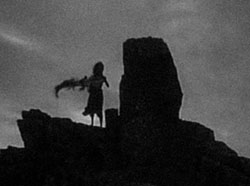
12. The end of Alan Garner’s section is a quote taken from a letter sent by Dafydd, referring to the time during the filming and The Stone Of Gronw, which the production had commissioned to be carved, prepared and set in place for the series:
“It was a good time… I have been to the stone. It is lonely now.”
Which seems like a nicely apposite and evocative comment on which to end this post’s wandering through The Owl Service’s corner of the otherly fields of television.