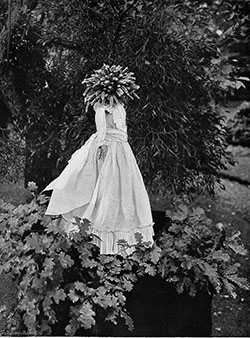
From time to time, I discover work that seems like an accidental forebear of wyrd culture, and which was created long before the contemporary upsurge of interest in the uncanny, eerie flipside of rural, folk etc orientated culture. An example of this are some of the paintings by Marion Adnams, who lived and worked in Derby from 1898 until her death in 1995. Her work found recognition during her lifetime but for an extended period she became semi-forgotten, and there was not an exhibition devoted to her work for fifty years, until one took place at Derby Museum and Art Gallery in 2017-2018.
Adnams never provided explanations for her work, believing that it should be interpreted as people wished. This non-explanation continues with her painting’s titles, which are often both evocative and intriguingly cryptic (and also at times somewhat presciently wyrd-like), and which include For Lo, Winter is Past and Monkey Harvest.

There is a notable 20th century “classic” surrealist style to some of her paintings, one of which features three wizened and largely leafless trees that seem to be almost dancing in a flat untextured landscape and to have flung their leaves up into the air, while another shows three enigmatic oddly shaped stones again in a flat largely textureless landscape and which are also somehow imbued with human-like qualities as though they are alive and twisting, perhaps talking to one another. Each has a similar sized round hole through its centre and it isn’t clear if these have happened naturally, if they have been created by humans and the stones are a form of ritualistic structures or if the holes have been created by the stones themselves in an unexplained preternatural manner.

When I first saw Marion Adnams’ work, it put me in mind of the work of British surrealist painter, war artist, writer, book illustrator, photographer and fabric, poster and stage scenery designer Paul Nash (1889-1946), who has tended to have a higher profile than Adnams.
Nash is said to have found inspiration in “landscapes with elements of ancient history, such as burial mounds, Iron Age hill forts such as Wittenham Clumps and the [henge and ancient stone circles] at Avebury in [the British county of] Wiltshire”, and this in turn seems to presage some of the inspirations and reference points for wyrd or otherly pastoral culture today.
The majority of Nash’s painting are devoid of people, but curiously at times their simplified geometric style, curves etc seem reminiscent of some of artist Tamara de Lempicka’s distinctive and seductive Art Deco portraits and nudes which connects with Nash’s comments in a letter he wrote to a friend in 1912, where he said “I have tried… to paint trees as tho’ they were human beings… because I sincerely love and worship trees and know that they are people and wonderfully beautiful people”.

Nash’s 1911 painting His Vision at Evening features a rolling rural landscape which has a portrait of a woman’s face floating above it whose hair flows outwards to the sides and seems to have become one with or be part of the clouds and sky.
Due to its mixture of mysticism and landscape elements it could be seen as a forebear of some of the more new age and mystical aspects of contemporary wyrd and otherly pastoral culture. It also seems to capture the “visionary” pastoral spirit of music, culture and the landscape that is explored in some of the earlier sections of Rob Young’s 2010 book Electric Eden, where he focuses on, amongst other things, creative work from the 19th and earlier twentieth century. This includes William Morris’ bucolic utopian novel News from Nowhere (1890), and early twentieth-century composers including Vaughan Williams and Holst, of whom Young says, in a manner that connects their work with Nash’s war related artwork which is discussed below, that their work was inspired by “thunderbolts of inspiration from oriental mysticism, angular Modernism and the body blow of the Great War”.

In contrast to the more oblique titles of Marion Adnams’ work, the title of Nash’s war painting We are Making a New World which he created in 1918, appears to be a comment on the destruction wrought by the First World War due to the contrast between its optimistic title and the war-scarred landscape depicted in the painting.
While Nash’s war paintings often have a hellish quality, as in part mentioned above, some of his other landscapes contain a bucolic, gentle, warm atmosphere, while both often feature a sometimes subtle, and at times overt, surreal, Modernist and/or softly geometric aesthetic.

The notable geometric style in some of his work could also be considered a forebear of what I have called the “otherly geometry” of some hauntological and wyrd orientated graphic design and art, including some of Julian House’s artwork for Ghost Box Records, David Chatton Barker’s for Folklore Tapes and some of Nick Taylor’s Spectral Studio work which I have previously described as being “work which often seems to make use of geometric shapes and patterns to invoke a particular kind of otherliness [and allows] a momentary stepping elsewhere”.
Accompanying which, Nash has come to be seen as playing a key role in the development of Modernism in English art, which has been described as:
“…both a philosophical movement and an art movement that, along with cultural trends and changes, arose from wide-scale and far-reaching transformations in Western society during the late 19th and early 20th centuries. Among the factors that shaped Modernism were the development of modern industrial societies and the rapid growth of cities, followed then by reactions to the horrors of World War I.” (Quoted from the Wikipedia.com page on Modernism.)
The manner in which Modernism was both a “reaction to the horrors” of conflict and also the modernisation of society, cities, industries etc could be considered part of a cultural and philosophical lineage which in recent years has included hauntological related work’s utilising of Modernist related iconography and culture, such as Brutalist architecture, often coupling this with a sense of Cold War Dread and/or a sense of melancholia or mourning for lost progressive post-Second World War futures.

Interconnected with which Paul Nash’s work and its intersections with wyrd cultural themes etc are included and discussed in the 2021 book Unsettling Landscapes: The Art of the Eerie, written by curator Steve Marshall, writer and former academic Gill Clarke and author and academic Robert Macfarlane. This accompanied an exhibition of paintings, photographs, sculpture etc at St Barbe Museum and Art Gallery in 2022 curated by the book’s authors:
“[The exhibition looks at] the unsettling, strange, gothic and eerie in British landscape art and examines how these ideas have influenced generations of British artists, Surrealism, Neo-Romanticism and on to current pre-occupations with conservation, belonging and hauntology.” (Quoted from text which accompanied the release of Unsettling Landscapes.)

The book includes the below quote from Paul Nash on his 1935 painting Equivalent for Megaliths which has an intriguing “otherly geometry” landscape meets 1980s cyberspace quality and was inspired by the previously mentioned henge and ancient stone circles at Avebury:
“In the fields a few miles north of Marlborough, standing or prone, are the huge stones, remains of the avenue, or the circles of the Temple of Avebury. The appearance of one or more of these megaliths, blotched with ocreish lichens, or livid with the bruises of weathering is sufficiently dramatic in a field of stubble, or in the grass meadows … These groups are impressive as forms opposed to their surroundings… and in the irrational sense, their suggestion of a super- reality. They are dramatic, also, however, as symbols of their antiquity, as hallowed remnants of an almost unknown civilization.”
This in turn provides further lines through the eerie and “unsettling landscapes” of wyrd and hauntological culture as it forebears and interconnects with one of hauntology’s most prominent theorists Mark Fisher’s comments in his 2016 book The Weird and the Eerie on how:
“[Because] the symbolic structures which made sense of [ancient monuments and stone circles] have rotted away… the deep past of humanity is revealed to be in effect an illegible alien civilisation, its rituals and modes of subjectivity unknown to us.”