Requiem (2018) is a television series created by Kris Mrska and co-produced by the BBC and Netflix. It is a largely rurally set supernatural thriller in which, after the unexplained suicide of her mother, an urbane London sophisticate who is a famous classical cellist finds herself unravelling as she attempts to discover the truth behind her death and in the process, her own origins. During her search, she discovers a cache of newspaper clippings that were collected and hidden by her mother, which in turn leads her to a rural community in which a young girl had gone missing some years before and was never found, and the mystery surrounding this disappearance begins to take on a multi-layered, supernatural conspiracy aspect.
Requiem could be placed in a loose category of television drama that I would describe as offering “glimpses of Albion in the overgrowth”, that is to say, mainstream dramas which to various degrees explore, utilise and express a flipside, or otherly pastoralism, and at times variously contain elements of, or are fully intertwined with folk horror.1
In relatively recent times, the historical fantasy series Britannia (2017-2021), The Living and The Dead (2016) and elements of the BBC comedy drama series Detectorists (2014-2022), could also be included in that loose grouping. And if you cast the net back further, it could also take in the “Savage Party” trailer released in 2012 for the Channel 4 soap opera, Hollyoaks, which has a playful The Wicker Man-esque (1973) aesthetic and the turn of the millennium remake of Randall & Hopkirk (Deceased) (2000- 2001) which, in some episodes, depicts a country idyll gone bad element and pays homage to previous decade’s folk horror film.
Requiem presents rural communities – in contrast to urban ones – as insular or “other”, and as having their own ways and beliefs that connect back to previous eras, in a manner not dissimilar to say Hot Fuzz (2007) and The Wicker Man. And as per The Wicker Man, in Requiem the “outsider” victim is essentially led on a misleading merry dance by the rural folk in pursuance of their beliefs and practices, because ultimately for the effective completion of a key ritual, the chosen sacrifice must come to the community willingly.
Also in the series, those “good”, respectable people of the rural community who turn out to be actually involved in a ritualistic supernatural conspiracy, appear to be largely made up of the relatively affluent middle class and above. For instance, the local “coven” is made up in part by a doctor/psychiatrist, a solicitor, a mildly bohemian antiques dealer and an owner of a large rural estate. They have more working class or lower in class foot soldiers, but these are more the led than the leading.

As is often the case with modern drama, Requiem sidesteps or ignores some of the realities of modern life, including communications networks, and the often-easy dissemination of news, images etc. Instead, a famous musician whose mother has died in bizarre circumstances is able to raise merry heck in a community and rake up all kinds of semi-buried truths in a very public manner, with only one apparent instance of a reporter and a traditional newspaper headline, and little or no recordings of her actions digitally by the public through, say, social media postings. The truth is likely that in such an instance today, her actions would be recorded and/or posted about and spread widely online within minutes of them happening.
This overlooking or sidestepping of such issues may well be a reflection of the difficulties contemporary scriptwriters face with the “well, the characters are trapped and threatened by forces X, Y and Z but with just one mobile phone call they could summon help” aspect of modern peril. Possibly hence, there being a fair few instances in modern film and television dramas where, for example, characters hold up mobile phones and say the likes of “No, no signal”, or drop, break them or comment on having left them at home etc.
Largely in Requiem supernatural elements are only very fleeting glimpsed or represented via audio, in a style reminiscent of John Carpenter’s Prince of Darkness (1987) and in both mirrors are depicted as portals through which the super- or preternatural can attempt to enter the day-to-day world. However, at one point in Requiem a form of spirit or demonic possession is shown as having not dissimilar characteristics to conventional electrical charges and discharges, which caused me to wonder how the supernatural can be convincingly and realistically represented on film and in television. What is the possible literal physical manifestation of such things? Are they or should they be otherworldly spectral or ectoplasmic apparitions? Do they have a connection to and/or have the characteristics of other real world, natural and scientific phenomenon?

Aside from the above electric-like possession, there is only one other overt special effects-orientated visual expression of the supernatural, which is comparatively unusual for contemporary, often CGI special effects-laden genre drama, and this choice to not over-represent via effects leaves space for the viewer’s imagination. This other overt expression is when one of the characters has been possessed, and in order to show this, her eyes flip to opaque black for just a moment. Prior to this, there is an ambiguity to this character and their possession, meaning that this more unequivocal depiction is potentially problematic as once the viewer has been overtly shown the supernatural it can normalise it, or it can seem to them a little obvious or too signposted that “this person is now bad”.
In spite of not actually having a large amount of screen time, a pivotal character in the plot is the aforementioned, mildly bohemian antiques dealer, Sylvia Walsh, played by Tara Fitzgerald, who seems to have an almost smugly evil aspect to her character. Walsh brings to mind, in part, a sort of occult middle manager with a sense of self-satisfying expectation, in a not dissimilar way to a character in Sean Hogan’s film The Devil’s Business (2011), which explores some similar themes to Ben Wheatley’s film Kill List (2011); in both of which two assassins or mercenaries find themselves embroiled in occult activities which are carried out within a curiously banal bureaucratic infrastructure.
The main character in the series, Matilda Gray, played by Lydia Wilson, has a very striking and almost otherworldly “Woman Who Fell to Earth” aspect to her appearance, which looking back over the series could be seen as a reflection of the hidden preternatural forces which are present around her and also even contained within her. Although in a more overtly fashionable, almost hipster way in Requiem, that otherworldly aspect of the appearance of a disturbed individual can also be found in Angela Pleasance’s physical appearance and screen presence in José Ramón Larraz’s 1974 film Symptoms which, as with Requiem, also depicts rural areas as being far removed from bucolic idylls.

Requiem’s introduction sequence is particularly striking and it combines various layered elements and atmospheres – a sense of beauty, subtle eeriness and darkness, a cello semi-hidden in the images, nature and wildlife, ancient folklore and superstition. It also contains kaleidoscopic and mirrored imagery, with subtle tinges of older cathode ray-style ghosted and offset television images, and brings to mind here and there, biological illustrator Angela Mele’s work for the 2014 documentary on slime moulds The Creeping Garden.
The sequence is by the Peters Anderson Studio, the lineage of whose work, in terms of its textural quality, could be traced back to the likes of Vaughan Oliver and Nigel Grierson’s work for the 4AD record label in the 1980s.
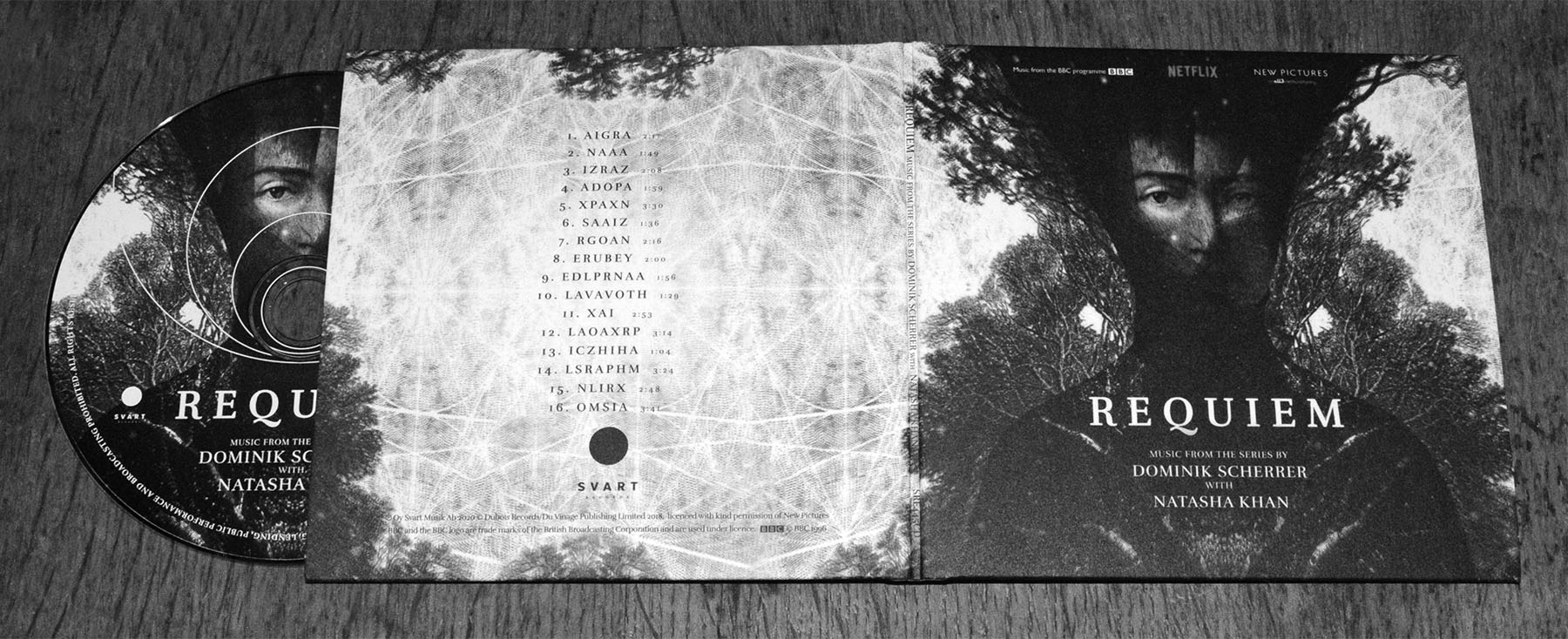
The soundtrack for Requiem was created by Dominik Scherrer and Natasha Khan (the latter of which is also known for her work as Bat for Lashes), and could be filed alongside that for The Living and the Dead in that it explores and accompanies a sense of otherly pastoralism (and in The Living and the Dead’s case folk music and culture) within a mainstream television setting.
On the Requiem soundtrack, Natasha Khan’s wordless vocals accompany the instrumentation and the resulting work is somewhat entrancing and has a sense of warmth or even intimacy to it, while at times also containing a subtly unsettling, darker tinged and sometimes dread-filled or ominous atmosphere.
In terms of reference points, it explores not dissimilar territory to Cat’s Eyes’ pastoral fantasia soundtrack for The Duke of Burgundy (2014), Lubos Fiser’s also fantasia-like soundtrack to Valerie and Her Week of Wonders (1970), the melodic conjurings of Jane Weaver’s “Parade of Blood Red Sorrows” which was featured in the neo giallo-esque vampire film Kiss of the Damned (2012),7 and possibly also the soundtrack for an imagined semi-forgotten supernatural tinged Italian giallo along similar lines to Kelli Ali’s “The Kiss” from her 2008 album Rocking Horse, a track which has a semi-forgotten-soundtrack quality to it, and also Sharron Kraus’ 2013 album Pilgrim Chants & Pastoral Trails and its pastoral wanderings and wordless vocalisations (and which coincidentally the Peters Anderson Studio also created the artwork for).
As a collection of work it could also well be a pleasingly leftfield release that might have been found on, for example, the aforementioned 4AD or Mute record labels in the 1980s, along the lines of the accessible melodic experimentalism of Holger Hiller on the album Obem im Eck (1986), in particular the track “Waltz”, or the more experimentally arthouse and atmospheric side of gothic-tinged, but not specifically “goth”, work as found on some of the otherworldly neo classical darkwave band Dead Can Dance’s releases from that period, in particular “The Host of Seraphim” from their 1988 album The Serpent’s Egg.
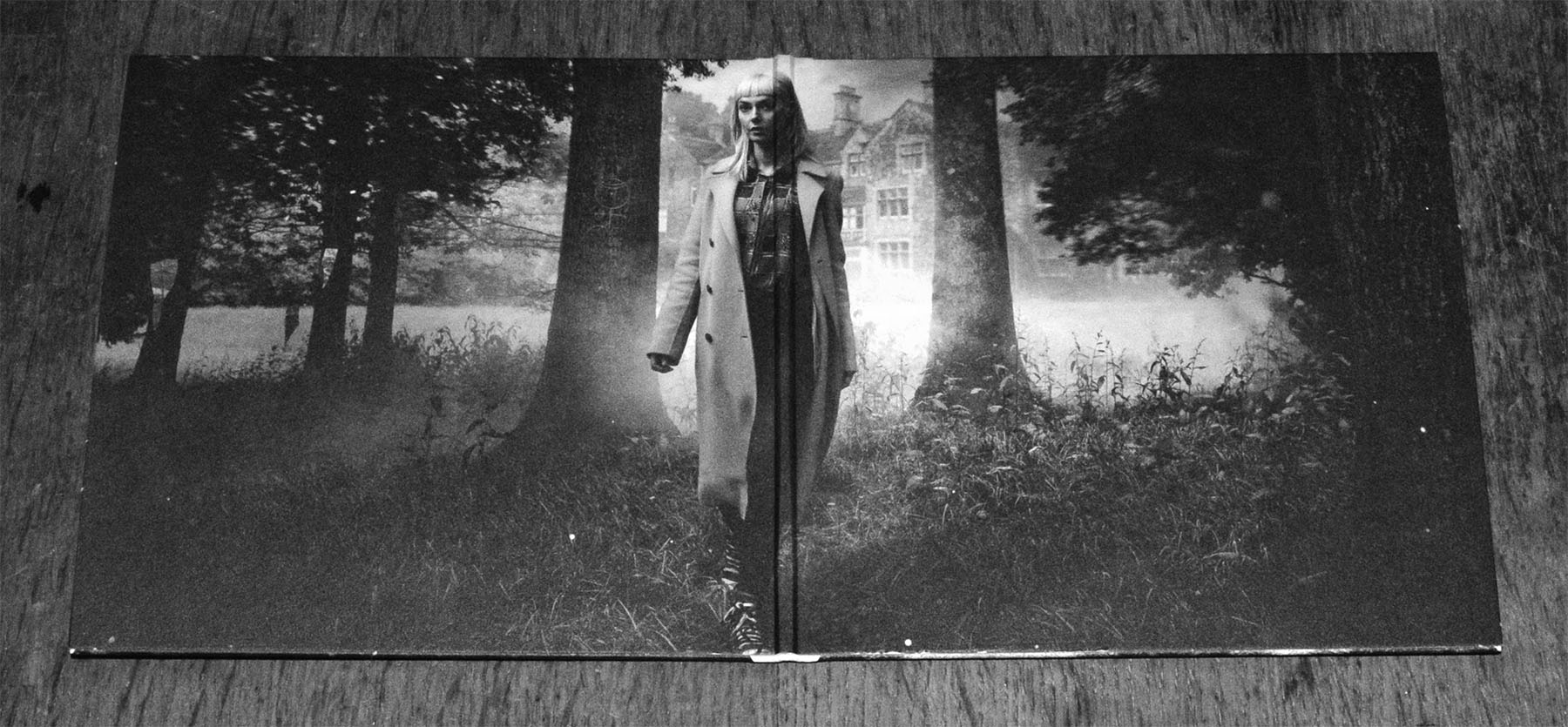
As with some of Dead Can Dance’s work, the soundtrack for Requiem sometimes creates a sense of reimagined medieval aesthetics – although less overtly and with a more contemporary edge than in Dead Can Dance’s case, whose work also often had a more epic, almost glacial quality or distance to it in contrast to the warmer, more intimate feel of the soundtrack.
Or moving slightly further along the timeline of 4AD releases, His Name is Alive’s Livonia album from 1990 could also be a reference point for the Requiem soundtrack, particularly the opening track “As We Could Ever”, which shares with it a quality of ethereal, otherworldly, wordless female vocalising.
Connected to which, although all possessing their own character, a number of the other tracks/albums mentioned above – “Parade of Blood Red Sorrows”, “The Kiss”, Pilgrim Chants & Pastoral Trails and “Host of Seraphim” – also share a distinct similarity in their sharing of wordless female vocals and otherworldly atmospheres. Also, as with the Peter Andersen Studio work for Requiem, the album cover art for Livonia and the insert for The Serpent’s Egg contain almost spectral aesthetics and a certain textured character in their pastoral-inflected work – all of which reflects the rural setting and super or preternatural themes of the episodes of Requiem.

When I first watched Requiem I felt that there was something about it that seemed to hint at some form of hidden unsettling layers and underpinning being present in the story, and which somehow placed it at a subtle, eerie remove from much of mainstream television drama but I couldn’t quite put my finger on why that was. However, in part the record label Svart’s CD and vinyl release in 2020 of the soundtrack revealed some of what those “unsettling layers” may be.
The album’s booklet includes writing by Erik Stein which reveals that the series does indeed include (semi-hidden) layers. Stein discusses how the series and album refer to and draw from the work of real life 16-17th century Anglo-Welsh mathematician, astronomer, teacher, occultist and alchemist John Dee, with the series featuring one of his books and the (imagined) work of his son. Stein discusses how Dee and his collaborator John Kelley:
“Formed the foundations of so-called ‘Enochian’ magic, a system of ceremonial sorcery based on the evocation and commanding of various spirits. Dee and Kelley claimed that they could communicate with these spirits through their own ‘Enochian’ language, [which they said] had been revealed to them directly via a series of angels.”
Stein describes how Scherrer and Khan used the names of those ‘Enochian’ angels for the album’s track names (“Aigra”, Naa”, “Izraz” etc) and also that Khan “uses ‘Enochian’ words and phrases as her lyrics” during the album.

Dee also claimed to speak to angels and spirits via a black mirror and created an esoteric figure called the “Monas Hieroglyphica” (which is said to embody his vision of the unity of the cosmos and has a horned devil-like meets Einstürzende Neubauten logo appearance),8 both of which interconnect with elements that appear in the series and in turn make any appearance of mirrors in it even more troubling.
Music is an inherent part of the plot of Requiem: as mentioned earlier the main character is a famous cellist, who works alongside her onstage musical partner and accompanying pianist to uncover the truth behind the machinations she unearths.
As part of their investigations they find, in a hidden basement, recordings of haunting music which appear to have been created and used for ritualistic purposes. Partly because of the time in