Edgelands is a word that refers to the edges of towns and cities that are neither urban nor rural; transitional, undeveloped or developing areas such as the land surrounding power stations, scrublands, wastelands, semi-derelict areas, semiindustrial areas and so forth. These are often the places where society creates, stores, repairs, discards, forgets about and disposes of the things it physically needs and they can also be starkly aesthetically neglected, though in contrast and in part because of that neglect or overlooking can also become something of a haven for nature and wildlife.
Edgelands contain many of society’s overlooked and often unsupervised nooks and crannies and so can seem to represent an ideal playground for a child (although they may not seem quite so ideal to parents due to them often containing various hazards and dangers).
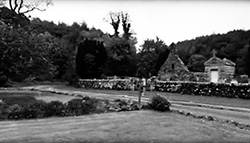
 (Photograph from Bernard Lowry’s Pillboxes and Tank Traps book.)
Edgelands are random places and fascinating for a child: for myself they included building a dam across the river next to an old crystal deposit encrusted railway tunnel, a concrete military pillbox sitting incongruously at the edge of a field, an overgrown and more or less abandoned local graveyard where you could scare yourself by moving and peering inside the walls of old monuments.
Or a road that had broken up and collapsed down a hillside where if feeling intrepid you were able to pry the cats-eyes1 the remains of the middle of the road, the craters on hillsides where you could excitedly scavenge rusted machine remains, thinking they were sites where planes had crashed (they may have been discarded agricultural equipment, but these remains could have been aeronautical in origin as historically planes had crashed nearby).

Alongside these more rural edgelands lie actual edgelands: places that could have been real life 1970s British public information film settings. Related to which I also found myself playing among humming electricity pylons and tumbling amongst the abandoned fridges and washing machines on a hillside which led down to a river that would change colour depending on what was being pumped into it upstream.
For myself, such youthful edgeland playgrounds also took in an edge of town decommissioned airforce base, which had become a semi-developed camping park complete with can, bottle and possibly spectre-filled air raid shelters.
In later years they would include wandering on grey Sundays through the local industrial estate, where a coffin factory shared space sandwiched between fields and the main road with a poultry-processing establishment, which I would walk around to the soundtrack of suitably upliftingly depressing music on a borrowed portable cassette player (!)
Marion Shoard is thought to be the first person to use the term “edgelands” to describe these areas in her Edgelands essay from 2002, where she eloquently describes and defines them and considers how they are often overlooked by society:
“Britain’s towns and cities do not usually sit cheek by jowl with its countryside, as we often casually assume. Between urban and rural stands a kind of landscape quite different from either. Often vast in area, though hardly noticed, it is characterised by rubbish tips and warehouses, superstores and derelict industrial plant, office parks and gypsy encampments, golf courses, allotments and fragmented, frequently scruffy, farmland. All these heterogeneous elements are arranged in an unruly and often apparently chaotic fashion against a background of unkempt wasteland frequently swathed in riotous growths of colourful plants, both native and exotic… Huge numbers of people now spend much of their time living, working or moving within or through it. Yet for most of us, most of the time, this mysterious no man’s land passes unnoticed: in our imaginations, as opposed to our actual lives, it barely exists… As we flash past its seemingly meaningless contours in train, car or bus we somehow fail to register it on our retinas.”
In a continuum from Marion Shoard’s observations, an extensive body of literature and creative work exists which has focused on these hinterlands.

One of the early and most renowned documents or celebrations of such overlooked, often unloved parts of our world was Richard Mabey’s The Unofficial Countryside book, originally published in 1973 (and reissued in 2010 by Little Toller Books, who specialise in work which takes in a gentle flipside of rural, pastoral and landscape concerns).
The Unofficial Countryside records Richard Mabey’s explorations and wanderings through edgeland areas and the natural world, which has made a home in places that had previously often been considered inauspicious for plants and wildlife such as inner-city car parks, gravel pits and rubbish tips.
Rather than being purely a natural history document, within the book he also proposes another way of seeing and experiencing nature during our daily lives, whether wildflowers glimpsed from a commuter train, fox cubs playing on a motorway fringe or a kestrel hawking above a public park.
The social, political and economic strife of the UK at the time of its original publication makes its subject matter of plants and nature creeping and surviving through broken concrete, covering bombsites, thriving in cities and the associated sense of neglect and collapse somehow rather appropriate.

In more recent times Paul Farley and Michael Symmons Roberts’ 2012 book Edgelands – Journeys into England’s True Wilderness undertakes a literary, poetic exploration of such areas and in it the authors document their travels, personal memories and connections to these transitional landscapes, taking in along the way childhood dens, container ports, wastelands, ruins, mines and the endpoints for society’s automobiles.

In a more audiovisual manner the 2013 film, music and photography project by Karl Hyde and Kieran Evans’ Edgeland/The Outer Edges presents a psychogeographic expressive, creative and documentary wandering through what feel like semi-uncharted lands and lives, ones which are overlooked, strewn with debris and contain a faded battered beauty amongst the mixture of nature and pylons.

Edward Chell’s 2013 Soft Estate also makes use of multiple forms, including a book, traditional gallery exhibiting and what are effectively returning to their source installations and takes as its subject matter such edgeland places when they are found at the side of motorways.
Its title is taken from and refers to the description given by the UK Highways Agency to the natural habitat that the motorways and trunk roads it manages occupy; an often unstopped-on hinterland that most of us only view as a high-speed blur from the corner of our eyes as we travel past these autobahn edgelands.
Soft Estate interacts with and documents these verges and landscapes, sometimes in a quite literal sense as some of the work is printed using road dust from such places, other work uses (presumably) engine oil, features plant life illustrations from these verges laser etched onto brightly chromed exhaust pipes or uses the same materials and colours as road signs.

In his paintings of the tubing which protects sapling trees in “soft estate” locations (many millions of which have been planted on such lands), the mind’s eye sees them not so much as trees but rather as gravestones. Indeed, there is a ghostly, spectral quality to these paintings; they have a hauntological aspect in that although they are created in contemporary times, they also seem like documents of modernity’s future and past.
Alongside which they also capture the spirit and point at which nature tumbles alongside and into mankind’s march of progress and there is a meditative, calming sense to them; they ease the soul and provide a moment’s respite.
The Soft Estate book is also a collection of essays and effectively an exhibition catalogue, albeit one which exists as a handsomely produced artifact in its own right. It includes a piece of writing by Richard Mabey and the inclusion of his writing here can be seen as providing a continuing line from and through considerations of edgelands in their various forms.

Intriguingly, some of Edward Chell’s Soft Estate work was installed in a number of the restaurants which formed part of the popular Little Chef chain of British roadside family restaurants that was founded in 1958 and which was inspired by American diners.
For many British children, these provided a first taste of what are now regarded as American-style burgers and fries. Although in the 1970s and 1980s (and possibly later) in Little Chefs they were served on a plate with knives and forks in what was nearer to a traditional restaurant setting rather than eaten by hand in a burger bar or cafe as would become standard with burgers in later years; along with the nature of edgelands themselves, such places, presentation and foodstuffs can be seen as another transitional/ liminal point.

When I wrote the original version of this chapter, which was included in A Year In The Country: Wandering Through Spectral Fields (2018), the number of Little Chefs had been dwindling for a number of years since their peak of 439 in the 1990s but I would still have rare sightings of them.
However, they felt like endangered species; a quaint remnant of times gone by before the ubiquity of transnational chains and the more utilitarian seeming widespread installation of motorway service stations
They proved to be an actual endangered species, of sorts, as they had all closed down by around 2018 but it still brings a smile to think of Edward Chell’s artwork in them, which seems like an apposite, humorous coming together of cultures.