Jonny Trunk has for a number of years been championing, compiling and reissuing library music via his Trunk Records label, journalism and broadcasting. He seems drawn to, and expresses an appreciation for, such music for a number of reasons including its at times musically innovative and intriguing qualities, alongside the significance that its scarcity lends it and the investigative work required to find such music, while also wishing to extend its reach into the world by reissuing it.
The Trunk Records library music-related releases have included compilations of the work by different performers originally released by a particular company such as The Super Sounds of Bosworth (1996) which brings together work from The Bosworth Music Archive and G-Spots (2009) which is subtitled “The spacey folk electro-horror sounds of the Studio G Library”.
They also take in related releases in an album such as Dawn of the Dead (2004), the soundtrack of which used library music in part from the Music De Wolfe label, alongside albums that focus on the work of one particular musician in this field such as Stand by for Adverts (2011), subtitled “Rare Jingles, Jazz and Advertising Electronics” and which features work by Barry Gray.

In a further appreciation, exploring and archiving of such work Jonny Trunk has also authored two editions of The Music Library, published by FUEL in 2005 and revised in 2016, a book which collects the cover art of library music.
Curiously in a rounding of the circle manner, as the Trunk Records reissues are often available in limited quantities on vinyl, although not to the same degree as the original library music albums, some of the reissues can become collectible and exchange hands for relatively high prices.
This is pure speculation, but it is possible that the limited nature of these releases may be partly due to the practicalities and costs associated with producing extended runs of vinyl records or associated limited licensing agreements. It may also be due in part to an understanding and appreciation of how scarcity can be one of the factors that makes such music and releases appealing to certain collectors.

Another strand of the Trunk Records reissues focuses on educational music. One such record is The Seasons, which features music by David Cain of the BBC Radiophonic Workshop and poetry by Ronald Duncan. Originally released in 1969 by BBC Radio Enterprises, it was reissued by Trunk Records in 2012.
As with much of library music, the original version of the album, if you should be able to find one, is likely to cost you a fair few pounds and pence while listening to it is one of those “shake your head and be pleasantly slightly stunned” moments in culture. The album was “designed to stimulate dramatic dance, movement, mime and speech” and was part of a series of radio broadcasts by BBC Radio For Schools called Drama Workshop, a creative drama programme for children in their first and second years of secondary school.
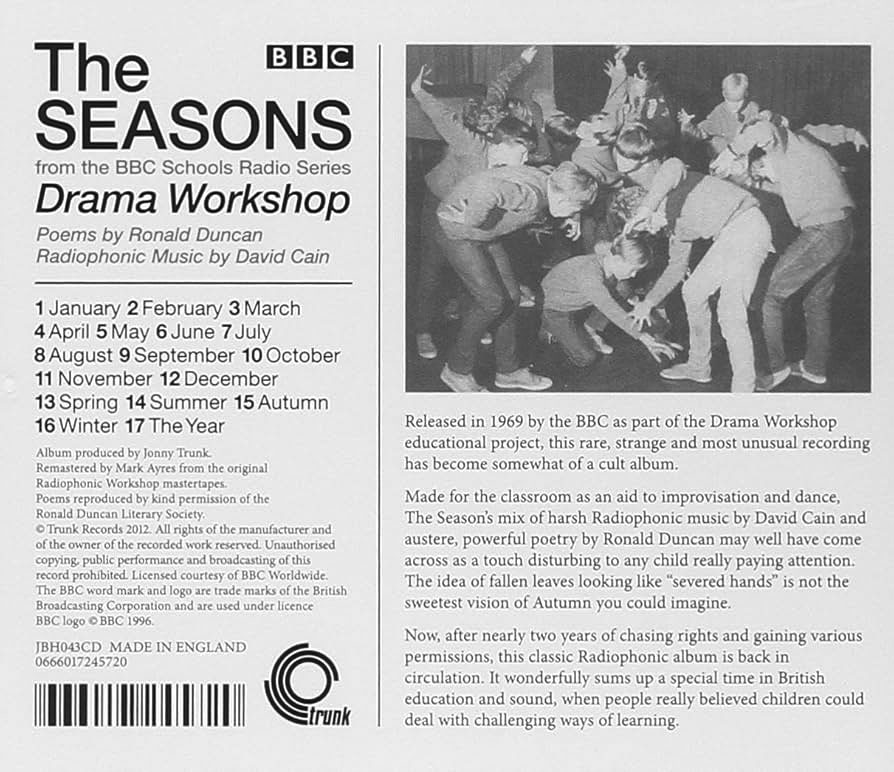
The album’s songs (that word is used fairly loosely in this instance) are divided into twelve months and four seasons and to a minimal Radiophonic-esque musical backing it features poetry along these lines:
“Like severed hands, the wet leaves lie flat on the deserted avenue. Houses like skulls stare through uncurtained windows. A woman dressed like a furled umbrella, with a zip fastener on her mouth steps out of number 53 to post a letter. Her gloved hand hesitates at the box. Then, knowing there will be no reply, she tears it up and throws it in the gutter. And autumn with its pheasants tail consoles her with chrysanthemums.”
Which could be regarded as being a touch odd for a later 1960s psychedelic album or performance piece, let alone something aimed at schools. The poetry goes on to say:
“An empress with an endless train walks the broad valley, she holds no sceptre, wears no crown, moving so proudly. White swans and modest little boats follow her slowly, thus the royal cortège goes down to the indifferent sea. Her way is lonely.”
Her way is lonely? Why is her way lonely? Who only knows… On his website Jonny Trunk says of it:
“By the mid noughties it was coming across as a major influence on retro futurism and the new-fangled scene they named hauntology. This comes as no surprise as the album has several layers and levels to it; it is weird, spooky, unsettling, very British, has an unusual whiff of childhood to some, it comes scattered with pregnant language and is full of unexpected metaphors, pagan oddness, folk cadences and insane noises.”

The hauntology reference is particularly apt as listening to it the music on the album sounds as if it could well be a Ghost Box Records release which had fallen backwards and forwards in time and when the album was reissued by Trunk Records, Ghost Box co-founder Jim Jupp said at his Belbury Parish magazine website:
“It’s an album that’s very much part of the DNA of Ghost Box: the perfect example of the spooked educational media we reverence and reference so often.”
This connection is made more implicit by the reissue which features a Q & A by Julian House (the other co-founder of Ghost Box Records) with David Cain, while the sleeve notes were written by sometimes Ghost Box artist Jon Brooks of The Advisory Circle.

The Seasons is part of a mini-genre of educational musicrelated oddness which as mentioned earlier also includes work performed by children themselves under adult guidance, examples of which have been issued on two other Trunk Records releases: Carl Orff & Gunild Keetman’s Music for Children/Schulwerk and the compilation of work by different groups of schoolchildren Classroom Projects, both released in 2013.
Music for Children/Schulwerk, which compiles work that originated in the 1950s as part of a programme intended to help the co-ordination and development of children and contains the results of simple, melodic musical exercises that variously reflect playground rhymes and/or contain elements of improvisation and choral qualities.

Classroom Projects is subtitled “Incredible Music Made by Children in Schools” and includes a wide range of styles of musical work which Jonny Trunk describes as being:
“…small primary school choirs or groups singing obscure folk songs to full-blown avant-garde experiments written and performed by children still at secondary or grammar school.”
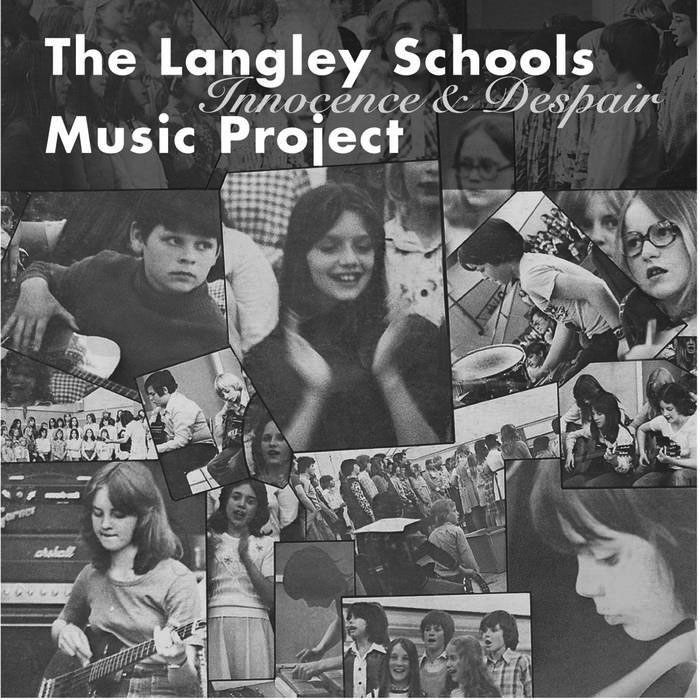
One of the best-known of all such recordings and albums is The Langley Schools Music Project Innocence & Despair, which includes recordings from 1976-1977 by Canadian schoolchildren where the reinterpret the likes of David Bowie, The Carpenters and The Beach Boys in a somewhat unique and inimitable style and that was first released commercially in 2001.
As with The Seasons and some of the work on Classroom Projects, presented in another context Innocence & Despair would quite possibly have been considered experimental or avant-garde music. It was a project undertaken by Canadian music teacher Hans Ferger, who said about it:
“I knew virtually nothing about conventional music education and didn’t know how to teach singing. Above all, I knew nothing of what children’s music was supposed to be. But the kids had a grasp of what they liked: emotion, drama, and making music as a group. Whether the results were good, bad, in tune or out was no big deal – they had élan. This was not the way music was traditionally taught. But then I never liked conventional ‘children’s music’, which is condescending and ignores the reality of children’s lives, which can be dark and scary. These children hated ‘cute.’ They cherished songs that evoked loneliness and sadness.”
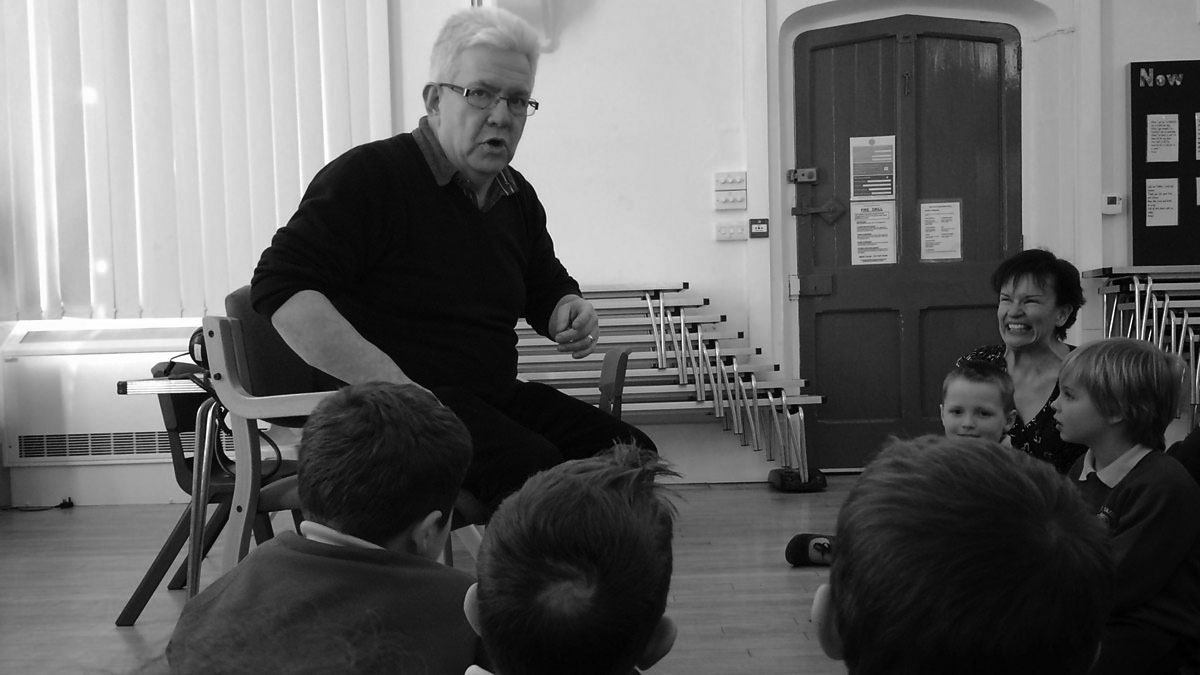
Which brings me to The School is Full of Noises, a documentary on the BBC’s Radio 4 first broadcast in 2015. In it, poet, journalist, playwright, and broadcaster Ian McMillan considered:
“How did tape loops, recycled everyday sounds and countless other weapons of the avant-garde find their way into school music lessons during the 1960s?”

As with Hans Ferger’s comments above, the programme imparts a sense that the educators who used, employed and experimented with such techniques did so in part to get away from a particular view of making music that focuses largely on learning “proper” instruments and making music “properly” and the associated exclusion that can at times be associated with that.
To quote one of the documentary’s participants, this was music education which:
“…wasn’t about privilege, it wasn’t about instrumental lessons outside school, it was about something that everybody could engage with, understanding music from the inside… knowing what it takes to make a piece of music, that it’s not something fully formed that exists in the world, it’s something that you make.”
Connected to the above comments, the programme also highlights how such work should possibly not be labelled as avant-garde or experimental music as that just seems to put it into a particular potentially excluding bracket – at its heart it is just music. Such labels can be convenient as markers and may help give audiences reference points, which is good and fine as long as they do not prove to be part of elitist barriers or marginalising.