Possibly the most well-known wolf-orientated dark fantasy tale is Little Red Riding Hood; the origins of which can betraced back to 10th century European folk tales, with the bestknown versions being based on stories written by Charles Perrault and The Brothers Grimm in the 17th and 19th centuries.
Although there are numerous versions of Little Red Riding Hood, a general summary of its plot tells of a girl who wears a red hooded cape or cloak, taking a walk from her village home, through the woods to deliver food to her grandmother, having been ordered by her mother to stay strictly on the path. She is approached by a Big Bad Wolf who wants to eat her and the food in her basket. She naively tells him where she is going and as a delaying tactic, he suggests she picks some flowers, which she does. The wolf then races ahead to the grandmother’s house, gains entry by pretending to be the girl, eats the grandmother and disguises himself as her.
When the girl arrives at her grandmother’s she does not initially realise that the disguised wolf is not her grandmother but rather, only notices that she looks very strange. They have an exchange where she comments on this:
“What a deep voice you have.”
“The better to greet you with!”
“What big eyes you have.”
“The better to see you with!”
And which culminates with:
“What a big mouth you have.”
“The better to eat you with!”
The wolf then jumps up from bed and eats the girl whole, after which it falls asleep. Some versions end here but in others a hunter or woodcutter comes to the rescue and, using an axe, cuts open the sleeping wolf allowing the girl and the grandmother to emerge unharmed. They then fill the wolf’s body with heavy stones and when it awakens and attempts to flee the stones cause it to collapse and die.

Little Red Riding Hood has been interpreted in a number of different ways, some of which suggest that it is variously a warning about the contrast between the safe, civilised world represented by the village and the dangers of the forest; the dangers of not obeying one’s parents; or the sometimes possibly predatory nature of men. It has also been suggested that it is a rite-of-passage story in which a girl leaves home, enters a transitional state and by going through the events in the tale becomes a woman.

The story seems to have an enduring appeal and is a near ubiquitous presence within children’s literature and even many centuries after its advent is still reinterpreted and used as inspiration for film and television dramas – one of which is The Company of Wolves, a 1984 film directed by Neil Jordan who also co-wrote the screenplay with Angela Carter, basing it on her earlier short story and radio adaptation.
The film is framed as possibly being the dreams of a sleeping girl in contemporary times, and it contains a number of cautionary interwoven stories based loosely around Little Red Riding Hood, the mythology of wolves and werewolves, the dangers of the woods etc.
These interwoven stories are set in and around the woods and a small village in an unspecified time in an earlier century, and they create an enclosed mystical dream world, conjuring a claustrophobic fairy tale forest where the sun and daylight rarely seem to enter, giant mushrooms grow, children’s toys come to life and mythological creatures roam. Tonally The Company of Wolves can be seen as being akin to a children’s film or television programme that has veered off into a much darker realm, accompanied by an aesthetic which brings to mind the Gothic horror of Hammer Horror films.

The result is an intriguing and curious example of British cinema and has a distinctive and appealing lack of totally polished expensively produced slickness that seemed to be an often-recurring characteristic of British horror, science fiction and fantasy television and film of the time. For example the sequences where humans transform into wolves are, if considered purely objectively, somewhat unreal and unconvincing but, in spite of that, they still have a mesmerising shocking impact and repellent visceral character (although when viewed today their unconvincing nature could in part be due to a comparison with, and expectations of, a certain amount of realism in special effects which has been brought about by the visual proficiency available in contemporary advanced CGI techniques).
The Company of Wolves appears to focus on the cautionary tale aspects of its source material, particularly in the way in which it repeatedly presents men, and their sexuality, as highly predatory, alongside the depicting of the passage into adulthood of a young girl and the trials and threats she may face in the process, especially with regard to that predatory male behaviour. Ultimately though, The Company of Wolves version of the Little Red Riding Hood character appears to reject her elder’s warnings about the “wolves that reside in men” and the comforts and security of civilisation as, when in the woods she meets somebody who declares himself to be neither man nor a wolf, despite her initial resistance she eventually appears to join him after he has transformed into a wolf, becoming a wolf herself and fleeing into the forest with him.
The film seems ambiguous about this ending as during its conclusion a voiceover by the actress playing the Little Red Riding Hood character warns, “As you’re pretty, so be wise, wolves may lurk in every guise… Now as then is simple truth, sweetest tongue has sharpest tooth.”

The Company of Wolves features a number of notable cameos, including Terence Stamp as the devil who anachronistically drives a Rolls Royce through the woods and stops to tempt a young boy/ man with an enchanted potion in a manner reminiscent of the White Witch’s use of Turkish delight sweets to corrupt her victim in C.S. Lewis’ novel The Lion, the Witch and the Wardrobe (1950). At this point Terence Stamp was in his mid-40s and, in The Company of Wolves he has a striking, slightly grey-haired almost regal presence, which appears to forebear his future standing as one of the elder statesmen of British acting.

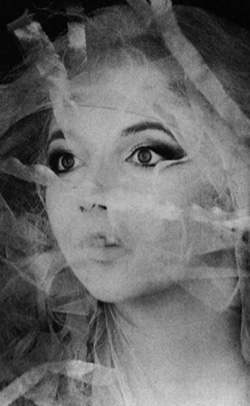
The experimental musician, artist, alternative almost pop star, interior designer and gardener, Danielle Dax, also appears briefly as a she-wolf from a world beneath the village and whom, despite meaning no harm, is shot at by villagers and ultimately returns to her subterranean lair as she feels she is not fit to stay. In The Company of Wolves, Danielle Dax’s performance and the stylised way in which she moves recall the performance-art-meetscontemporary-dance aspects of Kate Bush’s live and promotional video work earlier in her career, with whom Danielle Dax’s other music and performance work in the 1980s shares some similarities (although Dax’s background and music-orientated output from the 1980s is more rooted in, and explores, the cultural underground and to a degree psychedelic and gothic culture).
These similarities included the way in which both performers’ work contained a certain pop-hook sensibility while having leftof-centre characteristics and themes which they explored and also Danielle Dax’s live performances around the time of The Company of Wolves’ release in the mid-1980s shared a multi-faceted and non-conventional aspect with Kate Bush’s in the later 1970s and featured dancers/performers, body paint, hand-painted sets, costumes and the films of Holly Warburton, whose layered dream like collages also appeared on a number of her record covers.

In addition to this, Kate Bush’s work, particularly in the earlier part of her career, could also be seen to connect loosely with some of themes and aesthetics of The Company of Wolves: her songs and other work at the time drew inspiration from, and explored, a mixture of mythology, pastoral unsettledness and even outright horror and often seemed to describe a world unto itself. Her song “Hammer Horror”, for instance, utilises a gothic aesthetic and lyrics which talk of “The first time in my life, I leave the lights on to ease my soul”. Meanwhile, “Hounds of Love” borrows the line “It’s in the trees! It’s coming…” from the 1957 British film Night of the Demon which has come to be associated with folk horror, and “Waking the Witch” starts as a gentle rousing from sleep and then becomes a jarring nightmare of sorcery accusations and persecution, intertwining lyrics from the traditional shanty song “Blood Red Roses”.
Describing Danielle Dax as an “alternative almost popstar” is a reference to the nature and journey of her work in music and performance during the 1980s and early-90s. At one point she was signed to a major record label, which together with her visual flair and aforementioned pop-hooks should have been enough to propel her to more mainstream success. However, that this was not to be is reflected in the title of her 1995 compilation, Comatose Non-Reaction: The Thwarted Pop Career of Danielle Dax.

While visually striking on its own terms, Danielle Dax’s appearance in The Company of Wolves is intriguing due to her own background as an, at times, experimental performer and the manner in which her presence appears to possibly, unexpectedly, bridge the cultural worlds of mainstream film and underground culture. However, this “bridging” of different cultural worlds is not as surprising as it may initially appear, particularly as the film’s producer, Stephen Woolley, was one of the founders of the London-based Scala cinema in the late 1970s; a cinema renowned for its screening of a then unique mix of exploitation, horror, high art and transgressive film:
“The Company of Wolves pays homage to… and subconsciously draws from Woolley’s eclectic programming of London’s Scala repertory cinema, with shades of An American Werewolf in London (1981), Czech fantasy Valerie and Her Week of Wonders (1970) and The Draughtsman’s Contract (1982)… Too arty for mainstream horror fans but much gorier and more muscular than the arthouse expected, The Company of Wolves remains an endless delight for film enthusiasts and lovers of the Gothic tradition.” (Jane Giles writing in The Enchanted Screen: Picturehouse Presents a Season of Folk and Fairytale Films, 2017.)