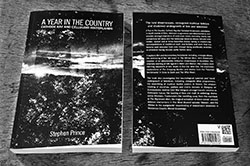
Watching Village of the Damned, the 1960 film adaptation of John Wyndham’s 1957 novel The Midwich Cuckoos, it seemed like the perfect summing up of one of the themes of A Year In The Country; an imagined sense of an underlying unsettledness to country idylls, of something having gone wrong and rotten amongst the hills, valleys and sleepy local streets of this green and pleasant land.
Below is a précis of the plot:
A typical English village suddenly finds all its inhabitants have passed out and anybody who tries to enter the village or its surrounding lands also loses consciousness. The army and authorities are called in to try and find out what is going on. The villagers awake apparently unharmed and it would appear life can go on more or less as normal in these bucolic surroundings, but months later all the women of childbearing age find themselves unexplainedly pregnant.

When born and as they grow all these children have a uniform appearance and similar piercing eyes and striking hair. They also have advanced intelligence, powers of mind reading and control and possess a hive mind where if one of them learns something they all do. They are truly the cuckoos in the nest and their powers, possible amorality and drive to survive threatens the village’s way of life, its inhabitants lives and possibly mankind’s rule and existence.

It is a film full of iconic imagery with nearly every scene arriving with at least one more: the early collapse into unconsciousness of that most British symbol of pastoral civility the bobby on a bicycle (bobby being a colloquial and possibly now period expression meaning police officer),1 night-time mobs with burning torches and the children themselves with their emotional detachment, silver hair and glowing eyes.
In many ways it could be seen to be the flipside or even accompaniment to the film and television versions of Nigel Kneale’s Quatermass and The Pit (1958-1959 and 1967 respectively). Quatermass and The Pit can be seen as a post Second World War consideration of the battle for genetic superiority, purity and control as experienced in a then still recent historic conflict. Village of the Damned could also be seen as reflecting or exploring similar themes via the amoral Aryan-esque race that are seeded amongst the population which is determined to survive and colonise whatever the cost.
Both Quatermass author Nigel Kneale and John Wyndham seemed to often specialise in tales where the landscape and rural areas were far removed from idylls. For example, in John Wyndham’s work there are the preternatural invaders of Village of the Damned and in his 1951 novel The Day of the Triffids, which is discussed further later in the chapter, survivors of a worldwide cataclysm take refuge in a rural cottage against mobile predatory plants.
In Nigel Kneale’s final series of Quatermass from 1979 rural stone circles are the sites of extra-terrestrial reapings of the world’s youth, the research conducive space that a country manor house should provide in 1972’s The Stone Tape instead becomes the scene for an unearthing and return of spectral events and in 1968’s Year of the Sex Olympics a remote rural island becomes a place to allow a television audience to voyeuristically view a family’s tragedy and the danger they are placed in.

There is also more than a touch of horror fictions and film from both before and after its release to Village of the Damned. This includes shades of Frankenstein when the villagers take it upon themselves to form the aforementioned burning torch bearing mob in order to rid themselves of this technologically, biologically advanced new life form. Also, The Omen (1976), with its sense of a cold detached cuckoo in the nest, with telepathic or telekinetic powers beyond our ken or control and who will use those powers to dispatch any threat or adversary.
(As an aside, although the preternatural cuckoo children are essentially a uniform hive mind or colony, their leader or more vocal spokesperson is played brilliantly by Martin Stephens, just the touch of a smile playing about his lips as he stares otherwise without emotion at his mother after sending someone to a fiery departure. He appears to have been the go-to young actor for such quietly unsettling preternaturalness in the early 1960s as he also appears amongst the reeds, willows, hauntings and transgressions of the 1961 film The Innocents.)
Village of the Damned acts as something of a time capsule when viewed today. The village seems to only be populated by upper middle-class figures of control and authority who have perfect diction or the local pub drinking working class and the population is noticeably not at all ethnically diverse. Which was possibly indicative of how things actually were then in such rural areas but to the modern eye it is a noticeably set, defined and delineated society.

Coupled with this the upper middle classes seem to take the frankly bizarre circumstances curiously in their stride and apart from the very occasional emotional outburst (mostly from a female and rarely the educated males) do not appear to get too disturbed, stressed or distressed about the fact that the women folk of the village have essentially given birth to and are being threatened by some unexplained, actually very other biological and possibly extra-terrestrial force.
In the film such things are generally dealt with at the same level of emotional alarm and froideur as if it was merely some socially rather unacceptable gaffe and this in turn can be seen to reflect wider “stiff upper lip” British societal and cultural mores of the time. Interconnected with which and returning to the film’s analogies with the then recent(ish) historical conflict of the Second World War, the way the British or at least the social class with authority deal with these invaders or colonising cuckoos, is shown to be very decent in comparison to how the rest of the world does.
Reason generally prevails and the British are for talking, consideration, study and compromise while elsewhere in the world where similar events have occurred, the film tells us there may well be brutality and the simple application of military force to deal with the problem.
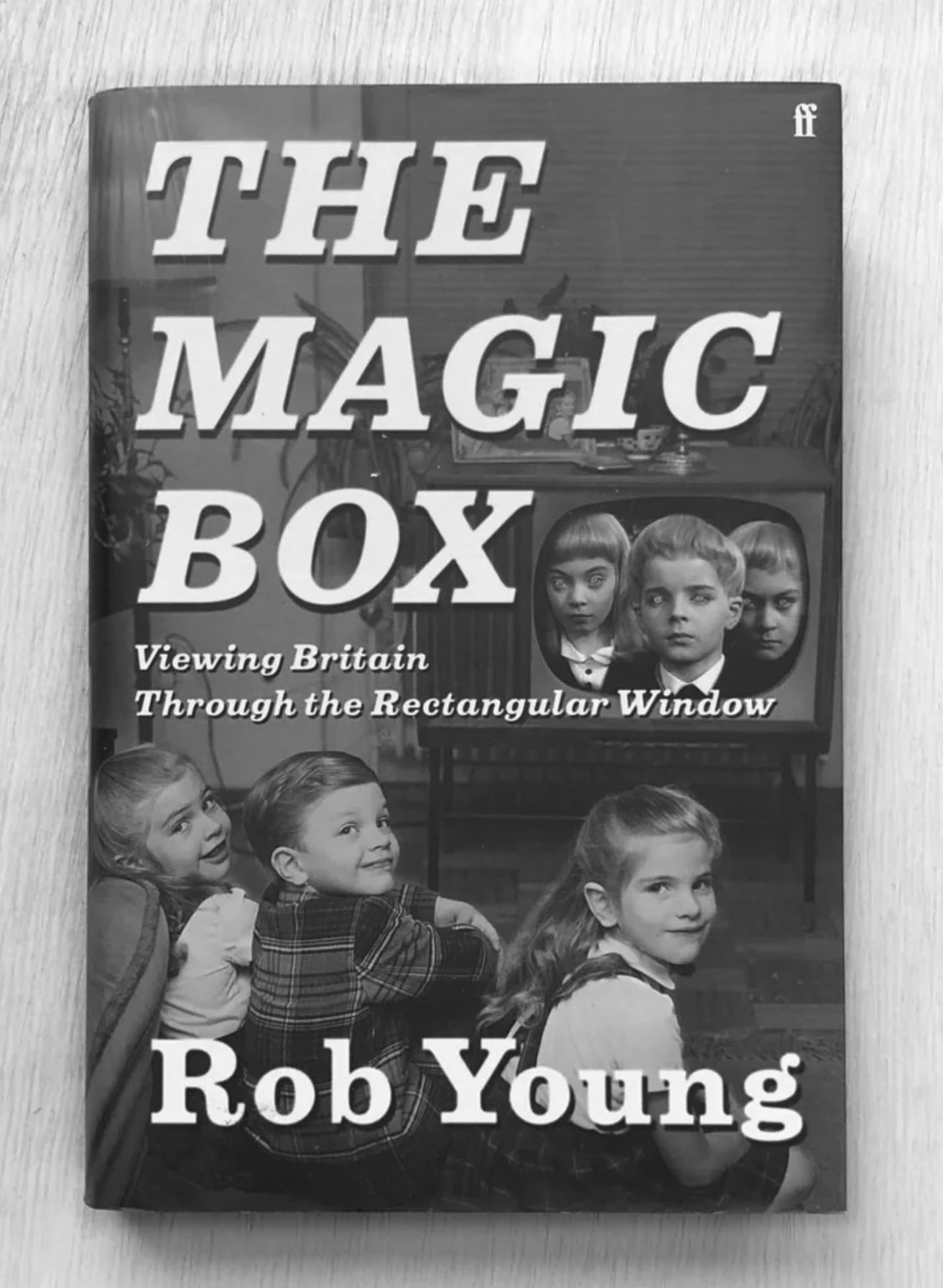
As something of a postscript in recent years the otherworldly children from the film have had their position further cemented in the “wyrd” cultural landscape as they appear on the scren of the “magic (TV) box” on the cover of Rob Young’s non-fiction book The Magic Box which was published in 2021 and in which he explores much of the film and television which has come to form the core of wyrd and hauntological culture and themes:
“Growing up in the 1970s, Rob Young’s main source of stories was the wooden box with the glass window in the corner of his grandparents’ living room… [The Magic Box explores the] cross-genre feast of moving pictures that were produced in Britain between the late 1950s and late 1980s – from The Village of the Damned, Bagpuss and Day of the Triffids to The Wicker Man, Worzel Gummidge and Brideshead Revisited – contributed to a national conversation and collective memory. It played out tensions between the past and the present, dramatized the fractures and injustices in society and acted as a portal for magical and occult notions. It expressed something about the nature and character of Britain, it’s uncategorisable people and its buried histories. It became a golden age that influenced an entire generation of filmmakers and television producers… In The Magic Box, Rob Young explores the strange and wonderful ways British identity has been portrayed on the screen, discovering a telemetric folklore of the British Isles.” (Quoted from text which accompanied the release of The Magic Box).