On the way towards starting A Year In The Country the three albums I probably listened to the most were Jane Weaver Septième Soeur’s conceptual cosmic folkloric Fallen by Watch Bird (2010), the acid folk compilation Gather in the Mushrooms (20041 and The Owl Service’s The View from a Hill (2010).
The View from a Hill could be categorised as folk but it has its own take or edge to it. Many of the songs on it are folk or traditional music mainstays and both musically and visually it uses what could be considered standard tropes of folk music, folklore and culture but this is anything but a mainstream folk album.
The reasons for that are hard to fully define but there are other layers and intelligence to the album, a pattern beneath the plough as it were; it feels subtly experimental but still maintains its listenability.
The songs wander from the Archie Fisher-esque widescreen but intimate take on the traditional song “Polly on the Shore”, through to the “quite pretty but if you listen to the lyrics you realise that this is actually quite an odd story of attraction and paternalism” “Willie O’Winsbury” (and a reprise by way of 1973 film The Wicker Man’s “Procession” as if played by a New Orleans marching band), through to the spectral “The Lover’s Ghost” (featuring vocals by former 1970s acid/psych folk band Mellow Candle member Alison O’Donnell) and the album also draws on the talents of amongst others The Memory Band’s Nancy Wallace and The Straw Bear Band’s Dom Cooper.
It ends with traditional song “Cruel Mother” which is astonishingly brutal and disturbing. Not because it is musically dissonant – it is actually wrapped up in a rather lovely musical package – but because its story of seduction and the desperate actions of an abandoned mother towards her children and their supernatural return and prediction of damnation is so unsettling.

The album ends with the line from that song “’Tis we for heaven and you for hell” and as Steven Collins of The Owl Service says in the sleeve notes, what could come after that?
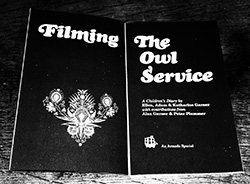
The band were formed by Steven Collins in 2006 and were first active until 2016 and reformed in 2021 with the band name being drawn from Alan Garner’s The Owl Service novel from 1967 and its subsequent television adaptation from 1969.

According to an interview with him in Jeanette Leech’s Seasons They Change – her 2010 book on the story of acid and psychedelic folk – originally The Owl Service did not physically exist as a band but was rather created by him as an imagined idea for his ideal folk band, one which drew its influences from a particular section of 1960s and 1970s British film and television and the sound of the English folk revival.
Apparently, people became interested in this imaginary band when he posted about it online (although they did not know that the band did not exist) and began asking when they would be putting their songs out into the world. From which the band became a real project, which is rather nice as a way of something starting.

I would not necessarily consider The Owl Service as overtly acid or psych folk; it is more a revisiting and reinterpreting of traditional folk and folk rock in a quietly left field or exploratory, respectful to but not hidebound by tradition manner. In this sense of revisiting and reinterpreting, they could be seen to be carrying on another tradition that can be traced back to the likes of folk singer Anne Briggs in the 1960s and early 1970s.
Mike Scott of The Waterboys said that when Kate Bush’s “Wuthering Heights” went straight to number one in the 1978 singles chart that it “Was like an old British soul got returned to us”.
Which puts me somewhat in mind of Anne Briggs and her music. Her recordings were also some of the earliest I listened to when the roots and seedlings of A Year In The Countrybegan to grow and develop in earnest.
Although connected with the folk revival of the 1960s, to a degree she was separate from it, somebody whose work and music trod its own path, the roots of which stretched backwards and forwards to old stories, today’s stories and created its own particular place under the sky; to refer back to that Mike Scott quote, listening to her work is like hearing the return of an old soul. There is a beauty, purity and transcendence to her music and her voice that quite simply stops the listener in their tracks.

As with Kate Bush, her work is characterised in part by a stepping back and away from the bright lights and hurly burly of public life. Alongside which aside from a handful of collaborative and compilation appearances there are only three recorded solo albums and two EPs that document her music, with the third of those albums Sing a Song for You being her final album (which she recorded in 1973 but that was not released until 1997) after which she seemed to wish to largely step back from public view and performance.

Which brings us to Lutine, a duo who were active from approximately 2013 until 2017 and whose work is rooted in folk music but which also exists within its own landscape, creating work which draws from folk and other music but is not a recreation or homage.
If you should take sprinklings, seedings and pathways to and from the following then you may arrive at some sense of Lutine’s work:
The songbird travellers and imaginers of Jane Weaver’s Bird Records, in particular Paper Dollhouse and Magpahi; the coruscating reimagined folk journeys of Espers; possibly the purity of the previously-mentioned teller and re-teller of old stories Anne Briggs; voices such as Audrey Copard from past revivals of folkloric music that seem to have stepped aside and into spaces of their own; the swooping ancient tellings of Dead Can Dance and Lisa Gerrard; the encompassing tranquil dramaticisms of The Cocteau Twins and their collaborative work featuring minimalist piano performed by Harold Budd.

Lutine’s 2014 debut album White Flowers, released by Front & Follow, is reminiscent of a peak point of the label 4AD in the 1980s until around the turn of the decade, a time when it was a home for fragile, textured beauty and explorations, with its releases often being packaged, enhanced and accompanied by the equally textured and intriguing visual work of Vaughan Oliver and Nigel Grierson working as 23 Envelope.
A particular point of reference in terms of Lutine and that period of 4AD is His Name Is Alive and the ethereal beauty of their 1990 album Livonia. If you take one of the literal definitions of ethereal as being “something which is extremely delicate and light, in a way not of this world” then you may be heading towards the atmosphere and work Lutine create.
However, they do such work without wandering into pastures of tweeness or cloyingness and there is a shimmering seam of something far from such things that underpins their music. That seam could not necessarily be described as a darkness but there is a subtle sense of stepping away from the light in their work.
“Dream pop” is another phrase which comes to mind and which has been mentioned in connection with Lutine and one which could also connect back to that 4AD/23 Envelope peak era of music and other fellow wanderers through chimeric soundscapes and melodic will-o’-the wisps such as Virginia Astley.
Lutine’s is chamber music from a time neither then, today or tomorrow. Thoroughly modern and yet steeped in waters from previous eras, gently experimental but particularly accessible.

Which brings me to the just mentioned Audrey Copard and her 1956 folk revival album titled simply English Folk Songs.
There is a playful, sometimes cheerful, sometimes wistfully sad delivery to the songs on this album, with its 14 traditional folk songs being presented simply and in an unadorned manner, featuring just Audrey Copard’s voice and sometimes guitar accompaniment.
It features the first recorded and commercially released version of traditional song “Scarborough Fair” which used the melody that was later used on the commercially successful version of the song released by Simon & Garfunkel in 1965 and also includes a version of “Died of Love” which Lutine would later include their own version of on their debut album.
English Folk Songs enabled me to hear these songs’ earlier incarnations and caused me to wonder how these versions may have somewhere along the line come to influence their future versions existences, revisitings and reinterpretations of folk music.