Posted on

The Living and the Dead – Further Glimpses of Albion in the Overgrowth: Wyrd Explorations 24

The BBC television series The Living and the Dead could be considered to be one of the more overt explorations of some of the themes of folk horror and its attendant sense of spectres and patterns beneath the land in recent mainstream broadcast drama:

“Set in rural England in the 1890s… Nathan Appleby, a pioneering psychologist, inherits Shepzoy House in a beautiful but isolated Somerset valley… he decides to make a new life for himself and his… wife, Charlotte… soon the idyll is compromised by strange and disturbing occurrences that all seem to inexplicably swirl around the increasingly troubled Nathan. Is he being haunted? Why? And by whom?” (Quoted from text which accompanied the series’ 2016 DVD and Blu-ray release.)

The Living and the Dead explores super- or preternatural events alongside the clash and interaction between the old ways and the new; folkloric and supernatural beliefs and modern scientific thought; within a rural setting. It has an underlying sense of the schisming, fracturing, crossing over and fragmenting of time in a manner that brings to mind the supernatural fantasy/science fiction television series Sapphire & Steel (1979-82).10 In both series, time events and spirits appear to break through from other eras and, memorably in The Living and the Dead, one of the main characters sees what he thinks of as a spirit who is reading what he describes as a “glowing book”, which ultimately is revealed to be somebody in the same location over a century later who is viewing a tablet computer, and also in both series, spectral Roundhead troops from the 17th century appear.

Various instances of such “timeslip” feature in other work by The Living and the Dead creator Ashley Pharaoh and his sometime collaborator Matthew Graham with whom he worked on the creation of the television series Life on Mars (2006-2007) and Ashes to Ashes (2008-2010) both of which dealt with time travel and possible portals through the fabric and layers of time via a not fully-explained, almost magical realist process.

Some of Graham’s other work has also dealt with different ways of travelling through time. The Last Train (1999), for instance, told of a random group of passengers on a train who are accidentally cryogenically frozen just before an apocalyptic meteor strike and 52 years pass before they eventually reawaken in a ruined Britain. He also adapted Nigel Kneale’s aforementioned television drama The Stone Tape as a 2015 radio drama broadcast by the BBC and directed by Peter Strickland, the plot of which involves the recording and transmission of a malevolent presence in the stone of a building over hundreds of years.

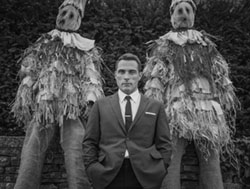
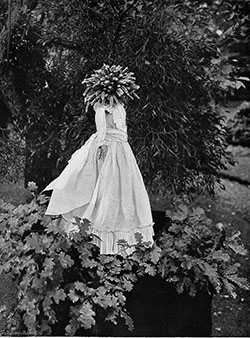
Some of the imagery in The Living and the Dead is reminiscent of Benjamin Stone’s photographs of British folkloric customs from the late 19th and early 20th centuries and the series is set around a similar time that he was travelling the country taking such photographs. Also, some of the folkloric hooded figures from the series are reminiscent of the found photographs of Halloween celebrations from previous eras that Ossian Brown collected in his book The Haunted Air (2010) particularly in terms of spirit if not always aesthetics (and please excuse the unintentional pun!).

The introductory credits feature excerpts from Stan Brakhage’s experimental 1963 film Mothlight in which layers of natural detritus and insects were filmed without the use of a camera but rather by pressing them between two strips of 16mm splicing tape. The resulting assemblage was then contact printed at a lab to allow projection in a cinema, with the objects chosen being required to be thin and translucent in order that they permitted the passage of light. The finished, constantly changing film creates a layered fluttering collage built from its natural components and has an unsettling character which complements the atmosphere of the series.

The soundtrack for the series is by Bristol-based duo The Insects and includes interpretations of traditional folk songs, including a rare vocal contribution by former Cocteau Twin, Elizabeth Fraser, who sings “She Moves Through the Fair” and also “The Lover’s Song” which is a variant of the night-visiting ballad “The Grey Cock” that tells the story of a young woman who has passed from the mortal realm visiting her lover. In the song, when she is asked where her sheets and maids are, she replies:

“The clay it is my bed, my dearest dear, she said
The shroud is my white Holland sheet
And the worms and creeping things are my servants, dear, she said
That wait upon me whilst I am asleep”

The traditional source material could be seen as belonging to a strand of folk music that is folk horror-esque, but which was created before that phrase existed. It could also sit alongside Forest’s “Graveyard” from the album The Full Circle (1970), and the more darkly-hued work of both Mr Fox and Comus, although their work belongs more directly to 1970s folk rock, acid and psych folk explorations rather than traditional folk.

The soundtrack also features a version of “Lyke Wake Dirge”, as once covered by folk rock band Steeleye Span – who enjoyed chart success in the 1970s with pop-tinged versions of traditional folk songs – which according to Wikipedia.com is:

“A traditional English song that tells of the soul’s travel, and the hazards it faces on its way from earth to purgatory. Though the song is from the Christian era and features references to Christianity, much of the symbolism is thought to be of heathen origin.”

The version in The Living and the Dead is not so much Steeleye Span pop folk-esque, but rather is nearer to a contemporary take on the fringes of mid-80s gothic music and the deep darkly tinged baritone of Nick Cave.

Further accenting such darker strands, the soundtrack also features a recording of the traditional harvest supper folk song, “The Brave Ploughboy” the version of which sung by folk band The Watersons features these more than a little folk horror-esque lyrics:

“So early in the morning to harrow, plough, and sow
And with a gentle cast, me boys, we’ll give the corn a throw Which makes the valleys thick to stand
With corn to fill the reaper’s hand
All this, you well may understand, comes from the ploughing boy”
 

Posted on

Requiem – Albion in the Overgrowth: Wyrd Explorations 23

Requiem (2018) is a television series created by Kris Mrska and co-produced by the BBC and Netflix. It is a largely rurally set supernatural thriller in which, after the unexplained suicide of her mother, an urbane London sophisticate who is a famous classical cellist finds herself unravelling as she attempts to discover the truth behind her death and in the process, her own origins. During her search, she discovers a cache of newspaper clippings that were collected and hidden by her mother, which in turn leads her to a rural community in which a young girl had gone missing some years before and was never found, and the mystery surrounding this disappearance begins to take on a multi-layered, supernatural conspiracy aspect.

Requiem could be placed in a loose category of television drama that I would describe as offering “glimpses of Albion in the overgrowth”, that is to say, mainstream dramas which to various degrees explore, utilise and express a flipside, or otherly pastoralism, and at times variously contain elements of, or are fully intertwined with folk horror.1

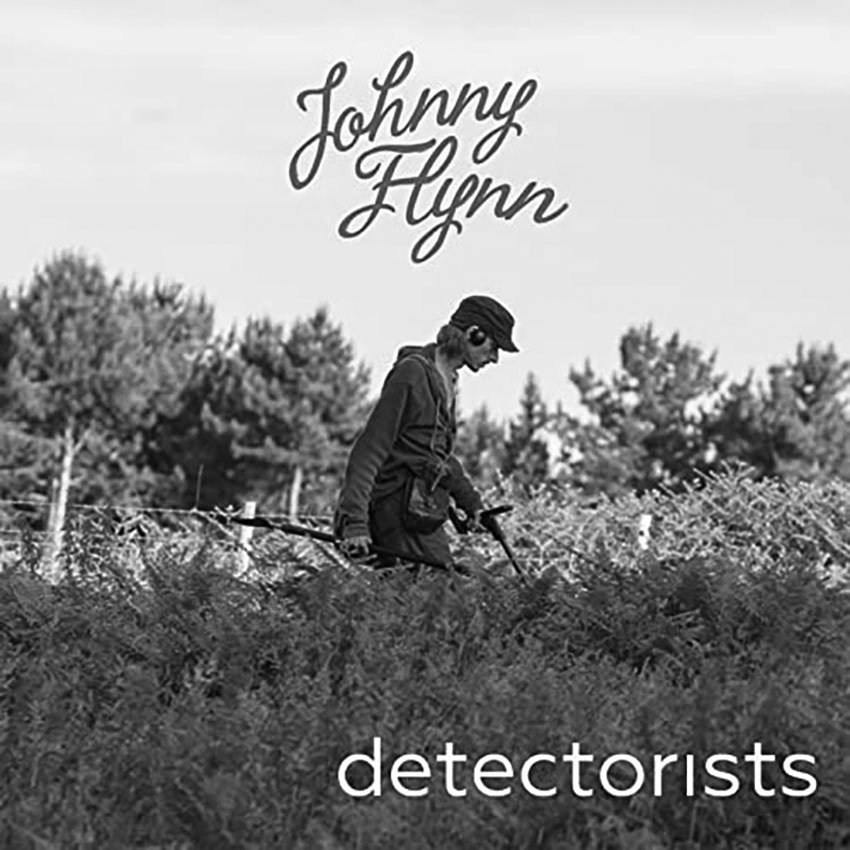
In relatively recent times, the historical fantasy series Britannia (2017-2021), The Living and The Dead (2016) and elements of the BBC comedy drama series Detectorists (2014-2022), could also be included in that loose grouping. And if you cast the net back further, it could also take in the “Savage Party” trailer released in 2012 for the Channel 4 soap opera, Hollyoaks, which has a playful The Wicker Man-esque (1973) aesthetic and the turn of the millennium remake of Randall & Hopkirk (Deceased) (2000- 2001) which, in some episodes, depicts a country idyll gone bad element and pays homage to previous decade’s folk horror film.

Requiem presents rural communities – in contrast to urban ones – as insular or “other”, and as having their own ways and beliefs that connect back to previous eras, in a manner not dissimilar to say Hot Fuzz (2007) and The Wicker Man. And as per The Wicker Man, in Requiem the “outsider” victim is essentially led on a misleading merry dance by the rural folk in pursuance of their beliefs and practices, because ultimately for the effective completion of a key ritual, the chosen sacrifice must come to the community willingly.

Also in the series, those “good”, respectable people of the rural community who turn out to be actually involved in a ritualistic supernatural conspiracy, appear to be largely made up of the relatively affluent middle class and above. For instance, the local “coven” is made up in part by a doctor/psychiatrist, a solicitor, a mildly bohemian antiques dealer and an owner of a large rural estate. They have more working class or lower in class foot soldiers, but these are more the led than the leading.

As is often the case with modern drama, Requiem sidesteps or ignores some of the realities of modern life, including communications networks, and the often-easy dissemination of news, images etc. Instead, a famous musician whose mother has died in bizarre circumstances is able to raise merry heck in a community and rake up all kinds of semi-buried truths in a very public manner, with only one apparent instance of a reporter and a traditional newspaper headline, and little or no recordings of her actions digitally by the public through, say, social media postings. The truth is likely that in such an instance today, her actions would be recorded and/or posted about and spread widely online within minutes of them happening.

This overlooking or sidestepping of such issues may well be a reflection of the difficulties contemporary scriptwriters face with the “well, the characters are trapped and threatened by forces X, Y and Z but with just one mobile phone call they could summon help” aspect of modern peril. Possibly hence, there being a fair few instances in modern film and television dramas where, for example, characters hold up mobile phones and say the likes of “No, no signal”, or drop, break them or comment on having left them at home etc.

Largely in Requiem supernatural elements are only very fleeting glimpsed or represented via audio, in a style reminiscent of John Carpenter’s Prince of Darkness (1987) and in both mirrors are depicted as portals through which the super- or preternatural can attempt to enter the day-to-day world. However, at one point in Requiem a form of spirit or demonic possession is shown as having not dissimilar characteristics to conventional electrical charges and discharges, which caused me to wonder how the supernatural can be convincingly and realistically represented on film and in television. What is the possible literal physical manifestation of such things? Are they or should they be otherworldly spectral or ectoplasmic apparitions? Do they have a connection to and/or have the characteristics of other real world, natural and scientific phenomenon?

Aside from the above electric-like possession, there is only one other overt special effects-orientated visual expression of the supernatural, which is comparatively unusual for contemporary, often CGI special effects-laden genre drama, and this choice to not over-represent via effects leaves space for the viewer’s imagination. This other overt expression is when one of the characters has been possessed, and in order to show this, her eyes flip to opaque black for just a moment. Prior to this, there is an ambiguity to this character and their possession, meaning that this more unequivocal depiction is potentially problematic as once the viewer has been overtly shown the supernatural it can normalise it, or it can seem to them a little obvious or too signposted that “this person is now bad”.

In spite of not actually having a large amount of screen time, a pivotal character in the plot is the aforementioned, mildly bohemian antiques dealer, Sylvia Walsh, played by Tara Fitzgerald, who seems to have an almost smugly evil aspect to her character. Walsh brings to mind, in part, a sort of occult middle manager with a sense of self-satisfying expectation, in a not dissimilar way to a character in Sean Hogan’s film The Devil’s Business (2011), which explores some similar themes to Ben Wheatley’s film Kill List (2011); in both of which two assassins or mercenaries find themselves embroiled in occult activities which are carried out within a curiously banal bureaucratic infrastructure.

The main character in the series, Matilda Gray, played by Lydia Wilson, has a very striking and almost otherworldly “Woman Who Fell to Earth” aspect to her appearance, which looking back over the series could be seen as a reflection of the hidden preternatural forces which are present around her and also even contained within her. Although in a more overtly fashionable, almost hipster way in Requiem, that otherworldly aspect of the appearance of a disturbed individual can also be found in Angela Pleasance’s physical appearance and screen presence in José Ramón Larraz’s 1974 film Symptoms which, as with Requiem, also depicts rural areas as being far removed from bucolic idylls.

Requiem’s introduction sequence is particularly striking and it combines various layered elements and atmospheres – a sense of beauty, subtle eeriness and darkness, a cello semi-hidden in the images, nature and wildlife, ancient folklore and superstition. It also contains kaleidoscopic and mirrored imagery, with subtle tinges of older cathode ray-style ghosted and offset television images, and brings to mind here and there, biological illustrator Angela Mele’s work for the 2014 documentary on slime moulds The Creeping Garden.

The sequence is by the Peters Anderson Studio, the lineage of whose work, in terms of its textural quality, could be traced back to the likes of Vaughan Oliver and Nigel Grierson’s work for the 4AD record label in the 1980s.

The soundtrack for Requiem was created by Dominik Scherrer and Natasha Khan (the latter of which is also known for her work as Bat for Lashes), and could be filed alongside that for The Living and the Dead in that it explores and accompanies a sense of otherly pastoralism (and in The Living and the Dead’s case folk music and culture) within a mainstream television setting.

On the Requiem soundtrack, Natasha Khan’s wordless vocals accompany the instrumentation and the resulting work is somewhat entrancing and has a sense of warmth or even intimacy to it, while at times also containing a subtly unsettling, darker tinged and sometimes dread-filled or ominous atmosphere.

In terms of reference points, it explores not dissimilar territory to Cat’s Eyes’ pastoral fantasia soundtrack for The Duke of Burgundy (2014), Lubos Fiser’s also fantasia-like soundtrack to Valerie and Her Week of Wonders (1970), the melodic conjurings of Jane Weaver’s “Parade of Blood Red Sorrows” which was featured in the neo giallo-esque vampire film Kiss of the Damned (2012),7 and possibly also the soundtrack for an imagined semi-forgotten supernatural tinged Italian giallo along similar lines to Kelli Ali’s “The Kiss” from her 2008 album Rocking Horse, a track which has a semi-forgotten-soundtrack quality to it, and also Sharron Kraus’ 2013 album Pilgrim Chants & Pastoral Trails and its pastoral wanderings and wordless vocalisations (and which coincidentally the Peters Anderson Studio also created the artwork for).

As a collection of work it could also well be a pleasingly leftfield release that might have been found on, for example, the aforementioned 4AD or Mute record labels in the 1980s, along the lines of the accessible melodic experimentalism of Holger Hiller on the album Obem im Eck (1986), in particular the track “Waltz”, or the more experimentally arthouse and atmospheric side of gothic-tinged, but not specifically “goth”, work as found on some of the otherworldly neo classical darkwave band Dead Can Dance’s releases from that period, in particular “The Host of Seraphim” from their 1988 album The Serpent’s Egg.

As with some of Dead Can Dance’s work, the soundtrack for Requiem sometimes creates a sense of reimagined medieval aesthetics – although less overtly and with a more contemporary edge than in Dead Can Dance’s case, whose work also often had a more epic, almost glacial quality or distance to it in contrast to the warmer, more intimate feel of the soundtrack.

Or moving slightly further along the timeline of 4AD releases, His Name is Alive’s Livonia album from 1990 could also be a reference point for the Requiem soundtrack, particularly the opening track “As We Could Ever”, which shares with it a quality of ethereal, otherworldly, wordless female vocalising.

Connected to which, although all possessing their own character, a number of the other tracks/albums mentioned above – “Parade of Blood Red Sorrows”, “The Kiss”, Pilgrim Chants & Pastoral Trails and “Host of Seraphim” – also share a distinct similarity in their sharing of wordless female vocals and otherworldly atmospheres. Also, as with the Peter Andersen Studio work for Requiem, the album cover art for Livonia and the insert for The Serpent’s Egg contain almost spectral aesthetics and a certain textured character in their pastoral-inflected work – all of which reflects the rural setting and super or preternatural themes of the episodes of Requiem.

When I first watched Requiem I felt that there was something about it that seemed to hint at some form of hidden unsettling layers and underpinning being present in the story, and which somehow placed it at a subtle, eerie remove from much of mainstream television drama but I couldn’t quite put my finger on why that was. However, in part the record label Svart’s CD and vinyl release in 2020 of the soundtrack revealed some of what those “unsettling layers” may be.

The album’s booklet includes writing by Erik Stein which reveals that the series does indeed include (semi-hidden) layers. Stein discusses how the series and album refer to and draw from the work of real life 16-17th century Anglo-Welsh mathematician, astronomer, teacher, occultist and alchemist John Dee, with the series featuring one of his books and the (imagined) work of his son. Stein discusses how Dee and his collaborator John Kelley:

“Formed the foundations of so-called ‘Enochian’ magic, a system of ceremonial sorcery based on the evocation and commanding of various spirits. Dee and Kelley claimed that they could communicate with these spirits through their own ‘Enochian’ language, [which they said] had been revealed to them directly via a series of angels.”

Stein describes how Scherrer and Khan used the names of those ‘Enochian’ angels for the album’s track names (“Aigra”, Naa”, “Izraz” etc) and also that Khan “uses ‘Enochian’ words and phrases as her lyrics” during the album.

Dee also claimed to speak to angels and spirits via a black mirror and created an esoteric figure called the “Monas Hieroglyphica” (which is said to embody his vision of the unity of the cosmos and has a horned devil-like meets Einstürzende Neubauten logo appearance),8 both of which interconnect with elements that appear in the series and in turn make any appearance of mirrors in it even more troubling.

Music is an inherent part of the plot of Requiem: as mentioned earlier the main character is a famous cellist, who works alongside her onstage musical partner and accompanying pianist to uncover the truth behind the machinations she unearths.

As part of their investigations they find, in a hidden basement, recordings of haunting music which appear to have been created and used for ritualistic purposes. Partly because of the time in

Posted on

Sapphire & Steel, Mark Fisher and Ghosts in the Machine – Nowhere, Forever and Faded Spaces within Cultural Circuitry: Wyrd Explorations 22

Sapphire & Steel was a British television series, broadcast from 1979 to 1982 and was created by Peter J. Hammond. It starred David McCallum and Joanna Lumley, who played the two interdimensional operatives of the title who travelled through time and place guarding the correct and continuing flowing of time.

In the series it is explained that Time is similar to a progressing corridor that surrounds everything but there are weak spots where Time, which is implied to be a malignant force, can break into the present and take things or people. Alongside this, we are told that there are also creatures from the beginnings and ends of time who roam the corridor searching for the same weak spots to break through and then wreak their own version of havoc.

Very little is explained or revealed about Sapphire & Steel’s backgrounds and while they take on the form of and appear as humans, although not overly dwelled on they are actually beings of another type and are described as being elements (hence their names).

They seem to be quite fond of humans and to have a sense of duty of protection towards them but this is accompanied by a quietly superior air, almost as though they are helping slightly less evolved pets.

Their methods do not seem rooted in scientific, technical and logically conventional techniques and indeed, as with Nick Whitfield’s 2010 film Skeletons which features a duo of operatives who also operate using not all that dissimilar methods, in terms of current scientific theory the premise of the series is nearer to an alternative take on super or preternatural forces.

If and where their techniques do have a scientific air in a contemporary sense, it is science that is beyond human knowledge at this time and seems to have an almost abstractly ad hoc aspect. Accompanying this, the actions and effects in the series are expressed more impressionistically rather than being concerned with high-end visual realism.

Creatures who have broken through the corridor of Time may only be represented as moving spots of light on the floor; when Steel is caught in the time trap of a crashing fighter plane he only has his predicament represented via his stance and audio effects and so on. However, they are no less effective for this and can be positively chilling, possibly as they leave space for the viewer’s imagination to fill in and expand on what they are shown.

This form of presentation also segues with the aspect of the series whereby different areas of Time break through into and exist in an at- times hidden manner within the modern day, expressing a sense of related layering and interweaving.

(Spoiler alert: If you plan on watching the series, the following section reveals details of its ending.)

I first began to re-watch Sapphire & Steel before the first year of A Year In The Country, and finished it during the second year of the project. I had also watched some of it when it was originally broadcast, but only episodically. In the days before the widespread availability of home video recorders and long before online catch-up television, my viewing of the series would only happen every other week as its broadcast clashed with a series that somebody else in my household wanted to watch, meaning that the two different programmes would be watched on alternate weeks. However, I had learned how the series ended as during that extended watching and rewatching I read Mark Fisher’s Ghosts of my Life book from 2014, that loosely focuses on hauntological- related themes and which opens with the ending of the series; Sapphire and Steel are left stranded in a roadside cafe that is suspended in space and their betrayers tell them:

“This is the trap. This is nowhere, and it’s forever.”

It is truly chilling as an ending to a series and as no further episodes of the television programme were commissioned (although it has been continued in more niche-orientated audio books), it genuinely seems as though they are trapped throughout all time.

As a series it contrasts with sections of modern drama in that there is not excessively kinetic movement from one location and big-bang moment to another. Compared to much of modern- day television it feels curiously almost soothing for not having that constant fast paced action.1 At the same time, it does not feel as if the viewer needs to recalibrate to the rhythms of previous eras television to appreciate it, in contrast to say some of 1970s television drama. As with the final series of Quatermass from 1979 that I have written about previously it is older television which stands up well as entertainment, as well as being of interest due to gaining cult status and/or becoming cultural reference points.

Sapphire & Steel was a curious choice for prime-time broadcasting; as Mark Fisher says in The Ghosts of my Life, it was science fiction without many of the expected trappings of the genre such as exotically different alien beings, spaceships, gadgets and advanced weaponry and it did not meet its audience halfway by providing thorough explanations for its world, story and characters.

Compared with today’s sometimes carefully-targeted genre series which are often fan pleasing rollercoaster rides of plot movement that rarely step outside of expected comfort zones, it is genuinely odd to think of how a series which was none of those things could end up as mainstream fare and on the front of the TV Times.

In some ways it could be seen as challenging television due to its lack of explanation of the whys and wherefores of its world and participants and its final unresolved plotline, which as with the lack of overly detailed and high-end special effects, left space for the imagination of its viewers to roam.

The earlier mentioned opening chapter of The Ghosts of my Life is called “The Slow Cancellation of the Future” with Sapphire and Steel’s casting out and possible betrayal “by their own side” being used as an analogy or introduction to some of the themes of hauntology; its sense of futures lost and of time/cultural time leeching forwards and backwards. Accompanying that, Mark Fisher has also considered how we are possibly going through a period where there is a sense of loss of loss.

This is a side effect of the contemporary endless and precise, if at times patchworkly used, archiving and replication techniques which are available via digital technology, which is in contrast with previous eras, where sometimes for example television broadcasts were performed live and not recorded at all, recordings were wiped or due to the fragile nature of older recording media they have degraded over time. Interconnected with which there has also come to be a romantic attachment to the markers of the decay, loss and degradation of recordings from earlier eras, for example the crackle of vinyl records, whether actual or applied retrospectively, as signifiers of certain atmospheres to contemporary recordings.

In line with such considerations, one of the things which is striking when watching Sapphire & Steel is that despite it being available on the more contemporary digital technology of DVDs and streaming, some of the versions which have been distributed digitally are not especially scrubbed up and restored – there are glitches, banding, small transmission-breaking-through crackles of interference at the edges of the screen, light trails and so on.

A good, sympathetically-done high-definition restoration on more visually opulent archival film and television can be something that adds to the viewer’s appreciation of it, but with Sapphire & Steel such a process may well be inappropriate; the unrestored marks and glitches feel like an inherent part of the series, its spirit and aesthetic. In these days of exact digital ease of duplication, there is something intriguing about these particular “faults”, they are the ghosts in the machine, as it were. Which brings me to Ghosts in the Machine.

This was a late-night programme that was broadcast between 1986-1988 on the UK’s Channel 4 television station (one of but four national channels at the time) which was dedicated to showing experimental/avant-garde video work: things you would be more likely to see in a gallery setting than via the mainstream television broadcast infrastructure. It was effectively non-populist television within a populist framework; a phrase that could also be used to refer to Sapphire & Steel.

At times there would be advert breaks with no adverts. Presumably this was because of a mixture of the late hour and Channel 4’s then-still minority output remit. Advertisers probably could not see the marketing potential for fizzy sugared water after a 10-minute almost-still framed broadcast of a pond which showed reflections of people who were not there diving into water (!)

It all seemed quite thrilling at the time; a glimpse into obscured culture that it is difficult to imagine being seen in amongst the transmissions of a mainstream broadcaster today, no matter how late the hour.6 Related to which Mark Fisher has also talked about “…the breaking of the circuit between the avant-garde, the experimental and the popular.”

Ghosts in the Machine was a brief moment when there was a spark generated by a few hair thin strands of connection in that circuit. And although Sapphire & Steel is not necessarily avant- garde, with its exploratory nature and the way in which it did not pander to audience expectations, along with Ghosts in the Machine it serves as a reflection of a time when there was more space within mainstream broadcast culture for such things than exists today.

Posted on

The Pale Horse – Lost Amongst Spells and Urban Wyrd Nightmares: Wyrd Explorations 21

The Pale Horse (2020) is a television mini-series adaptation, written by Sarah Phelps and co-produced by the BBC and Amazon, of billion selling author Agatha Christie’s novel of the same name that was originally published in 1961 and which has been described as the most supernatural of her 66 detective novels.

Due to its inclusion of a number of folk horror-like scenes, themes etc the adaptation could be considered an example of what I call “Albion in the overgrowth”, which is a phrase I’ve tended to use to describe mainstream television dramas etc which to various degrees explore, utilise and express an “otherly pastoralism” or rural wyrd and at times variously contain elements of, or are fully intertwined with, folk horror.

Both the novel and the 2020 adaptation centre around a man called Mark Easterbrook and his encounters with a trio of women who are possibly witches and both are also set in early 1960s London and a fictional rural town called Much Deeping but a considerable number of the other details etc of Christie’s novel have been changed in the adaptation.

In the 2020 adaptation Mark Easterbrook is a suave urbane city dwelling antiques dealer whose name is found on a list of people in the shoe of a dead woman. A number of people on the list subsequently die or are discovered to have died and the series tells of Easterbrook’s attempts to discover the truth of why they have died and if he is next. As the series progresses it shows him struggling with his belief that there is a rational explanation for events which conflicts with evidence that often appears to point towards the deaths being the result of the actions of the above-mentioned trio of women who are fortune tellers but as said above may also possibly be witches and who live at The Pale Horse, a former inn in Much Deeping.

It is far from the cosy family viewing experience that can be found in some popular murder mystery television dramas, where the death/s are often merely a puzzle to be solved and, other than to the actual victims, seems to cause little truly disastrous direct nor collateral damage. In contrast with such dramas, The Pale Horse is an at times near hallucinogenic and often unsettling tale but which smuggles its dark atmosphere and events under a distracting guise of urban style and glamour. At the same time, it does not rely on gore and sensationalist visual shock to unsettle and create its darkly hued atmosphere but rather the sinister aspects of the story and events are more subtly and even ambiguously shown and implied which marks it out as somewhat unusual in today’s cultural landscape.

The just mentioned cosy murder mystery aspect of some television drama is something which has come to be associated with Agatha Christie’s work possibly in part because of the success of the various television adaptations of her Miss Marple novels, which centre around an elderly spinster who lives in a quiet village and who stumbles upon murders before going on to help the police to solve them and which often have a twee rural character. In contrast with these, Phelps’ adaptations have been said to “[reveal] the clenched fist of terror at the heart of Agatha Christie’s novels… [and] deconstruct the cosy image that has grown around the Mother of the Whodunnit, like lichen around a headstone” and to acknowledge the dark character of her source material of which she has said when she returned to it that she was:

“Profoundly shocked by [it]… That’s what I really hope comes across [in my adaptations, that Christie’s books are] brutal… [she] plants these little clues in her books and I pick them up and run with them… I’m honouring the secret, subversive Agatha… There’s something dangerous about her – and there’s a lot of academic work to be done on the tension in the novels between the book she knew the public wanted to read and the one she wanted to write.” (Sarah Phelps quoted in “ABC Murders writer Sarah Phelps to adapt another Agatha Christie novel”, David Brown, radiotimes.com, 6th February 2019.)

Accompanying which the darker character of Phelps’ adap- tations may also in part be a reflection of the contemporary popular culture landscape which allows for and often contains more overtly dark themes, atmospheres and so on than was the case when Christie originally wrote The Pale Horse.

In a number of ways Phelps’ adaptation of The Pale Horse is very much an urban wyrd tale, as it connects with this loosely interconnected mode or form of culture which, as I also in part refer to in the Preface, has been described as having:

“A sense of otherness within the narrative, experience or feeling concerning a densely human-constructed area or the in-between spaces bordering the bucolic and the built-up or surrounding modern technology with regard to another energy at play or in control; be it supernatural spiritual, historical, nostalgic or psychological. Possibly sinister but always somehow unnerving or unnatural… [and] that taps into the undercurrent of the city. In a similar way to psychogeography, it can find new narratives hidden below the top-layer; of dark skulduggery and strangeness beyond the reasonable confines of what we consider part of city life.” (Quoted from “Urban Wyrd: An Introduction”, Adam Scovell, Folk Horror Revival: Urban Wyrd – 1. Spirits of Time, 2019.)

However, rather than being purely “urban” wyrd, which might well imply that the supernatural forces emanate from and are contained within the series’ urban set scenes and locations, The Pale Horse often plays with a sense of the city and ordered sophisticated urban life being invaded and overpowered by a form of long-distance supernatural power that is controlled by rural dwellers.

The series is visually striking and intertwines a stylish 1960s, almost populuxe-esque aesthetic with the tropes of folk horror; its main character Easterbrook dresses in sharply tailored suits and has a high living affluent way of life and an, on the surface at least, picture-perfect wife and flat. However, there is a sense of a rottenness at his core, of something that is eating away at him, coupled with a controlling, self-serving nature and amorality of which Mark Sewell who plays the character has said:

“There’s something about the exteriors of [such] people, that in order to support that level of luxury there’s an underbelly of brutality to maintain it… That seemed to be really reflected in [Easterbrook’s] character’s story.” (Quoted from “TV: Agatha Christie adaptation stirs up a witch’s brew of woe”, author unknown, theherald.com, 8th February 2020.)

However, that “brutality” and the sense of control Easterbrook has in his urban life proves to be far from invulnerable and in a sequence where he and his wife visit a traditional rural fair at the town of Much Deeping where the trio of witches who may be involved in the deaths live, when he crosses fields to spy on them, they seem to preternaturally sense that he is there and there is a palpable sense that he is out of his depth and faced with powers he does not understand and cannot control.
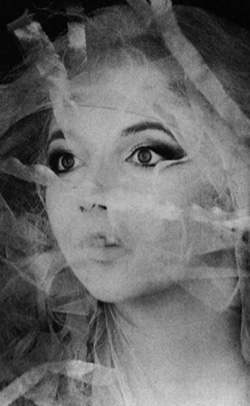
It is during the fair that the drama becomes its most overtly and even orthodoxly folk horror-like: during it there is a folk ritual procession which features locals in surreal animal heads and masks, ghostly looking shrouded children in white dresses and people dressed in sack cloth costumes bestrewn with wheat eaves and wearing cloth head masks with ghastly simplistic features possibly burnt into the fabric.

When the procession stops the gathered crowd shouts “Cut the king” and one of the townsfolk is selected to chop the head off a towering figure with a shock of hair made from crops that had been carried during the procession. When the head is cut off, in a manner that seems somewhat grotesque and bizarre, members of the crowd swoop in to pluck parts of the head and eat them. However, the king’s head is made of bread and this “cutting” is part of a harmless traditional harvest ritual but that is not revealed in the series nor is it known by the urban outsiders Easterbrook and his wife and they find it unsettling, particularly his wife who sarcastically thanks him for a fun day out, before declaring she is going to find a stiff drink and leaving him alone amongst the locals.

Unlike much of horror however this takes place in bright daylight and amongst bucolic beauty, which gives it the air of a waking daytime nightmare, where something very untoward is happening but the outsider watcher does not know quite what it is:

“[There is] great sunshine, beautiful greenness and the corn is growing and everything else. And there’s this shiver that runs through the blood because even in bright sunshine, there’s something scratching at the back of your neck. And you might see it if you turn your head quickly, or it might’ve disappeared by that point… [it] happens, just out of the corner of your eye.” (Sarah Phelps quoted in “The Pale Horse writer interview: ‘I’ve changed elements of the end’”, Rosie Fletcher, denofgeek.com, 18th February 2020.)

Adding to the folk horror-esque character of the series for viewers who have seen Nicolas Roeg’s 2007 supernatural folk horror-esque drama film Puffball is that Rita Tushingham plays one of the witches and whose character’s piercing stare, straggling hair and possible use of supernatural powers in The Pale Horse seem to almost be a revisiting of her part in Roeg’s film in which she plays an elderly matriarch with a not dissimilar appearance and witch-like character who lives rurally and uses dark folkloric magic to achieve her aims.

The Pale Horse is the fifth adaptation of Agatha Christie’s work by Sarah Phelps and each have had recurring images or hidden “easter eggs” which include a painting of a trussed lamb by Agnes Dei and a stuffed polar bear. In the above interview with Den of Geek, Phelps talks about how in the painting you do not know if the lamb is alive or dead and that it has no free will:

“The way I think about the Agatha Christie universe is you have a hero or the antihero, the main character, and there was a point at which they put their foot on a position and that point comes way back… they have no choice. They had a choice a long time ago and they didn’t take it.”

Stuffed animals often have an inherent creepiness to them and the stuffed polar bear in The Pale Horse is no exception and this is coupled with the bears’ fiercely threatening apex predator appearance and position in the natural world.

Easterbrook unboxes the bear in his antique shop in the first scene of The Pale Horse and there is something surreal and unsettling about it which seems to be an indicator that, as Phelps says in the above interview, causes the viewer to think “Something terrible is going to happen to this man”. It also subtly calls into question Easterbrook’s morality and personal moral compass as he is shown to be fully prepared to reduce this wild creature to being merely another decorative bauble.

These recurring easter eggs in Phelps’ Christie adaptations are also accompanied by her repeated use of real-world historical dates, events, newspaper stories and so on, with for example a murder taking place on a prominent date connected with the rise of political extremism in pre-Second World War Germany and Easterbrook reading a newspaper which reports on the trial of a related captured extremist.

The flat Easterbrook shares with his wife is full of mod cons and every inch is perfectly styled but it is very much, to quote the title of the Roxy Music song, “In Every Dream Home a Heartache”.

His beautiful and stylish wife suffers from mental health problems, which are exacerbated by his womanising, related deception, mind games, and cold-hearted treatment of her.

At points the isolation and emptiness of his wife’s life is shown in a subtly brutal manner, as she sits alone and motionless in their stylish flat which could well have tumbled from the pages of a glossy aspirational lifestyle magazine. At other times she is shown as being little more than a harassed skivvy at social gatherings in their flat, with her supposed friends denigrating and being dismissive of her relationship with Mark.

It becomes apparent that Easterbrook’s former wife died in the bath at the flat, possibly due to some kind of electricity related accident, and he wakes repeatedly at night after reliving the time around her death. These dream sections, which take place in the flat’s corridors, are reminiscent of Stanley Kubrick’s iconic horror film The Shining (1980) in which scenes that take place in a hotel’s empty corridors have an almost unbearable and unsettling tension and in both The Shining and The Pale Horse these relatively ordinary and prosaic settings are transformed into nightmarish places.

The Pale Horse is also in part reminiscent of Basil Dearden’s film The Man Who Haunted Himself (1970) as in both a comfortably affluent urbane city dweller finds his grasp on and understanding of reality fracturing, possibly due to some preternatural and unknown force or events. As The Pale Horse progresses Easterbrook’s self-possession, control and sanity seem to increasingly crumble; he always maintains his stylish exterior but it increasingly becomes merely a well-presented, finely tailored and manicured shell, while his inner life in turn becomes a hellish and hallucinatory one as he repeatedly tries and fails to discover whether he is the victim of a supernatural curse placed on him by the trio of witches.

The crumbling of his psyche is often subtly implied rather than overtly visually expressed but it is more overtly depicted in one of the most conventional horror-like sequences in the series during one of his nightmares about his first wife’s death during which he is shown walking down the eerily blue lit corridor of his flat at night. When he opens the door, he falls back terrified and his silhouette is shown cowering in front of the folkloric “king” from the town fair and at this point it seems as though the “otherly” rural and its powers have fully invaded and conquered his well- ordered and affluent urban life and home.

Interconnected with which his flat is stylishly contemporarily decorated but there are three out of place seeming antique ornamental faces displayed in the main fireplace which have an unsettling air to them. One appears to be horned or be of a man wearing a creature’s horns, while the other two appear to be bellowing or in pain and they could be seen as accidental totemic links to the folkloric rituals at Much Deeping or perhaps to even be a conduit for the possibly supernatural powers of the trio of rural witches.

Alongside which when Easterbrook and his wife drive to the fair at Much Deeping, they pass the town’s contemporarily produced metal name sign on the road that is surrounded by and draped with folkloric red ribboned doll-like figures as part of the fair’s celebrations. As with some of the costumes and rituals at the fair, although the dolls are nominally harmless, in the context of the story and its events they assume the air of a warning and seem to indicate that those who pass them are leaving behind the norms and safety of urban life. There is also an interplay between modernity and the old ways in this scene, with modernity seeming to be literally subsumed by the folkloric figures and therefore the “old ways”, and this interplay or conflict is one of the constant undercurrents in The Pale Horse, as it also is in much of folk horror orientated work.

Throughout the drama Much Deeping’s rural area and country dwelling inhabitants are depicted as the threatening “other” and to have an unknowable alienness to city folk, in a manner which is often found in folk horror related work, such as the insular, pagan and at times wanton ways and rituals of the locals in the iconic folk horror film The Wicker Man (1973).

However, eventually it is revealed that the trio of witches may well not be the source of the deaths but rather they have merely been pawns used in nefarious plans by somebody in the city, who has been using information given to the witches when they tell urban visitor’s fortunes to discover those who have a wish for certain people in their lives to be killed in order to inherit, prevent scandal and so on. He does this for financial reward and has merely been playing mind games with Easterbrook by leaving corn dollies on his car and filling his head full of supernatural and near deranged Biblical portents.

Ultimately though the drama ends on an ambiguous note; Easterbrook appears to be trapped in some form of purgatory where he will have to endlessly relive the death of his first wife, who it has been revealed that he killed in a moment of jealous rage, and it is unclear whether the trio of witches have used supernatural powers to place him in this state of damnation or even if they do actually have such powers. The story finishes not so much with a sense of a conflicting duality between urban dwellers and a threatening, supernatural rural other but rather that evil, corruption and rottenness springs from Easterbrook himself.


Posted on

John Carpenter and Alan Howarth’s “Halloween III: Season Of The Witch – Main Title” from Halloween III: Season of the Witch’s Soundtrack: Songs for A Year In The Country 20

For myself Halloween III is possibly the most “Carpenter-esque” John Carpenter soundtrack… The film itself is an intriguing and curious piece of work that via its plot’s use of fragments of stone from Stonehenge that contain an ancient mysterious power still reverberates with echoes of Nigel Kneale’s apparently considerably revised original script.

Posted on

Shadows, Josephine Poole and the Layering of Folklore and Myth: Wyrd Explorations 20

Shadows was a supernatural and fantasy young adult- orientated British television anthology drama series which featured 20 approximately half-hour long stand-alone episodes and was produced by the commercial broadcaster Thames Television and broadcast for three series between 1975 and 1978. In more recent years it has been broadcast by archival British television channel Talking Pictures TV and released on DVD by film and television releasing company Network.

It is part of the strand of late 1960s and 1970s British children’s and young adult television drama that also included the likes of The Owl Service (1969-1970), The Changes (1975), Children of the Stones (1977) and Raven (1977), which often contained and explored surprisingly complex, challenging and at times dark or unsettling themes and atmospheres, particularly considering its intended younger audience, and which in part due to these characteristics has become a reference point for hauntological related and/or otherly pastoral or wyrd culture.

The Inheritance episode, originally broadcast in 1976 as part of Shadows’ second series, and written by Josephine Poole  involves a son called Martin, who is on the threshold of adulthood and though he lives in an urban area he wants to work in the countryside. As with a number of other episodes in the series it explores issues around youthful autonomy as he is at odds with his mother, who wants him to take up an office job in insurance.

Martin’s aged and ill grandfather, who has spent his life working rurally as a deer harbourer, comes to stay with them and shows him a deer antler he once found, which is from a type of deer he had never seen and which mysteriously left no tracks. The grandfather, who very much seems as if he belongs to another era and has little time for modern ways nor the mother’s wish for her son to work in an office, goes on to tell Martin of how in the old days antlers were worshipped and people used to do a horn dance, the meaning of which he says went back to “the dark days”. He also tells Martin of how a close bond grows between the harbourer and the deer, who seem to know when one of the harbourers has died or will do soon, and come to pay their respect.

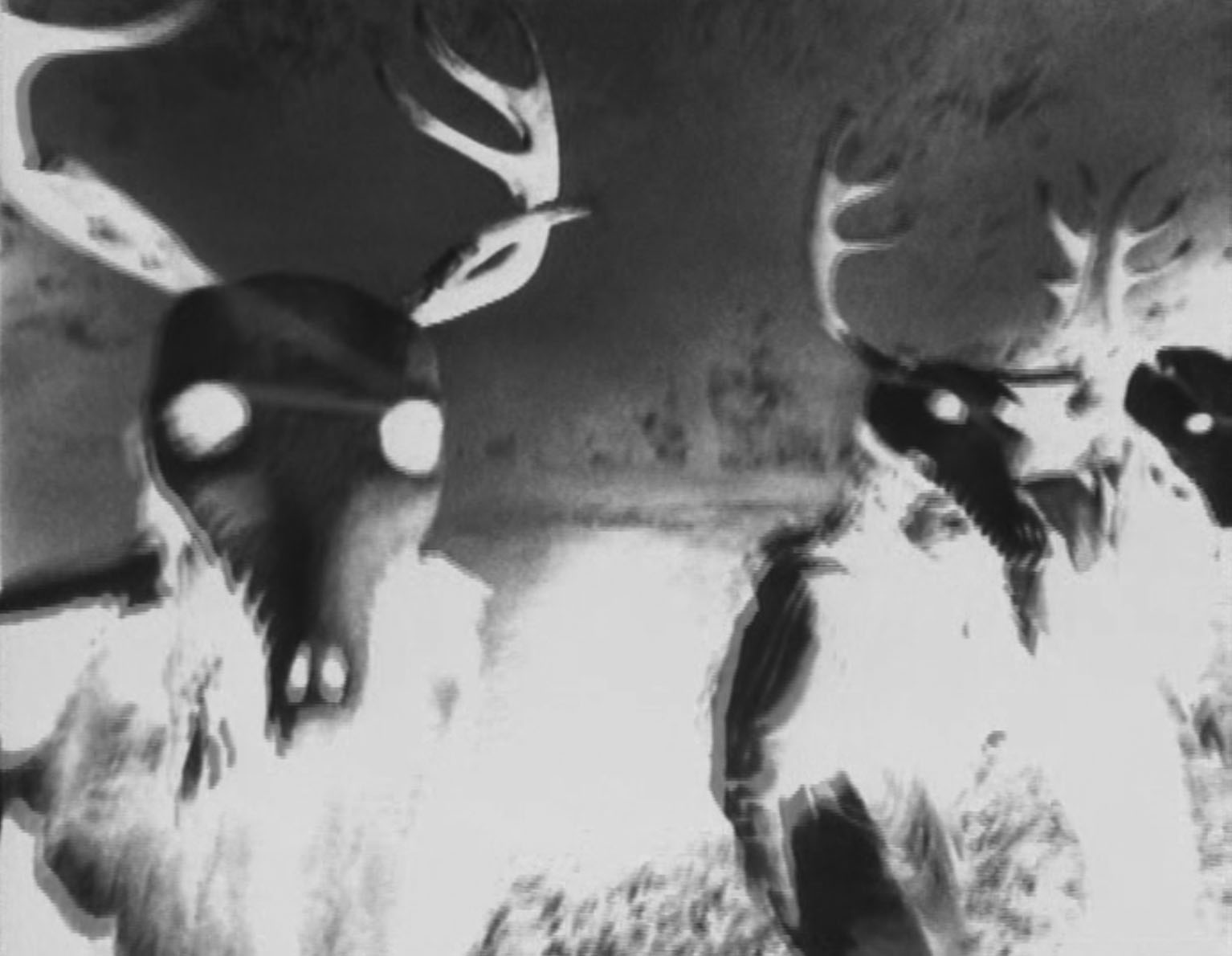
His grandfather’s tales and connection with the land further fuel Martin’s desire not to work in an office, and they both set off to a nearby park early in the morning in order to watch the wild deer. When Martin subsequently wanders through the park on his own, he sees a group of five men in medieval-style costumes, who are wearing deer skull and antler horn headdresses, and who undertake a form of folkloric ritual dance to also medieval-style music before fading away, after which he finds a similar rare antler to the one his grandfather has.

The horn dancers seem to be an intrusion onto the mortal plane of the spirit world and curiously Martin seems largely unperturbed by seeing them, or even to find it especially unusual, and after telling his grandfather about it, his grandfather replies by saying the dance was incomplete as there should have been six participants, and that he wishes he could have seen the dance before he died.

Following this, the episode features a very visually-striking sequence where it steps away from realist aesthetics when Martin has an unsettled night’s sleep and has fever dream-like visions of the horn dancers but this time they are depicted via a form of tinted negative. As the sequence segues into colour it is revealed that one of the dancers is his grandfather, who says his grandson’s name as Martin awakes.

The grandfather has died in the night, apparently not being able to see the horn dance before he died, but rather to have joined it in the afterlife. Martin’s mother gives Martin his grandfather’s inheritance, which is the key to his harbourer’s cottage, and therefore a way for Martin to more easily fulfil his wish to work in the countryside.

In a final discussion, or relatively mild-mannered showdown, between Martin and his mother over his futures plans, she talks about how she grew up in the countryside and just wanted better for her children and to “get away from the mud”. Martin’s reply is that he has to make his own choice and that he is “opting for the wind”.

Martin’s wish to work in the countryside in the episode connects with the back to the land movement which gathered pace after the late 1960s  as part of which people wished to reconnect with the basics of life, nature and agriculture and were drawn to a rural way of life. As with Martin’s similar desires, this was not so much a strictly counter-cultural movement but it overlapped with it in terms of participants and inspiration, such as a rejection of rampant consumerism and careerist defined lives.

As previously mentioned, the episode was written by Josephine Poole, who since 1961 has published more than two dozen books for children, young adults and adults. These include the young adult novel Billy Buck (1972), which shares some similar themes with The Inheritance, in particular the way it revolves around an ancient horn dance. However, whereas in The Inheritance the folkloric dance is depicted in a positive light, in Billy Buck it is used in conjunction with bonfire night revels as a way of exploiting a rural village for sinister purposes by driving the locals to hysteria and tapping into their appetite for persecution in order to destroy an ancient family.

Billy Buck can be grouped with two other young adult books published in the early 1970s, William Rayner’s Stag Boy (1971) and Penelope Lively’s The Wild Hunt of Hagworthy (1971), all three of which draw from similar mythical and folkloric associations with deer and related real-world folk rituals:

“[These books] share the setting of Exmoor and the Devon/ Somerset border, where a deeply-buried folk heritage rises from the landscape – [including] a horn dance of the type still enacted today at Abbots Bromley, a wild hunt, [and] an ancient antlered helmet.” (Quoted from “Running with the Deer – 1971 in Children’s Literature”, Jem, Whistles in the Wind (whistlesinthewind.wordpress.com), 2012.)

Alongside sharing these folkloric themes, the books also connect with a wider trend in 1970s literature:

“The invasion of ancient folklore and myth into the present is a feature of many novels for ‘young adults’ of the late sixties and early seventies. There had been… the Alan Garner effect: in 1967 [his novel] The Owl Service redefined the remit of this type of writing, beyond ‘writing for children’, ambitious in the way it dealt with human emotions against an older, wiser and more powerful landscape. The stories were different because they were as rooted in everyday realism as the kitchen-sink dramas of British film… They existed against a particular sense of modernity at the time: heritage culture hadn’t really begun; things were either ‘old-fashioned’, or they were ‘modern’… [A possible name for this type of story could be] ‘British Ancient Landscape Hauntological Domestic Realist Wilderness’” (Quoted from “Running with the Deer – 1971 in Children’s Literature” and “Appreciating Josephine Poole – Moon Eyes”, Jem, Whistles in the Wind (whistlesinthewind.wordpress.com), 2012.)

This “invasion of ancient folklore and myth into the present” in fictional young adult-orientated work was also a feature of 1970s British television including the likes of the previously mentioned The Changes and Raven, that draw from Arthurian legend,  alongside both The Inheritance and Dark Encounter episodes of Shadows, the latter of which I discuss in another post.


Posted on

The Stone Tape – Nigel Kneale’s Unearthing of Tales from Buried Ancient Pasts: Wyrd Explorations 19

Writer Nigel Kneale’s work for film and television has been something of an ongoing touchstone, point of reference and inspiration for those interested in or creating work that takes in a wyrd sense of the uncanny or unsettled in the landscape and the spectral concerns of hauntology.

The Stone Tape is a 1972 television drama written by him which features a team of British scientists holed up in a country mansion while they attempt to create a new recording technique (and presciently to compete with the Japanese at such things). They discover a form of historic, spectral recording which exists within the substance or literally the stone of the house itself and attempt to study, initiate and possibly capture it as part of their research and development process.

The programme mixes and layers scientific techniques along with an interest in preternatural or supernatural occurrences and while it is set in a country mansion it is not overtly concerned with depicting a rural setting but has nonetheless come to be connected with an interest in folk horror.

This is commented on in reference to The Stone Tape by Andy Paciorek in his article “From the Forests, Fields and Furrows”, which acts as an introductory essay to the loose genre of folk horror at the Folk Horror Revival website:

“Some consider that the setting should be rural for the film [etc to be considered folk horror], but I think a broader view may be considered. The tradition of the horror may indeed have rustic roots and pastoral locations may provide the setting for many of the stronger examples [of folk horror], but people carry their lore and fears with them on their travels and sometimes into a built-up environment. Also, below the foundations of every town is earth with a more ancient past.”

The premise behind the programme comes from stone tape theory, which speculates that ghosts and hauntings are analogous to tape recordings and that electrical mental impressions released during emotional or traumatic events can somehow be “stored” in moist rocks and other items and “replayed” under certain conditions.

This was an idea that was first proposed by British archaeologist turned parapsychologist Thomas Charles Lethbridge in 1961 (philosopher H. H. Price also formed a similar concept in 1940). Lethbridge believed that ghosts were not spirits of the deceased but were simply non-interactive recordings similar to a movie. The Stone Tape television drama helped to popularise the idea and the phrase and as with the recordings in the walls of the mansion featured in it, has continued to echo down the years.

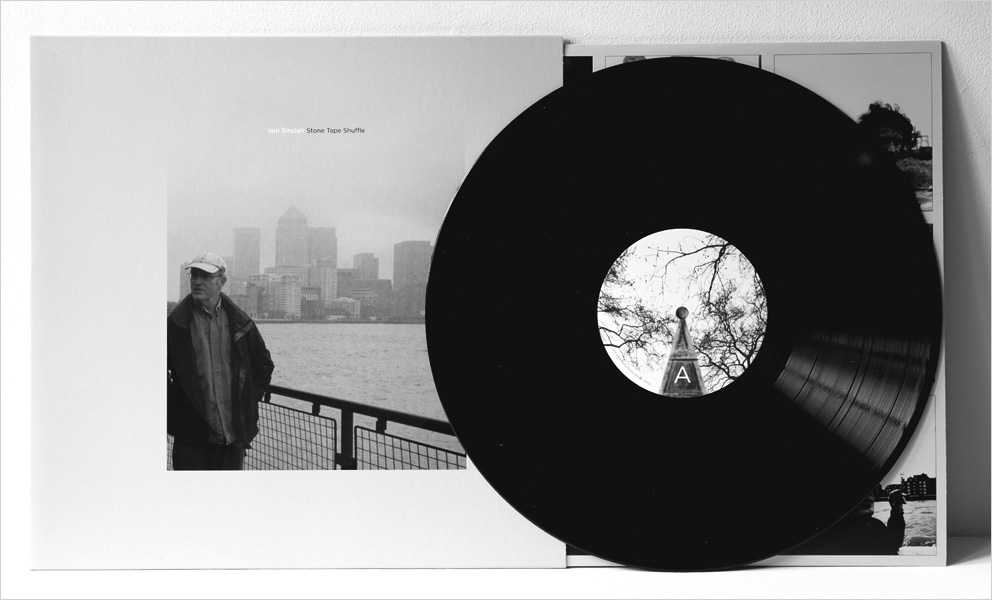
This is particularly so in terms of its title that has been used as the name of record label Stone Tape Recordings, which was founded by Steven Collins who was also the founder member of folk rock band The Owl Service, as the title of an album of site specific spoken word recordings by Iain Sinclair called Stone Tape Shuffle released by Test Centre in 2012 and the name of hauntological otherly folkloric explorers duo The Stone Tapes.

In 2015 there was also a radio play version of The Stone Tape which was broadcast on BBC Radio 4 as part of their Halloween Fright Night season. This added extra layers of cultural intertwinings with hauntological related culture; it was directed by Peter Strickland who wrote and directed the 2012 film Berberian Sound Studio, which in itself has a number of hauntological intertwinings, not least its depiction of an imagined folk horror-esque giallo film and sound recording studio and the inclusion of film and design work by Julian House of Ghost Box Records.

The radio play also featured music by James Cargill of Broadcast (who also created music for Berberian Sound Studio). The soundscape was by Andrew Liles, who has worked with a number of musicians/performers that through the title of a 2003 book by David Keenan which explored such areas of at times culturally subterranean music, have become known as England’s Hidden Reverse, including Current 93 and Nurse With Wound.

Further connections to hauntological points of interest include that the script was by Matthew Graham who was also the writer and/or co-creator of mainstream hauntological-esque timeslip television drama series Life on Mars (2006-2007) and Ashes to Ashes (2008-2010), alongside post-apocalyptic accidental cryogenic time travel science fiction series The Last Train (1999).

Andy Paciorek’s mention of an “ancient past” below the earth in relation to Nigel Kneale’s work connects with one of the recurring themes in his writing; that of the existence of echoes or artifacts from far distant times that may be hidden from view, or literally buried beneath the ground.

In The Stone Tape this takes the form of the spectral recordings in the material of the house, while in the television series and film Quatermass and the Pit (1958-1959 and 1967 respectively), which were also written by Nigel Kneale, it is depicted via the discovery of an ancient alien spacecraft under London which is found to have a malign influence and be part of an alien experiment in genetic modification and manipulation of humans over hundreds or thousands of years, which has been responsible for much of the war and conflict in the world.

As an aside and returning to a sense of echoing down over the years, the main location in Quatermass and the Pit is used in the 2001 album title The Séance at Hobs Lane by Mount Vernon Arts Lab. This album was created by Drew Mulholland and is in itself an exploration of the echoes of society and culture, being a psychogeographic exploration of London’s hidden and underground spaces, eighteenth century secret societies and Quatermass itself. It is seen as a forebear of hauntological work and in what could be seen as an acknowledgement of the pathways it helped to pioneer was reissued by Ghost Box Records in 2007.


Posted on

Marion Adnams, Paul Nash and Unsettling Landscapes – Wyrd Art Forebears and Pathways Through Time: Wyrd Explorations 18

From time to time, I discover work that seems like an accidental forebear of wyrd culture, and which was created long before the contemporary upsurge of interest in the uncanny, eerie flipside of rural, folk etc orientated culture. An example of this are some of the paintings by Marion Adnams, who lived and worked in Derby from 1898 until her death in 1995. Her work found recognition during her lifetime but for an extended period she became semi-forgotten, and there was not an exhibition devoted to her work for fifty years, until one took place at Derby Museum and Art Gallery in 2017-2018.

Adnams never provided explanations for her work, believing that it should be interpreted as people wished. This non-explanation continues with her painting’s titles, which are often both evocative and intriguingly cryptic (and also at times somewhat presciently wyrd-like), and which include For Lo, Winter is Past and Monkey Harvest.

There is a notable 20th century “classic” surrealist style to some of her paintings, one of which features three wizened and largely leafless trees that seem to be almost dancing in a flat untextured landscape and to have flung their leaves up into the air, while another shows three enigmatic oddly shaped stones again in a flat largely textureless landscape and which are also somehow imbued with human-like qualities as though they are alive and twisting, perhaps talking to one another. Each has a similar sized round hole through its centre and it isn’t clear if these have happened naturally, if they have been created by humans and the stones are a form of ritualistic structures or if the holes have been created by the stones themselves in an unexplained preternatural manner.

When I first saw Marion Adnams’ work, it put me in mind of the work of British surrealist painter, war artist, writer, book illustrator, photographer and fabric, poster and stage scenery designer Paul Nash (1889-1946), who has tended to have a higher profile than Adnams.

Nash is said to have found inspiration in “landscapes with elements of ancient history, such as burial mounds, Iron Age hill forts such as Wittenham Clumps and the [henge and ancient stone circles] at Avebury in [the British county of] Wiltshire”, and this in turn seems to presage some of the inspirations and reference points for wyrd or otherly pastoral culture today.

The majority of Nash’s painting are devoid of people, but curiously at times their simplified geometric style, curves etc seem reminiscent of some of artist Tamara de Lempicka’s distinctive and seductive Art Deco portraits and nudes which connects with Nash’s comments in a letter he wrote to a friend in 1912, where he said “I have tried… to paint trees as tho’ they were human beings… because I sincerely love and worship trees and know that they are people and wonderfully beautiful people”.

Nash’s 1911 painting His Vision at Evening features a rolling rural landscape which has a portrait of a woman’s face floating above it whose hair flows outwards to the sides and seems to have become one with or be part of the clouds and sky.

Due to its mixture of mysticism and landscape elements it could be seen as a forebear of some of the more new age and mystical aspects of contemporary wyrd and otherly pastoral culture. It also seems to capture the “visionary” pastoral spirit of music, culture and the landscape that is explored in some of the earlier sections of Rob Young’s 2010 book Electric Eden, where he focuses on, amongst other things, creative work from the 19th and earlier twentieth century. This includes William Morris’ bucolic utopian novel News from Nowhere (1890), and early twentieth-century composers including Vaughan Williams and Holst, of whom Young says, in a manner that connects their work with Nash’s war related artwork which is discussed below, that their work was inspired by “thunderbolts of inspiration from oriental mysticism, angular Modernism and the body blow of the Great War”.

In contrast to the more oblique titles of Marion Adnams’ work, the title of Nash’s war painting We are Making a New World which he created in 1918, appears to be a comment on the destruction wrought by the First World War due to the contrast between its optimistic title and the war-scarred landscape depicted in the painting.

While Nash’s war paintings often have a hellish quality, as in part mentioned above, some of his other landscapes contain a bucolic, gentle, warm atmosphere, while both often feature a sometimes subtle, and at times overt, surreal, Modernist and/or softly geometric aesthetic.

The notable geometric style in some of his work could also be considered a forebear of what I have called the “otherly geometry” of some hauntological and wyrd orientated graphic design and art, including some of Julian House’s artwork for Ghost Box Records, David Chatton Barker’s for Folklore Tapes and some of Nick Taylor’s Spectral Studio work which I have previously described as being “work which often seems to make use of geometric shapes and patterns to invoke a particular kind of otherliness [and allows] a momentary stepping elsewhere”.

Accompanying which, Nash has come to be seen as playing a key role in the development of Modernism in English art, which has been described as:

“…both a philosophical movement and an art movement that, along with cultural trends and changes, arose from wide-scale and far-reaching transformations in Western society during the late 19th and early 20th centuries. Among the factors that shaped Modernism were the development of modern industrial societies and the rapid growth of cities, followed then by reactions to the horrors of World War I.” (Quoted from the Wikipedia.com page on Modernism.)

The manner in which Modernism was both a “reaction to the horrors” of conflict and also the modernisation of society, cities, industries etc could be considered part of a cultural and philosophical lineage which in recent years has included hauntological related work’s utilising of Modernist related iconography and culture, such as Brutalist architecture, often coupling this with a sense of Cold War Dread and/or a sense of melancholia or mourning for lost progressive post-Second World War futures.

Interconnected with which Paul Nash’s work and its intersections with wyrd cultural themes etc are included and discussed in the 2021 book Unsettling Landscapes: The Art of the Eerie, written by curator Steve Marshall, writer and former academic Gill Clarke and author and academic Robert Macfarlane. This accompanied an exhibition of paintings, photographs, sculpture etc at St Barbe Museum and Art Gallery in 2022 curated by the book’s authors:

“[The exhibition looks at] the unsettling, strange, gothic and eerie in British landscape art and examines how these ideas have influenced generations of British artists, Surrealism, Neo-Romanticism and on to current pre-occupations with conservation, belonging and hauntology.” (Quoted from text which accompanied the release of Unsettling Landscapes.)

The book includes the below quote from Paul Nash on his 1935 painting Equivalent for Megaliths which has an intriguing “otherly geometry” landscape meets 1980s cyberspace quality and was inspired by the previously mentioned henge and ancient stone circles at Avebury:

“In the fields a few miles north of Marlborough, standing or prone, are the huge stones, remains of the avenue, or the circles of the Temple of Avebury. The appearance of one or more of these megaliths, blotched with ocreish lichens, or livid with the bruises of weathering is sufficiently dramatic in a field of stubble, or in the grass meadows … These groups are impressive as forms opposed to their surroundings… and in the irrational sense, their suggestion of a super- reality. They are dramatic, also, however, as symbols of their antiquity, as hallowed remnants of an almost unknown civilization.”

This in turn provides further lines through the eerie and “unsettling landscapes” of wyrd and hauntological culture as it forebears and interconnects with one of hauntology’s most prominent theorists Mark Fisher’s comments in his 2016 book The Weird and the Eerie on how:

“[Because] the symbolic structures which made sense of [ancient monuments and stone circles] have rotted away… the deep past of humanity is revealed to be in effect an illegible alien civilisation, its rituals and modes of subjectivity unknown to us.”