As I’ve written previously at A Year In The Country, the subtly dystopic 1980 science fiction film Death Watch, based on the novel The Continuous Katherine Mortenhoe, could be considered part of a lineage, or possibly almost a mini-genre, of cinema, and even television, which looks critically, askance and judgingly at television, warning of its potential as a corrupt and/or corrupting medium. This post considers some of the other films and television dramas in that “almost mini-genre”.
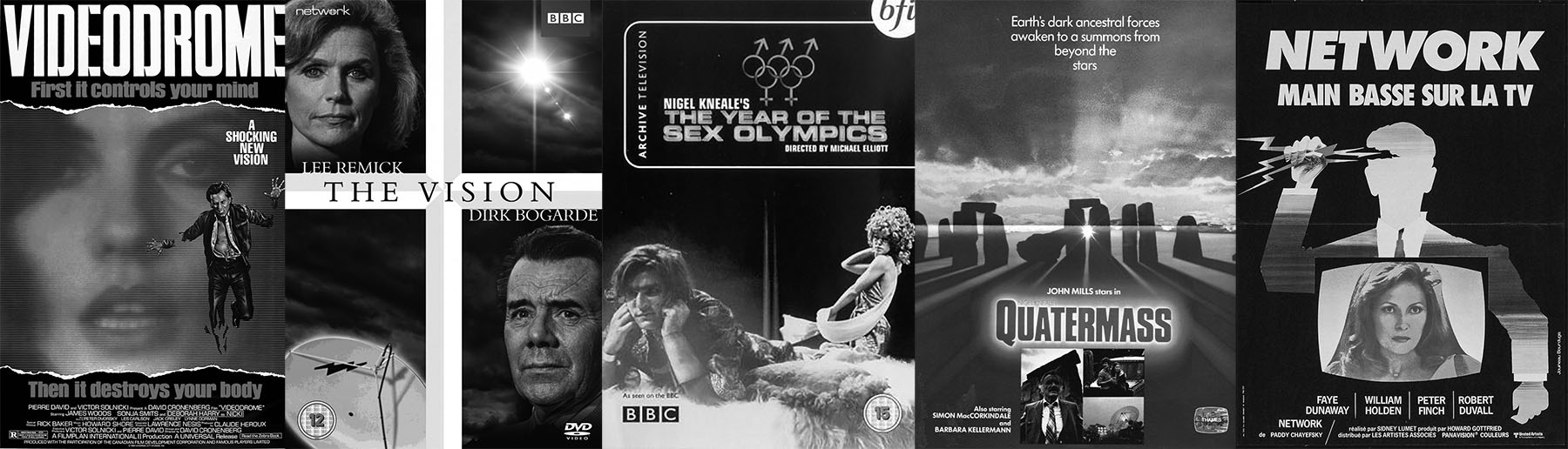
In David Cronenberg’s 1983 film Videodrome, set in North America, television literally corrupts and mutates viewers exposed to explicit, transgressive pirate broadcasts, turning them into mutated deadly killers, with the intention of “toughening up” an America gone soft, in order to fight an ill-defined and oblique, possibly liberal-minded, threat. This toughening up is also part of the insidious plans of an American right-wing religious television company in British BBC television drama The Vision (1987). In this the company begins broadcasting high-quality, no expense spared, audience friendly content in Europe and Britain, and it promises to be highly responsive to audience feedback, with it heavily promoting its interactive nature via an ongoing public phone-in service. However, it has an underlying agenda of influencing voting patterns through opinion piece programmes placed amongst the populist content, and behind the scenes manipulation, and even blackmail, of public figures in positions of power. It does this in order to prepare the populations of their target countries for what the company’s backers (a loose ideological and religious grouping known as “The Vision”) consider will be an end-of-days, armageddon-like conflict with the communist Soviet countries.

As with Death Watch, The Vision presents a near future day-to-day real world, with a subtle sheen to it, which in this case seems to set it apart from the more prosaic or day-to-day depictions of reality that can be found in some other television drama from a similar period. This may well be partly due to its apparently high-end production values, and also the inclusion of two former major cinema stars; British actor and one-time matinée idol Dirk Bogarde and Academy Award nominated American actress Lee Remick. Bogarde plays an aged former television presenter, who was previously a household name known for his warmly accessible demeanour, for whom work has dried up. Initially he overcomes his aversion to the company’s plans and accepts a job as its figurehead presenter, taking the path of least resistance and biggest cheque, in order to essentially be a trojan horse for their propaganda. Remick plays the director of the company, whose depiction of her character contains both a steely evangelical focus and more than a hint of cinematic star charisma and glamour.
Eventually Bogarde’s character rebels and he refuses to work for the company which, through their manipulation of the press, subsequently destroys his reputation and the lives of some he is closest to. His plans to reveal the company’s true purpose on its first night of broadcasting are skillfully handled and neutered by the company, and there is a sense that it is already too powerful, well-funded and efficiently organised to not succeed. While the series’ imagined Cold War based threat is now a period piece, the drama remains powerfully effective in its depiction of the potentially unaccountable and undemocratic nature of large media companies, and how the high cost of related infrastructure and effective large-scale promotion of media content, restricts access to just a few.
(Remick’s character compares this with how historically Europe’s information network was once controlled by just one organisation, the Catholic church, but that the low-cost and accessibility of printing broke this up, but that now the monopoly system was returning via the likes of her company.)

The drama ends on two somewhat unsettling, or even chilling, notes: the company’s television complex is seen from the air, with its stark angular modernity notably contrasting with a traditional windmill and greenery, implying that the company is already deeply embedded amongst the very heart of Britain; and in a metatextual manner as the credits roll, the camera zooms out to reveal that they are actually playing on a starkly lit television studio monitor, which leaves the viewer with an unsure sense of reality and also of the successful infiltration of “the vision” into television’s infrastructure.
While the drama focuses on large-scale infrastructure broadcast television, which was one of the dominant media forms and technologies of the time, it also appears to be somewhat analogous and prescient in relation to contemporary debates around social media which, as with the television channel in The Vision, offers a high degree of public interactivity, but is also owned and controlled by a small number of monopolies.
Elsewhere:
- The Vision – Network DVD
- Quatermass (1979) – Network’s Teaser Trailer
- Network trailer
- The Parallax View – Montage scene
- Opening Wednesday at a Theater or Drive-In Near You: The Shadow Cinema of the American ’70s
- Death Watch – Cinema re-release trailer
- Death Watch – Park Circus DVD and Blu-ray
- Death Watch – Shout! Factory DVD and Blu-ray
Elsewhere at A Year In The Country:
- Katherine Mortenhoe’s Journey Through a Subtly Dystopic Landcape
- The Dawning of a New Cinematic Age of Surveillance – Artifacts and Curios from The Conversation, The Parallax View, 3 Days of the Condor and The Anderson Tapes
- The Dawning of a New Cinematic Age of Surveillance – Three Days of the Condor
- The Stone Tape, Quatermass, The Road and The Twilight Language of Nigel Kneale – Unearthing Tales from Buried Ancient Pasts
- A Baker’s Dozen Of Professor Bernard Quatermass
- Quatermass finds and ephemera from back when
- Huff-ity puff-ity ringstone round; Quatermass and the finalities of lovely lightning
- Laurie Anderson’s O’Superman As Performed In A Real World Fever Dream