File under:
A Year In The Country: Work
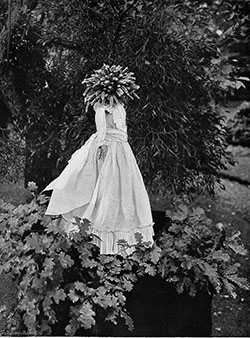
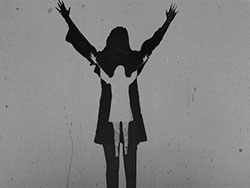
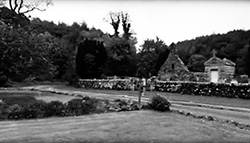
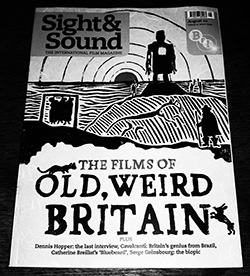
Something of a tip of the hat to Misters Christopherson and Balance.
File under:
A Year In The Country: Work
Something of a tip of the hat to Misters Christopherson and Balance.

File under:
A Year In The Country: Work
View more visual work from the A Year In The Country project in the Gallery.

Trails and Influences: Electronic Ether. Case #26/52.
Being a chap of a certain age, when listening to some of what has been labelled hauntological music I’ve thought to myself… “Hmmm, this isn’t a million miles away from the (largely) English instrumental abstractions of hip-hop from the nineties, along the lines of Mo’Wax” (or probably I actually think “This reminds me of Mo’Wax a bit”).
Boards Of Canada would be a starting point for such things. Their work sounds like the audio foundations for hauntology before it discovered its philosophical bent. And it wasn’t a surprise to see former Mo’Wax gents reappear/the connection with such things via the wanderings of the likes of The Memory Band vs Ghost Box Further Navigations release.
I suppose the borrowing, sampling, re-imagining and reinterpreting of previously existing records and sounds in a collage form in some such music is not dissimilar to hip-hops collage/cut’n’paste style which lead to the hazy beats and borrowings of Mo’Wax.
One of the more overt of those times when I think of the connection to such things as Mo’Wax is Mr Ian Hodgson’s Moon Wiring Club work. It makes me think of chaps in big trainers curiously transmuted to share in teacake time…
 …this is music which I tend to think of as being more playful than spectral. It’s a world of whimsy, wrapped in painted psychedelic wrappings (rather swinging Carnaby Street-esque I tend to think; the associated illustrations remind me of the dandy-isms of such things, in particular Malcolm English and I suppose you could draw a line from such things and a Kinks-esque Village Green Preservation Society pleasant but slightly fantastical fair isle-ness to Moon Wiring Club. Hmmm…).
And returning again to the Mo’Wax connection, the distinctive presentation and packaging of the aesthetics of this world is part and parcel of the experience (something shared by both Moon Wiring Club and Ghost Box Records; the design work is part of the transportation mechanism, as it were).
Although, entering into Mr Hodgson’s Blank Workshop is more to step into a world of chocolate crispie cakes, bunking off school to watch vaguely science-fiction escapist TV (Streethawk?, Automan?), maybe eat a bag of chips if you had the money than, well, unsettled otherlyness and it has a delve about amongst a cultural 10p mix that wanders a little further along to nearer our own time…

I was particularly taken by the Asda Mix. As I listened to it, the phrase that kept popping into mind was “This is like a hauntological primer”… but it’s not. It’s very fun rather than serious. Yes, it may open with the theme to a mid-1970s post-societal collapse television series but you’re just as likely to journey through the Two Ronnies as such things.
Lovely packaging for it to. Listen to it here.
(Oh and C70s? Did they make C70s? For when you need just a bit more than an hour but not quite two albums worth of ferrous recordings).
 And while we’re on the subject of things you can find in the ether… I still find myself chuckling when I think of the meeting of Jonny Trunk, Ian Hodgson and friend on the OST show. Let the battle of knowing exactly which catalogue number and colour label a particularly piece of library music has commence. Well worth a wander along and listen if you should enjoy the above instant party tape. Stand outs? The recording of a set of supermarket pricings comes to mind…
(During the show Mr Hodgson discusses his love of sweet wrappers, which doesn’t surprise me as I found myself wanting to write painted psychedelic sweetie wrappings in the above paragraph…).

I’m also somewhat entertained (worried?) by the photograph from an interview with the gent in question by a chap from The Outer Church… if you should want to read more about the connections between hip-hop and such things you can do that… well you might have to break open the piggy bank… more about that in the following paragraph…
While we’re wandering amongst the fields of zeros and ones, if you don’t have as much shelf space as you might like, for some of your good English pounds you could read a different copy of The Wire magazine every day for the next year (at the time of writing) here and still have a few issues left in spare change. Or hop along more precisely to Gecophonic transmissions here.
Mind you, also at the time of writing what a rotation around the suns worth of such things would pay for could buy you approximately 160 teacakes according to the smorgasboard of information in amongst the zeros and ones. I’m not just being obscure there (not just). There is a link and reason for mentioning teacakes again. If you visit the Phantom Circuit here you may well see the connection.
 PS Indirectly Mr Hodgson is responsible for one of the phrases that has stuck in my head the most leading up to and during this year in the country: “slathered in the fiction that it comes from an older, weirder England”.
Although in my head I tend to think it says “slathered in the fiction that it comes from an older, more brutal England”, which I think probably says something about my own approach to all such things and makes me think of the behind-the-net-curtains noir of Black Box Recorder (see Day #10/365).
Wander along to the Gecophonic Audio System here.
 File under: Trails and Influences.
Other Pathways. Case #31/52.
I’ve been thinking here and there about cultures away from the shores of Albion which might be considered to have some similarities with some of the otherly folkloric/hauntological culture that I’ve been wandering through during this year in the country; the sense of an unregulated, sometimes overlooked culture with deep roots in the land and history, that could be seen to be haunted by spectres of a nation’s past.
The folk cultural history (in the sense of being from the wild woods, away from the cities, a touch more autonomous and of/by the people ) of places rather than the pop cultural history (based in urban centres, mass spectacle, centrally controlled).
…along which lines, if I was to look way over the oceans I would probably cast my gaze towards what I tend to think of a certain dusty plains, Southern Gothic aesthetic and artifacts.
 I’ve touched briefly on such things when talking about General Orders No.9 (see Day #51/365), an astonishing piece of flickering celluloid which takes in the discarded, collapsed, neglected and yet also invaded/consumed landscape of America’s deep south…
If I was to pick two particular other cultural artifacts and resonances in the air which represent such things then it would probably be the albums Hex; Or Printing In The Infernal Method by Earth and Folklore by 16 Horsepower.
These are haunted and haunting pieces of work. Musically quite different but I feel they’re wandering similar pathways, somewhere in history.
The second, although not really pigeonhole-able, could be seen to be a form of visionary, folkloric dark Americana.; very melodic and presented in traditional song form. It draws on gospel but if this is a revival it’s wandering the forest with its sins, having travelled from its church roots but never too far that it can’t hear the calls from its home.

The first takes a similar aesthetic but applies a relentless but strangely comforting heaviness and sense of being enveloped and crushed, this time taking a vocal-less drone guitar path through the dust bowls of its land.
And when it stops, I don’t want it to end.
They are both the fever dreams of stories etched in the land, shadows of the past in the present.

Mirrors of folklore and drawing the lines:
Lead Earth gent Dylan Carlson has begun to explore English folklore, culture and related esoteric pathways quite explicitly (see Day #156/365) and has mentioned late 1960s/early 1970s folk rock along the lines of Pentangle as being an influence on more recent work… you could well peruse him discussing such things via a certain gent from The Outer Church here.
 16 Horsepower’s live performance of Joy Division: It’s a fair few years since I first saw this but having re-watched it still entrances and transports me. Mr Eugene Edward is channelling something here.
Watch the grip of the mercenary hand here. Although to truly appreciate it, bringing home it’s intended place would be most recommended.
Visit Mr Carlson’s various projects in the ether here.
More than worth a mention if you should be travelling such pathways: Searching For The Wrong Eyed Jesus…

This and General Orders No.9 could be seen to be mirror images of studies of this fair isle’s outer edges and edgelands (see Day #160/365)…
 File under: Trails and Influences: Touchstones.
Case #27/52.
I’ve been interested and curious by just how many times references to the final 1979 Quatermass series have kept cropping up during this year in the country: not always obviously but when I recently re-perused it I kept having “Ah, that’s where that’s from” points of aha, connection and reference.
On this recent re-viewing I wandered if it wasn’t some kind of original point where the branches and trees of A Year In The Country first began to seed and grow; it has such a sense of the landscape and the fields being a place where ancient stories are told and retold, of pastoralism that is both refuge and an otherly unsettled place but more in a machinations of eldritch science/science fiction manner than ancient man made rituals. The patterns beneath the plough in this story are particularly deep, sewn from elsewhere in the cosmos and stretch way back through our history, to a previous (almost) final harvest.
Hmmm.
 I first came across the series in the early 1980s via it’s novelisation which was bought from the bargain bookshelves of one of my local newsagents (such places were something of an exciting cultural node for a young chap; I expect many an hour was spent wandering their shelves of comics and books, see Day #15/365 for more on such things).

I read it when I was going through an extended phase of reading science fiction that I expect was a bit beyond my years and comprehension but which I was drawn to and maybe searching for what would later become niche corners of culture.
This book in particular I was fascinated by and even to this day my mind still seems to ponder some of its themes and images.
And there are a lot of them: ancient stone circles as markers for where the human race was once reaped by an alien intelligence, of that intelligence possibly taking just a trace of the people it “destroys”/harvests – in a similar way as humans take just a trace of the musk deer to make our perfume, the collapse of society into near barbarism and the prime minister’s home having a tank outside to guard it (though it was said to not be mobile and to have a family of cats living in it), the new age wanderers seeking to be taken to the “planet”, decadent Benny Hill meets Clockwork Orange pandering television programs…
And it’s a fantastic vision of a Britain gone to seed and crumbled. I know that it will have been location scouted to show that but there is an underlying sense that this is more documentary than fiction in its portrayal; it captures something of the corrupt spirit of the times or at least how those times are sometimes remembered.

I don’t actually know if I saw the program when I was young, so I don’t know if it would qualify as a version of hauntological misremembered memory of it and its possible strangeness. I have a suspicion I may have seen the occasional snatch of an occasional episode late at night, on a black and white television with the sound turned right down and a coat over my head and the set so that the flickers of the screen didn’t give away my should be in bed watching…

…one thing that struck me on a recent re-viewing was just how genuinely watchable and gripping it is. Very modern in a way and stands up well with the pace and entertainment qualities of modern-day broadcasts. I mention that as it seems in contrast to some other become-otherly television programs that may be mentioned around these parts, which you almost have to recalibrate yourself to a different previous eras rhythm of story telling to appreciate today (see Day #33/365 for more on such things). It hadn’t been that long since I had previously seen it and still I was gripped from the start…

As seems to be my way of late, here are a few notes I made as I re-watched it:
1) Rather posh gang member muggers at the start in a thespian finishing school way.
2) “A wedding between a corrupt democracy and a monstrous tyranny.”
3) It’s an interesting comment on where the utopian freedoms and possible decadence of the 1960s and 1970s went when it overreached and curdled.
4) Every looks run down, bodged together in this Britain even radio telescope stations; there is a sense of a true plucky British spirit.
5) Burning books: almost Dickensian street market – a stall selling books “Guaranteed to burn well”.

6) “We’re being harvested.“
7) “Beware the quasars.”
8) “You mustn’t be like that when you grow up, promise me you won’t turn foolish. Promise me.“
9) There’s a curious sense of old world gentility in the face of societal collapse.
10) “It was here to, here in England, at ringstone round.”
11) The leader of the planet people is the worst kind of demagogue (and curiously looks rather like his almost opposite number, the radio telescope scientist leader… I kept having to double-take to check it wasn’t him).

12) It’s interesting as it’s a comment in a way against an over-reliance and over-emphasis on youth in society: “Yes, the older the better” on the scientists, officers and soldiers who become the investigators and possible saviours.
13) “A trace, a mere trace, you’re talking about a fragment” (see themes and images section earlier).
14) “You’d think she’d never had a stick in her hand before.” (see Benny Hill meets Clockwork orange, also in the themes and images section earlier); the logical extension of Legs and Co.?
15) “It’s the only show anybody watches anymore. It has a special place, it’s what we used to call a family show.“” Similar to Nigel Kneale’s prescient consideration of television in his other flickering stories, where programs have been reduced to The Hungry Angry Show.

16) “A ripe crop can’t appeal to the reaper. I think this is the gathering time. The human race is being harvested.“
17) “A cosmic error.“
18) “What was underneath
18) “A meadow. Appropriate for a human harvest.“
19) “What was underneath stayed under the open fields.” I’m actually unsettled typing some of this. Nigel Kneale’s stories seem to deal with very particular human and historical archetypes that get under the skin. By the end of Quatermass and The Pit’s atavistic pogroms I just really wanted it all to stop and the film to end, to leave me alone.
20) Scenes of (literally) underground government; all shabby, patched together and shrouded in cigarette smoke. It seemed like an accurate depiction of cultural memories of the hidden histories and subterfuges of the 1970s.

21) “Of course. The mother bird draws attention away from the chicks.“


22) Re longstanding sports gathering grounds: “The sacred turf they call it. I wander what’s underneath?” There’s a sense of distrust of mass gatherings and festivals, of the blind mass mind adherence and obedience of them.
23) There’s more than a touch of a connection and line from the harvesting of a species and it’s essences here to Under The Skin.

24) “You see the sky all sick? What that is, is spillings.” Well, there’s another bit of shoulder hunching heebie jeebies as I relate that.
25) “I can make them exist, do you know that? Not by magic or faith but… but by thinking.” Contrasts and battles between returned, resurging unquestioning beliefs and the rationality (?) of modern-day scientific belief systems.
26) Is it more unsettling because one of the planet people is future pop-ette Toyah Wilcox and one of the soldiers she helps convert is a future Blue Peter presenter?

 27) It’s interesting how the closing credits change colour gradually over each episode and then in the final credits it’s just nursery rhymes and children playing amongst the ringstone round. A return to a pastoral idyll but there’s something just slightly menacing (foreboding?) to it.


28) “I have watched the sky and the land become clean.“
A Pastoral Tinderbox. £10.00.
A set of 12 prints contained in a sliding matchbox style two part black matt rigid card box set.
Limited edition of 52 sets.
The prints are printed with archival Giclée pigment inks on textured 100% cotton fine art paper.
Each print is hand signed and hand numbered.The box is hand signed and numbered inside.
Size of prints: 6.7 x 6.7 cm / 2.6 x 2.6″.
Size of box: 7.5 x 7.2cm / 3 x 2.8″.
Available at our Artifacts Shop and in our Etsy shop.
 File under: Trails and Influences. Other Pathways.
Case #30/52.
I’ve had World On A Wire sat around for a fair old while and have been meaning to peruse it but only recently did…
It’s a two-part television program from 1973, based on a book by Daniel F. Galouye (one of the covers for which is one of my favourite pieces of paperback art – a very analogue vision of a digital reality and its pastoral features).
World On A Wire is one of those particularly curiously prescient pieces of science fiction, prefiguring everything from second life style escapist computer games, virtual reality, social media, future Hollywood blockbusters, science fiction in various forms…
…and interestingly, although it was made in 1973, in contrast to much televisual output from Britain around that time, this is a program which isn’t all muddy coloured grimness. This is a shiny corporate (then) future, one of the lost futures pasts…
A brief overview of the plot: a supercomputer hosts a simulation program, a Simulacron, of a virtual world of human beings who are unaware that their world is not real. The technical director of the program is on the verge of some kind of major breakthrough but dies in peculiar, unexplained circumstances… his successor interacts with a security adviser who disappears without a trace and nobody else seems to know who he is/was, one of the virtual inhabitants commits suicide and reality/virtual reality and it’s inhabitants become intermingled with disastrous and life/freedom/corporate privilege threatening consequences for the program’s director…

Here are some notes I made as I went along:
1) Has a similar emotional distance/coldness like Cronenberg or Paul Schroeder’s work; the characters are often literally physically still and posed (at least in the first half).
2) It has more than a few similarities to A Dream Of Wessex and its prescient creation of virtual worlds (see Day 26/365) and the use of those worlds to consider possible future problems/needs within society.

3) The characters within the virtual world are called Identity Units – that made me smile and think of current day “social” digital worlds.
4) This is hauntological source material without the grimness – it presents a vision of a lost future that is all shiny corporate beauty.
5) There’s an impossibly glamorous corporate style to the world it presents and an unreal cartoon like beauty and glamour to some of the female characters – like Jessica Rabbits tumbled from the cartoons…
6) It takes place in a curiously depopulated world – one almost like a computer game/virtual reality simulation where only the main characters have been programmed and given screen time.

7) It’s also a curiously enclosed world, again at least in the first half – people hardly ever stray from the main corporate building.
8) This is a world drenched in blue and pink light. It’s quite lovely but also quite cold.
9) Dialogue: “I’ll deal with the little ideality.”
10) Dialogue: “I always thought switching minds was a utopian joke.”
11) Dialogue: “Your puppets are dancing again.”
12) Identity Unit name: Chrisopher Nobody.
13) Dialogue: “Okay, delete him.” (Comment on Christopher Nobody).
14) Dialogue: “I’m just a bundle of electronic circuits… a projection if you like.”
15) Dialogue: “Think about it, everyday you reign like God over a miniature world you helped to create and which you mistake more and more for a real world. You can add and delete people at will… this leads to feelings of depression, guilt and fear.”
 In many ways it’s a program of two halves (literally as it was broadcast in two parts): the first is a vision of a future that is all middle-class corporate exploration and quietly decadent leisure, all presented in a beautiful yet cold, subtley queasy aesthetic, largely under the cover and security of company buildings and the rewards of affluent domiciles and couplings… then when the gremlins come tumbling from the machine there is a sense of being ejected from this slightly soulless eden out into the wider world (and into a more conventional chase movie in a way)… although here even the forest seems particularly civilised and managed, another corporate perk.
Intelligent, stylish television. Lovely bleeping, drone filled electronic (and in part almost collapsing and disintentegrating vocal Weimar-esque cabaret) score.
View the recent(ish) trailer here. Consider it’s purchase here.

File under:
A Year In The Country: Work
View more visual work from the A Year In The Country project in the Gallery.

File under:
A Year In The Country: Work
View more visual work from the A Year In The Country project in the Gallery.
 File under: Trails and Influences: Recent Explorations.
Case #24/52.
For a while now I’ve been finding myself drawn to certain areas of what could be called ambient music and/or tonal drone instrumental music.
I didn’t expect it, nor has it been a conscious decision but sometimes you look up and something has crept up on you.
This isn’t necessarily ambient music in the more new age sense of relaxing background music… in the racks of (hardly now existing) record shops, this is more likely to be filed under dark ambient.
In common with its lighter, brighter namesake, it is still music that you can let wash over you but at the same time it is often a much more experimental, subterranean form of this music than it’s sometimes blissful genre companions.

I’ve wandered why I’ve been drawn to such things, often in the past having been quite an appreciator of the traditional song structure, melody and lyrics… possibly in these days of cultural informational input, overload and the cutting up of culture and attention into tiny, tiny bits and pieces, the less invasive, longer in time duration, contemplative pieces that can be found in such music have become a refuge, a place where I can appreciate music but also let my mind wander and dream.
And in the sense of being able to let your mind travel or absorbing music for an extended period of time, I’m reminded of what one of the originators of such things, Brian Eno, said when discussing ambient music; that he wanted to create music that you could use in the same way as you did light – it was just there and that you don’t necessarily want light to always be erratic, pulsing or strobing.
I used the word subterranean earlier for a particular reason… often the music I have been listening to conjures in my mind a sense of being literally underground, of journeys through tunnels deep below the ground.
 One of my favourite of such things is the work of Grey Frequency.
I first came across their work via a visual medium, while tumbl(r)ing down particular hills in the valleys of zeros and ones… I thought, ah, here is somebody that is approaching a sense of unsettled pastoralism, childhood wastelands, post-post war architectural concrete brutalism and associated patterns/textures in a manner not too dissimilar to myself.
And then I listened to the music and I was travelling and tunnelling through those aforementioned subterranean passageways, accompanied by a sense of bliss become dread, of creaking, lurking monoliths…
And what are those monoliths? What is that sense of dread? Well, this is inherently hauntological music, in that it captures a sense of the lost futures and utopias which were once promised; those creaking monoliths are the sounds of the fading half-life of the utilitarian reinforced concrete structures which were once signposts and symbols of those futures and better days. This is music as collapsed edgeland industrial estates and wastelands, where the buzz of the pylons carry electricity to elsewhere, nolonger here and transmission centres have fallen silent.

This is music and a project which, for me (and of course I can only talk for myself, I don’t know the intentions of its creator) is imbued with a sense of the cold war dread that accompanied much of my childhood, of a country and its infrastructure in a state of crumbling and decay. And this might sound odd but for some reason when I hear Grey Frequency, it reminds me of soundtracks to big budget science fiction films… but the foreign, outer places its stories traverse aren’t those of far future worlds, those otherly lands are now our own futures past and landscapes.
 Grey Frequency is a multi-faceted project; music is at its core but it also takes in photography, lithographic print and video work. Its various manifestations can be found here (audio signals and physical artifacts), here (audio signals), here (static visual transmissions), here (cathode ray flickerings), here (ether connections) and here (compact communications).
If you’re of a certain age and cultural inclination, you may also enjoy Retro Reverbs, which is built by Grey Frequency personnel; a scrapbook or source library of imagery all held in a well-worn, long-lost mass publication paperback cover (adults only, as such things may well say on the cover).
You can take in the audio experience of Mr Brian Eno being interviewed by a picture book story telling, bearded, self-declared thaumaturge here, which is part of a chain reaction that was previously fed by Jon Brooks supporter and occasional appearer in these pages Stewart Lee.
 File under: Trails and Influences: Touchstones. Case #26/52.
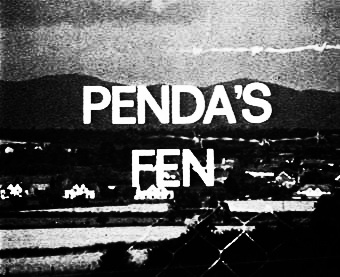
Well, where to start with Penda’s Fen?
There have been are a few films and television series along the pathways of A Year In The Country that have been “How did that happen? How was that allowed onto/into mainstream television and cinema?” moments.
But I expect they all pale somewhat in that sense before Penda’s Fen, created for television by David Rudkin and Alan Clarke.
While The Ash Tree (see Day #188/365), also created by David Rudkin, is an unsettling film, it still exists and can be located within conventional film/horror narratives and genres. The same cannot be said for Penda’s Fen.
This is a film that takes in the revival of ancient pagan kings, hidden underground government facilities (cities?), left-wing truths/ranting/paranoia, substitute Mary Whitehouse-esque self-appointed moral majority figures, awakening sixth form adolescent sexuality, fancying your local milk man, alternative religious histories/theological study, demons, army cadet forces, William Blake’s Jerusalem, the threat and worry of the never stopping industrial conveyor belt, returning dead classical musicians who wish to see the silver river and verdant valleys but who are actually staring at a flaking brick wall, the battle of religion against older gods, a birthday cake, adoption, fertility, almost breaking the fourth wall self-criticism about himself in David Rudkin’s script, angelic riverside visitations, Kenneth Anger-esque phallic firework dreams…
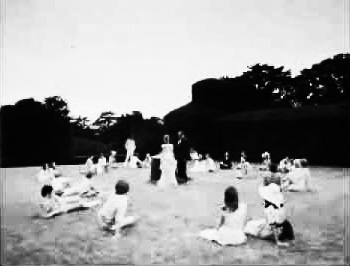 …and that’s just off the top of my head as it were. Oh and I’d forgotten about the voluntary bodily de-appendaging scene that’s a cross between some 1970s swingers get together, an episode of Tales Of The Unexpected, a folkloric gathering in The Wickerman and who knows what else.
It could be a head spinning melange and collage of freakish/cult film making but it’s not. Although in its hour and a half (actually, its first half hour) it manages to have covered more topics than a whole catalogue of other films may do, this is a very cogent and coherent film. It is a film which at its core I think deals with conformity, coming of age and mankind’s sacred covenant with the land. I think.
This is visionary film making (though made for television). Challenging, unique.
With which, 28 sentences, quotes, images, thoughts, from and about Penda’s Fen:
1) “What’s in a name… the devil of a lot or in light of this film, a demon of a lot…”
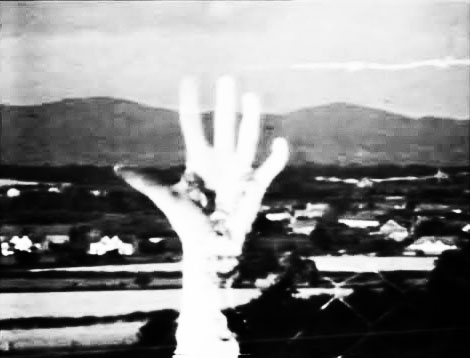
2) Image: bloodied hand grasping barbed wire superimposed over the idyll of the English landscape.
3) “Don’t be silly Stephen.”
4) “Hear the angel and the demon on those hills.”
5) Thought: schoolboy soldiers as England’s last hope.
6) “The house rules that the media are a source of evil to society.”
7) “The manipulators, the fixers, the psychopaths who have real power in the land.”
8) Thought: in the beginning he is a priggish, conservative youth… by the end…

9) Thought: shades of the hidden subterranean subterfuges of Edge of Darkness?
10) “What is it that is hidden beneath this shell of lovely earth? Some hideous angel of technocratic death?”
11) “You can tell he’s not a nice man from his television plays…”
12) “The lonely (lovely?) places technocrats choose for their obscene experiments.”
13) “…you’ll find the sick laboratories built on or beneath these haunted sites.”
14) “Are you interested in the occult?”
15) “Not in the least, I’m a writer, demons of my own.”

16) “Some say the spire of a church acts as an aerial, attracting around it the old elemental forces of light and darkness in combat.”
17) “They believed light is a valuable spark in man, under constant attack from the forces of darkness.”
18) “The public have lost the imaginative strength they had, their sight and will to see what’s really going has been steadily weakened by the entertainment barons for gain, the yes men for craveness.”
19) “We’re not people anymore with eyes to see, we’re blind gaping holes at the end of a production line…”
20) “You hanker suddenly to join your generations underside.”
21) Image: Elgar returned, wheelchair bound in a deserted, derelict building.
22) “When the church, any church goes to war against an older god, it has to call that older god the devil.”
23) Thought: ah, interesting, pagan actually means/is derived from “of the country, of a village.”
24) “Revolt from the monolith… come back to the village.“

25) Thought: the woman from the moral majority crusaders even looks like Mary Whitehouse’s silhouette from a distance as she comes over the hill.
26) “I am nothing pure, my race is mixed, my sex is mixed, light with darkness.”
27) “You have seen your true guardians of England, sick father and mother who would have us children forever.”
28) “Cherish our flame, our dawn shall come.”
Mr Rudkin, a tip of the hat to you sir.

You can read the full text of the above interview here.
 Trails and Influences: Electronic Ether. Case #25/52.
I have wandered why folk music and culture? Why have I been drawn to it and why is A Year In The Country in quite a large part focused on it?
It’s not been a conscious thing but I think as this year-long journey winds it way I’m starting to put together the pieces.
Rob Young, author of Electric Eden, has discussed the connection between such music/culture and utopian impulses and desires and how there is a connection to historic acts of land enclosure/clearance and I think that has played a not considerable part in me being drawn to such things:
“…I think the industrial revolution has much to do with it – beginning around 1760, when a Parliamentary act called ‘Inclosure’ forcibly removed common lands from the folk and scooped them into private ownership. That pushed many agricultural workers towards the new cities and factories where the only remaining employment opportunities lay. This displacement is at the bottom of so much of the British empathy with the countryside, I believe, as so much utopian thought and music here seems to desire to tap into folk memories of an unsullied rural state of mind which now appears like a golden age. Surviving relics from the world before that industrial ‘Fall’ are revered: old buildings, texts, songs, etc, are like talismans to be treasured, as a connective chain to the past.”
Acts of Enclosure? Hmmm, that rings a bell…
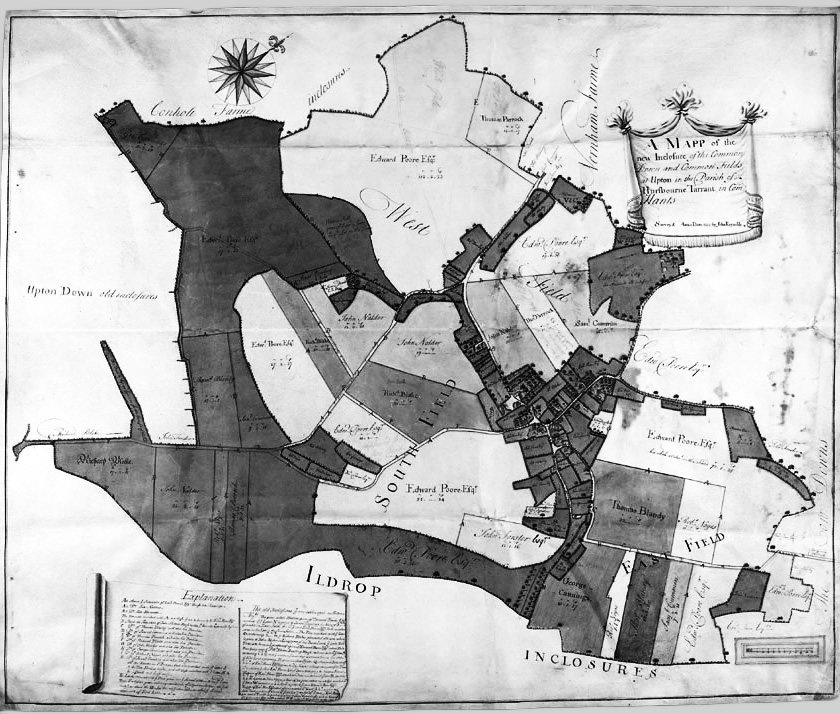
As the years have gone by I have found myself priced out of my own land; the cost of putting a roof over your head (in terms of the ever upward path of rental prices), of keeping the lights on and the wolves from the door seems to quietly, gradually be removing a certain less material wealth directed way of life out of the cities and in particular the city centres of this fair isle.
 If you’re not driven by such counting the gold coins and pieces of silver aims in a particular way then the space needed for the creation of more wayward forms of culture has become a hard(er) path to follow and the resulting pathways have led me away from the hearts of cities and towns. (See also Mark Fisher’s comments on such things via Day #163/365).

Although I think I enjoy living amongst the fields, there is an element of choice being taken away and of things reverting to older forms of wealth/class division; it is a form of social and economic clearing out and exclusion, a removal of access to the clustering and critical mass of population that is sometimes required for cultural forms to develop and take hold.
 In a way this could be considered to be a form of enclosure, the mirror image of that earlier 18th century version: this time it’s non-acts/the ending of acts of Parliamentary regulation which have in part caused it (removing statutory rent control or regulation for example), rather than overt legislation and the “common people” are being removed from the inner cities rather than forced into them.
But as I say this is being done quietly and there seems to be little viable venue or direction for a consideration that maybe a society where a handbag can cost more than a house did but a few years ago is probably not one which… well, doesn’t have it’s head up its ass and in the sand.
(I don’t think that’s a political left/right consideration, that’s just common sense that a society where that is the case without overly demurring about it is one that is out of kilter.)
I think also semi-consciously my removing myself from urban environments has been a side effect of a need to place filters between myself and the overload of culture and input which can occur more easily in such environments (although now of course there are small and not so small boxes of zeros and ones that can offer up over-gorging of such things sat in the corner of all abodes even out amongst the fields)… you rarely see billboards in such parts of the world, the headlines and shiny covers of publications and periodicals can’t catch and enter your eye from every corner… and something I thought about the other day, there’s an interesting lack of surveillance and recording out in country towns compared to their city brethren.

(The battle against the restrictions that the Acts of Enclosure put in place have rumbled forward through history.)
I’m not trying to say that all cities and compact population environments are inherently evil nor that the countryside and country living is all green grassed idyll… nor that pastoral/folk culture is part of some dichotomous good/bad pathway with urban/pop culture…
More just thinking (typing) aloud as I try to connect the dots.
The rhythms and cadences of the music that makes sense beyond your youth and out amongst the fields is different, the stories that folk music, certain areas of hauntology and pastoral/subterannean ambient music tell seem to fit living amongst such lands more… and I know the stories of pop/alternative culture a little too well and they have been told, retold and used too often by the mainstream and non-mainstream media, until for me their stories nolonger carry the meanings and connections they once did.
(I use the word pop in its root Roman sense of populi – and to quote myself quoting Rob Young – to mean culture “derived from centrally controlled, regimented, urban communities which were entertained/appeased/distracted by mass spectacle”; see Day #40/365 for more on such things and wanders amongst the wald.)
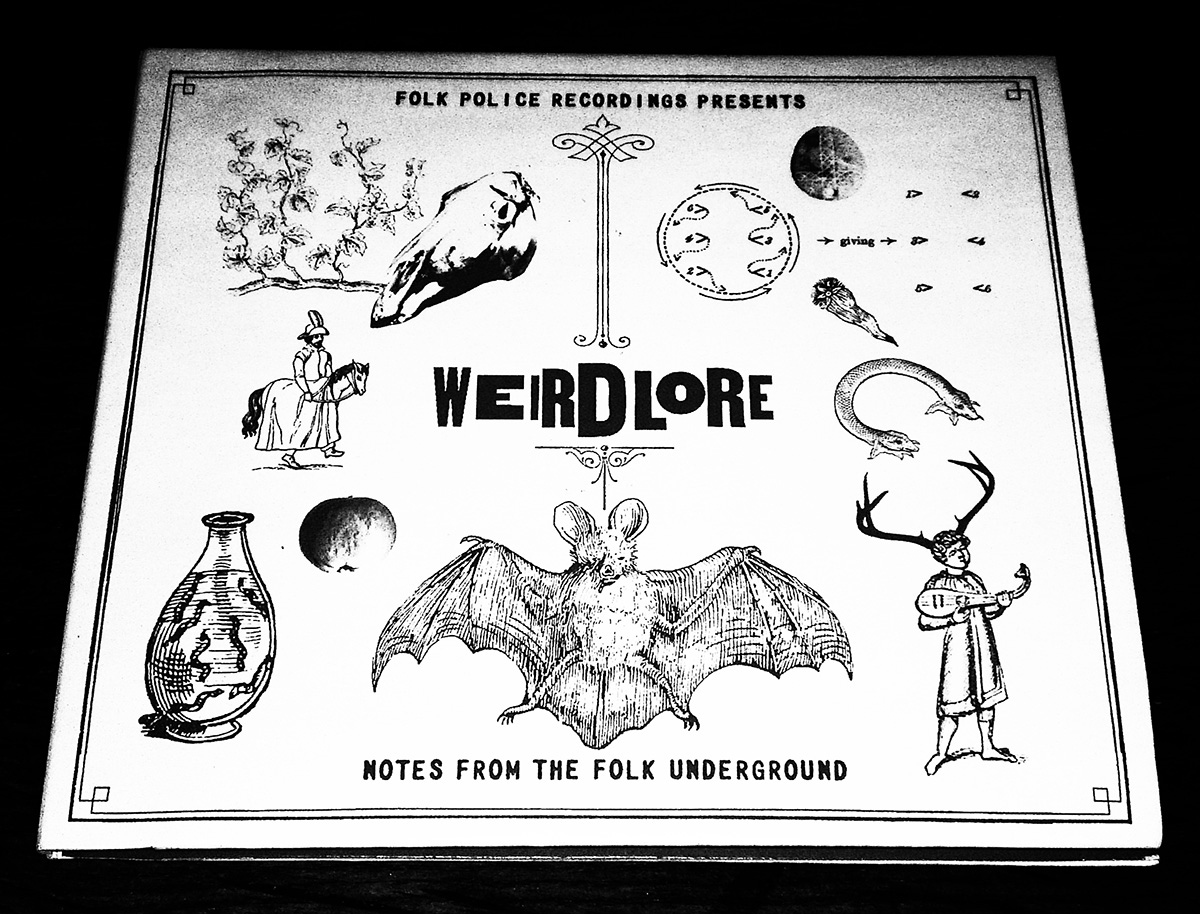 Since the advent and popularity of more urban based pop music/culture, what has been called folk music/culture has only periodically been popular/considered acceptable for wider marketing/consumption (the high summer of folk rock in the late 1960/early-to mid 1970s, the interest in freak folk in the earlier-to-mid 2000s) and as Jeanette Leech says in her introduction to the Weirdlore album:
“…when light is not on a garden, many plants will wither. But others won’t. They will grow in crazy, warped, hardy new strains. It’s time to feed from the soil instead of the sunlight.”
Hmmm. I’ve always tended to think of the direct sunlight of media and mass attention as a double-edged sword for subcultures, often not giving things the space they need to grow and develop fully…
…which brings me back to why folk music/culture; this sense of it being a cultural form which has been left alone, one which has been allowed to gain nourishment from the earth rather than the rays for me means that the space around it feels less regulated (at least in the areas I’ve been searching and researching); there is still some space to move and dream around such things, which may be less so in other areas of culture. You can still walk these “wild woods” a little more freely.
Visit Electric Eden in the pages of A Year In The Country here and here.
Visit Weirdlore around these parts here.
The right to live amongst the common land around these parts here.
William Gibson’s comments on the effects of the direct sunlight of attention, subcultures as places where post-industrial societies go to dream and their premature plucking can be visited via Day #162/365.
Peruse the full interview with Rob Young here and wander along a multitude of pathways here.
The Marks Upon The Land pin badge set. £5.00.


Limited edition of 52 sets.
Each set is hand signed and numbered.
4 x 25mm / 1″ button/pin badges in a see-through pack with printed card header.
Free UK shipping.
Available at our Artifacts Shop and in our Etsy shop.

File under: Trails and Influences. Other Pathways. Case #29/52.
“Your search in Castingham shall be vain, witchfinder.”

I suppose the horrors and monsters under the bed I’ve been drawn to/explore during A Year In The Country have tended to be more man made than supernatural; I suppose this is a view that connects with Ben Wheatley’s consideration of Threads as a horror film and even his own Kill List more concerns the evils of man than those of phantasms and spirits.

“Now we have ye, now we see ye, in your night shape, the night hare.”
Having said which, I seem to keep stumbling across the more ghostly concerned work of M.R. James, largely in televisual form and via the referencing from other practitioners rather than in the leafs and pages of books…
Along which lines, The Ash Tree from 1975.
It was created and prepared for cathode ray transmission by David Rudkin, who for a while seemed to be the go-to chap for otherly Albion-ic television (he was also responsible for Penda’s Fen and Artermis 81); there is something visionary about this small body of work.

“I am confounded…”
In many ways The Ash Tree feels like it could sit quite comfortably amongst the not-so salubrious fare that littered the faded dream palaces of mid seventies Britain, it has that nasty, unsettling feeling to it that a fair few cinematic escapees of the time in this fair isle did, possibly reflecting a wider sense of corruption and malaise in society (a theme that I seem to return to around these parts and more of which in a moment)… Connecting it with such other flickering tales is not to dismiss it, just that, well, it’s not easy viewing.
Having recently rewatched it, I still feel unsettled. I’m kind of mildly surprised that it escaped onto television as it’s a very adult piece of work, one which borders in part on exploitation cinema, albeit with an underlying arthouse intelligence.
I think of it as a film, even though it was made for television and is only just over half an hour long; it feels like a film in compact, condensed form.
…and that from which it is compressed may well be in part Witchfinders General, with which it shares an era and some themes… and it also brings to mind once again the deadly tree games of a certain early-mid 1970s British horror portmanteau film (see Day # 167/365)…

I don’t know if it was just the murky colours of the transfer I watched but this is yester-year, pastoral England most definitely transposed to that aforementioned 1970s dissolution and grime. There is little beauty in this landscape and it’s rolling fields. Bleak is a word that comes and jumps to mind; these are moors and feeding grounds full of judgement, punishment, voyeurism and unexplained carrion.
“What I have seen I have seen…”

Although I won’t enter into details of the plot overly here, suffice to say this is a tale of the hunting, hounding and revenge, of an establishment “vendetta, against women who are better” (to semi-quote The Eccentronic Research Council).
“…an unorthodox guidance…”
Hmmm.

Seek out it’s shiny disc wandering here (tread carefully, this isn’t light and easy viewing) and the Sacred Disobedience of David Rudkin here.
Visit other fields in England at Day #73/365 and Day #78/365.

File under:
A Year In The Country: Work
View more visual work from the A Year In The Country project in the Gallery.

File under:
A Year In The Country: Work
View more visual work from the A Year In The Country project in the Gallery.

File under: Trails and Influences: Recent Explorations. Case #23/52.
 I’m not sure how I came across the work and life of Angus McPhee. It’s been a very recent discovery and I’m still learning and exploring… it’s a difficult subject matter to write about as I want to be as respectful as possible…
It’s astonishing work and a sad and astonishing life story.
Here’s a brief introduction courtesy of the Weaver Of Grass, which was a document of the development and touring of a show about his work:
 “Angus McPhee was from Iochdar, in South Uist, part of the Outer Hebrides, or Western Islands of Scotland. He was a crofter who as a young man went off to war in 1940. Something happened during the next few years and he was invalided home, a changed man, an elective mute. Soon he was transferred to Craig Dunain, a Victorian psychiatric hospital outside of Inverness. There he spent the next 40-odd years. During this period he created extraordinary woven grass objects. These were hardly recognized by the hospital staff, until in the late 1970s the noted art therapist Joyce Laing visited the hospital, looking for examples of ‘Art Brut’, Outsider Art, or ‘Art Extraordinary’. Joyce seized upon the pieces she found in the hospital grounds, and thus fortunately was able to preserve a small part of Angus’s work.” (When Angus had finished one piece he would discard it and start another).
I think I shall let those few words, his once home and the work tell it’s story and speak for itself.


 Some pathways you may wish to wanderdown: encyclopedic ether, history and stories, visual stories, fellow re-weaver, weaving tome, collection, Horse + Bamboo weaving strutters and players.

File under: Trails and Influences: Touchstones. Case #25/52.
Subtitle:
A Triple Bill For One Night Only
Curse Of The Crimson Altar – A queen escapes from beneath…
A Field In England – Box Fantasma reimagining…
The Equestrian Vortex – Released from the ferrous loops…

And in the theme of a curious disconnect between what a film is actually like and how your imagination thinks of it (see Day #181/365 and Day #183/365)…
 There are two versions of The Curse Of The Crimson Altar in my mind; one is the actual film, which is a pleasant enough, fairly mainstream potboiler… and the other version which lives in the basement of the main film, drenched in green light, with a soundtrack by Trish Keenan and James Cargill and where Ms Barbara Steele reigns supreme… in this other version, the sections lorded over by their queen have grown and taken on a life of their own, to become a fully fledged feature that has quietly subsumed that which originally spawned it.
When taking in this film, it does feel like for brief moments it steps down into the basement and into another place, giving just a glimpse of what could have been…
…and I suppose in a way, there’s a connection between such things and the creation of imaginary soundtracks to films that never existed (see Day #167/365).
 Why Trish Keenan and James Cargill?
Well, partly because of this quote from an unedited interview transcript with Ms Keenan:
“I’d like people to enjoy the album as a Hammer horror dream collage where Broadcast play the role of the guest band at the mansion drug party by night, and a science worshipping Eloi possessed by 3/4 rhythms by day, all headed by the Focus Group leader who lays down sonic laws that break through the corrective systems of timing and keys.”
(see Day #33/365)…
…which tends to make me think of Curse Of The Crimson Altar and this other version that I hold in my cultural wishes and dreams list…
…and partly because of them creating the soundtrack for Berberian Sound Studio and it’s film within a film, The Equestrian Vortex… somewhere in my mind and the universe that inner loop of celluloid also exists. I know it must do…
…just as somewhere there is also a version of A Field In England reimagined by Julian House (see Day #73/365).
 And talking of Ms Barbara Steele… although I’m not a huge horror fan, sections of Mark Gatiss A History Of Horror series for the venerable British Broadcasting Corporation have stuck in my head… in particular when he interviews Barbara Steele about Black Sunday; the chap can barely contain himself or his utter excitement at hearing her talk about the phantoms and shock of the film and she fantastically plays up to the part. A fine meeting of your childhood nocturnes…
You can watch that section starting around 20.32 here (careful, careful, this is not for the fainthearted)…
 File under: Trails and Influences: Touchstones.
Case #24/52.
Talking about “curious disconnect(s) between what you think/hope a film/piece of culture will be like and what it actually is like…” (see Day #181/365), some of my favourite pieces of work leading up to and through A Year In The Country have been the introduction and end title sequences to particular cathode ray series produced in this island state around the late 1960s to about 1980.
In these days of instant zero and ones access to knowledge about almost all culture, I find that sometimes I don’t want to know about a piece of culture, sometimes I just want to enjoy and soak it up, to travel with it… or sometimes to not actually watch, say, the series itself but just to let it and what it represents exist in my mind only. Accompanying that, title sequences act as hints or clues to these imaginary, unseen stories…
Sometimes when I do sit down and watch a series, it feels like a separate piece of work to the imaginary version that I think of… or if I saw it when I was younger, this new set of images I’m sat watching bear only a passing resemblance to my stored memories of the series I once watched (along similar lines, a perusal of James Cargill’s considerations of such things is well worth a look-see; more on that at Day #33/365 and here.)

I’m not quite sure why but my interest in such introduction/end title sequences halts at programs recorded around 1980.
Why is that?
In a more easily definable sense its possibly because after around 1980 British fantasy/science fiction television began to try and compete with the slickness and spectacle of cinema blockbusters but it couldn’t and in the process it lost some of its own character or mystery…
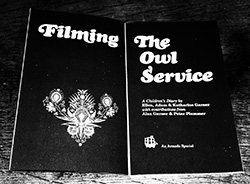
But there’s something not quite definable at play here. Compare the title sequence for the mid-1980s Tripods with that for the late 1960s The Owl Service; the first is part of now, of today, of here, the latter is from then, before and elsewhere.
Trying to work out why such things have become such icons or touchstones of something otherly, of hidden layers and meanings would appear to be quite a large part and parcel of the A Year In The Country journeying…
…in a more abstract sense, possibly it’s because that point in time was a tipping point in society, it’s direction, aims, wants and needs; a move towards more individualistic concerns, accompanied by a move economically, politically and socially towards the right.

Programs made up until that point somehow are imbued with an antideluvian quality, they are now broadcasts or remnants from an “other” time; in many ways, that is one of the defining features of what has become known as hauntology – a collective mourning or melancholia for this time before, these lost futures, this reaching for the stars (in a socially progressive sense).
So, programs made before 1980 were produced before the beginning of the end of the sway of a certain kind of progressive modernism/utopianism thought and ideals, replaced by a monotheistic capitalist/scientific belief system…

…and they are both belief systems; the more a system of thought shouts that it is the only way, that it is logical, rational, right, backed by hard evidence, it’s advocates have a particular prescribed clerical uniform etc (robes become white lab coats?) then… well, I expect it’s not.
The march of history is endless and one day I suspect scientific theories based at their core on matter we can’t see, feel, touch, hear or often definitively proven will be considered in the same way that… well, previous eras forces, spirits, gods and malevolences that couldn’t be seen, touched or proven are often considered now; one way of looking at the world but kind of quaint, not true, belonging to a less sophisticated time and so forth.
This is not to be dismissive of any of such things. They arise when needed and are (in some ways) suitable/useful for their times. Scientific and capitalist beliefs are that now. Sometimes it’s just steam engine time, so they happen:
 “You know steam engine time? Humans have built little toys, steam engines, for thousands of years. The Greeks had them. Lots of different cultures. The Chinese had them. Lots of different cultures used steam to make little metal things spin around. Nobody ever did anything with it. All of a sudden someone in Europe did one out in a garden shed and the industrial revolution happened. That was steam engine time.” William Gibson here.
One day, it may nolonger be steam engine time.
And so, on this page, a selection of remnants from transmissions before the flood.
Children Of The Stones / Sky / Day Of The Triffids / The Omega Factor / Noah’s Castle / The Owl Service / Quatermass.


Thanks to Mark Fisher for helping bring together threads of thought and a cohering of ideas around the sense of lost futures associated with hauntological thinking in his Ghosts Of My Life book (see Day #163/365).
The Reaping Amongst The Stones archival print. £30.00.


Limited edition of 52. Each print is signed and numbered.
59.4cm x 21 cm / 23.4″ x 8.3″ (same width as A2, half the height of A2).
Printed with archival Giclée pigment inks on Hahnemühle Photo Rag 100% cotton paper.
Available at our Artifacts Shop and in our Etsy shop.