Posted on — Leave a comment

The Restless Field – Preorder And Release Dates: Artifact Report #12/52a

The Restless Field-cover art-A Year In The Country

The CDs are now sold out but the album is available to download at our Bandcamp page, Amazon, The Tidal Store, 7digital etc and can be streamed on Spotify, Apple Music, Deezer, YouTube etc.

Release date 2nd May 2017. Pre-order 10th April.

The Restless Field is a study of the land as a place of conflict and protest as well as beauty and escape; an exploration and acknowledgment of the history and possibility of protest, resistance and struggle in the landscape/rural areas, in contrast with more often referred to urban events.

It takes inspiration from flashpoints in history while also interweaving personal and societal myth, memory, the lost and hidden tales of the land.

Audiological contents created by Field Lines Cartographer, Vic Mars, Bare Bones, Assembled Minds, Grey Frequency, Endurance, Listening Center, Pulselovers, Sproatly Smith, Polypores, Depatterning, Time Attendant, A Year In The Country and David Colohan.

References and starting points include: The British Miners Strike of 1984 and the Battle Of Orgreave. Gerrard Winstanley & the Diggers/True Levellers in the 17th century. The first battle of the English Civil War in 1642. The burying of The Rotherwas Ribbon. The Mass Tresspass of Kinder Scout in 1932. Graveney Marsh/the last battle fought on English soil. The Congested Districts Board/the 19th century land war in Ireland. The Battle Of The Beanfield in 1985.

Will be available via our Artifacts Shop and our Bandcamp Ether Victrola.


(File Under: Encasments / Artifacts – Artifact #2a)


Posted on — Leave a comment

Broadcast and The Focus Group – #2: I See, So I See So: Audio Visual Transmission Guide #11/52a

Broadcast and The Focus Group-2-I See, So I See So-4

I recently wrote about Witch Cults, one of the videos which were created by Julian House to accompany the album Broadcast And The Focus Group Investigate Witch Cults Of The Radio Age.

There was another video created at the same time for the song I See, So I See So.

This one is more obviously set in a recognisable real, realist or natural world than Witch Cults, which is more inherently other or occult and in which the normal or actual world and its colours very rarely make an appearance.

However, I See, So I See So is still a view through the looking glass.

What it puts me in mind of is the intros to the likes of The Tomorrow People and possibly The Owl Service or maybe some flipside Camberwick Green-esque animation series intro. It seems to shadow, layer and reflect such things but without being a replication.

At one point a crudely rendered orb flies across the screen, from room to outside a building, out into the country and almost to a child’s hand, which calls to mind an effect from a 1960s/1970s Children’s Film Foundation series of some flying creature, spirit or visiting alien.
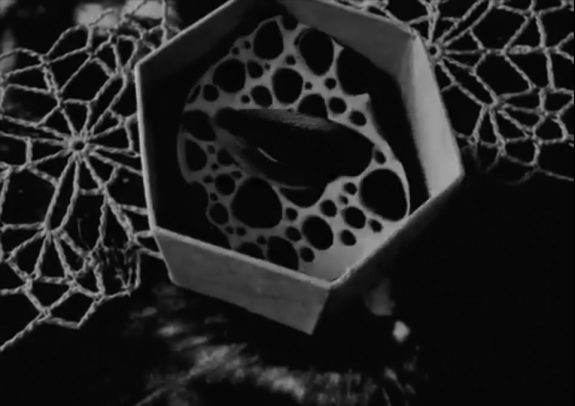
Broadcast and The Focus Group-2-I See So I See So-1

Elsewhere in the video box is filled with objects, shapes, a staring disembodied eye, which also seemed to connect back to a previous era’s children’s television, viewing it as through an avant-garde, experimental film co-op filter.

At various points the video includes variations on Julian House’s signature mandalas and op-art graphics, rapidly changing images and rapidly moving psychedelic lights and patterns.

However, as with the television series intros, the mention of psychedelic is not meant to infer a replication of a previous era’s cultural forms.

Broadcast and The Focus Group-2-I See, So I See So-2

If this is psychedelia then it is more an evolution, a using of such things as a lens through which to view, refract and explore:

“I’m not interested in the bubble poster trip, ‘remember Woodstock’ idea of the sixties. What carries over for me is the idea of psychedelia as a door through to another way of thinking about sound and song. Not a world only reachable by hallucinogens but obtainable by questioning what we think is real and right, by challenging the conventions of form and temper.” (Trish Keenan in an interview with Broadcast by Joseph Stannard, published in Wire magazine issue 308.)

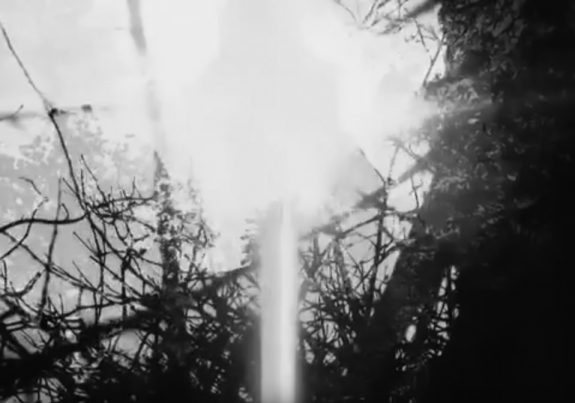
Although I See, So I See So and Witch Cults are two of the more conventional songs on the album, they still contain elements of the collaging and jump cuts that characterise the album as a whole.

The video for I See, So I See So in particular seems to be a visual reflection of that and the associated collage techniques.
Broadcast and The Focus Group-2-I See, So I See So-3

This, along with Trish Keenan’s comments about challenging conventions of form and temper puts me in mind of two quotes regarding such things that I have included in A Year In The Country once before:

“House is a fan of the inadvertent avant-gardness of ‘bad’ or ‘clunky’ design, as seen in Polish movie posters of library music sleeves. He intentionally achieves similar effects through “bad looping, looped samples that change their start and end points. With visual collage there’s a way in which images that are cut out ‘badly’, maybe with bits of their background or surrounding image, make it difficult to discern where on part of the collage begins and another ends. This trompe l’oeil effect (a visual illusion) brings you deeper into the collage, confuses your ability to discern images as surface”…” (From Simon Reynolds article Haunted Audio, published in Wire magazine issue 273.)

Broadcast and The Focus Group-2-I See, So I See So-5

“…assembled using a sampling method which makes a virtue of its imperfection. House (Julian of Ghostbox Records/The Focus Group) evidently delights in the inexact fit, the abrupt cut, and for the most part, the rhythms on Witch Cults are irregular, giddily tripping over themselves and each other. In drawing attention to the awkwardness of each edit, House does not demystify the art of sampling so much as emphasise its position at the intersection of magic and science…” (Written by Joseph Stannard as part of the above interview in Wire magazine issue 308.)

(File Under: Cathode Ray & Cinematic Explorations, Radiowave Resonations & Audiological Investigations)

AVT Guide listing: Broadcast and The Focus Group – #2: I See, So I See So


Posted on — Leave a comment

Ancient Lands And A Very Particular Atmosphere From Back When: Wanderings #11/52a

day-8-anthony-burton-wilderness-britain-jorge-lewinski-book-1985-a-year-in-the-country

I feel that “say no more” might be appropriate at this point…

…but…

For a while now when I find myself in those reasonably-rare-nowadays places, bricks and mortar second hand bookshops, I will take myself off to browse the section/s called something like Topography, Landscape or maybe Nature for largely photography based books that capture a particular kind of mood or atmosphere.

What that atmosphere is I find hard to quite be able to put my finger on but the books often seem to be from the 1970s, to have a quietly haunted atmosphere, a certain kind of dour British representation of the landscape (and I don’t use dour here in a negative sense, it’s more in a, hmmm, expressively subdued manner).

Maybe a certain sense of loss or melancholia but not in a purely hankering after the past and stasis manner.

The Right Side Of The Hedge-Country Life Today-Chris Chapman-Ian Niall-A Year In The CountryI think one of the first of such books I bought along such lines was probably The Right Side Of The Hedge by Chris Chapman or possibly, when I was heading in the general direction of such things, Vanishing Britain by Roy Christian (both of which are from 1977).

Such books and work aren’t deliberately hauntological, the idea and phrase had not yet been created, it’s rather that with the passing of time they seem to contain within them an often quite subtle left-of-centre sense of the land, its layers, marks and spirit.

As I say, it’s hard to quite define but I know it when I see it (and sometimes it can be just in one or two photographs in a book rather than the whole thing).

Bollocks To Alton Towers-Uncommonly British Days Out-Robin Halstead-Jason Hazeley-Alex Morris-Joel Morris-A Year In The Country-covermonumental-folies-stuart-barton-book-1972-a-year-in-the-country-1

One of the books along these lines that I’ve mentioned before is Monumental Follies, which I was pointed towards by Jason Hazeley, author of  B* To Alton Towers and the modern day humorous reinterpretings of Ladybird books that the nation seems to have taken to their hearts and homes in fairly large quantities.

Monumental Follies and other similar books seem to step aside from the more chocolate box, rose tinted view of such things; there is a sense in the photographs they contain that maybe the weather was fairly permanently under an overcast, grey 1970s sky that was forever about to ruin family days out.

(The image that starts this particular wandering is from Anthony Burton and Jorge Lewinski’s Wilderness Britain book. Published in 1985, just to break the mould a little.)


(File under: Trails and Influences / Year 3 Wanderings)

Intertwined wanderings around these parts:
Week #4/52: The Following Of Ghosts – File Under Psychogeographic / Hauntological Stocking Fillers
(Wherein I consider Mr Hazeley and fellow writers/journeyers B* To Alton Towers… which if I was writing this post in thirty or so years time I expect may well be included in with such books as the above due to an understated melancholy and sense of loss  which can be found amongst its pages.)

Week #5/52: The Right Side Of The Hedge – gardens where (should we?) feel secure and velocipede enhanced long arms…

Week #50/52: Monumental Follies – An Exposition On The Eccentric Edifices Of Britain (to give the book its full title)


Posted on — Leave a comment

A Small But Dedicated Growing Library Of Albionic Undercurrents & Folk Horror: Ether Signposts #11/52a

Folk and folk horror books-Seasons They Change-Electric Eden-Witches Hats-Field Studies-Adam Scovell-b

When I first started researching what would become A Year In The Country there were only two contemporary books that I knew of which explored the undercurrents and flipside of folk and related/interconnected culture.

They were Rob Young’s Electric Eden: Unearthing Britain’s Visionary Music and Jeanette Leech’s Seasons They Change: The Story of Acid and Psychedelic Folk, published in 2011 and 2010 respectively.

Seasons They Change-acid psych folk-Jeanette Leech-Electric Eden-Rob Young

“…a sweeping panorama of Albion’s soundscape… (Electric Eden) investigates how the idea of folk has been handed down and transformed by successive generations – song collectors, composers, folk-rockers, psychedelic voyagers, free festival-goers, experimental pop stars and electronic innovators.”

“In the late 60s and early 70s the inherent weirdness of folk met switched-on psychedelic rock and gave birth to new, strange forms of acoustic-based avant garde music… Seasons They Change tells the story of the birth, death and resurrection of acid and psych folk. It explores the careers of the original wave of artists and their contemporary equivalents, finding connections between both periods, and uncovering a previously hidden narrative of musical adventure.”

Witches Hats & Painted Chariots bookWhile there still aren’t a huge number of such books, there is a small, growing library of such things and so I thought it would be a good thing to bring together some of them.

So, alongside the two above books I would also probably include as a companion work to Seasons They Change:

Witches Hats & Painted Chariots: The Incredible String Band and the 5,000 Layers of Psychedelic Folk Music by Jon ‘Mojo’ Mills and Andy Morten. This was published in conjunction with Shindig magazine, of which the authors are the editors and it also features the likes of Dr Strangely Strange, Comus, Heron, COB and Forest.

More specifically along the lines of folk horror there have been two books published in the last couple of years:Folk Horror Revival Field Studies-Adam Scovell-b

Folk Horror: Hours Dreadful and Things Strange by Adam Scovell, the descriptive text for which begins with:

“What exactly is Folk Horror? Is it the writing of M.R. James and Alan Garner? Is it the television scripts of Nigel Kneale, John Bowen and David Rudkin, the films of David Gladwell and The Blood On Satan s Claw? Or could it be the paranoid Public Information Films of the 1970s; the Season Of The Witch ; The Advisory Circle reminding us to Mind how you go?”

Folk Horror Revival: Field Studies which is an anthology collection of essays that explores various areas of folk horror related work by a number of different writers including Kim Newman, Robin Hardy, Thomas Ligotti, Philip Pullman, Gary Lachman, John Coulthart, Grey Malkin (The Hare And The Moon), Sharron Kraus, Andy Paciorek and Chris Lambert.

Not yet quite enough to fill out a library shelf but possibly enough to warrant its own section and shelf marker.

(File under: Other Pathway Pointers And Markers)

Destinations and directions:
Electric Eden
Seasons They Change
Witches Hats & Painted Chariots
Folk Horror: Hours Dreadful and Things Strange
Folk Horror Revival: Field Studies


Posted on — Leave a comment

The Marks Upon The Land And Fellow Travellers; Broadcasts And Reviews: Artifact Report #11/52a

The Golden Apples Of The Sun Radio Show-The Marks Upon The Land-A Year In The Country

Tracks from The Dark Chamber EP and Airwaves: Songs From The Sentinels that accompany The Marks Upon The Land book can be found amongst some rather fine company at The Golden Apples Of The Sun Radio Show, which is always worth a wander around. This particular episode is…

“…hosted by Claude Mono. It commences with a soundscape from Under The Skin, the unsettling sci-fi film that creates a strange brooding dystopian landscape within contemporary Glasgow and its surrounds. More soundscapes from A Year In The Country, Broadcast, Pram, The Dandelion Set, Stereolab and space-psych from Our Solar System… immersive listening…”

Visit The Golden Apples Of The Sun here.

John Coulthart-Feuilleton-A-Year-In-The-Country“The Marks Upon The Land… converts the bucolically familiar into something more eerie or even sinister, a series of widescreen mutations that create pareidolia spectres through symmetry and layering. Seen in isolation, these images are arresting enough but they gain power by being collected together, fashioning a statement of intent.”
John Coulthart at his Feuilleton site.

“Airwaves: Songs From The Sentinels (is an) aural exploration of what it must sound like to rise above the earth, and hear everything that is going on beyond the range of hearing.  Snatches of radio percolate around the slowly shifting themes, mysterious crackles and sudden sideslips, a symphony in which nothing happens, but an awful lot takes place.”
Dave Thompson at Spincycle / Goldmine Magazine.

Crooked Button Radio Show

There were also tracks played on The Crooked Button Radio Show / NearFM on the 19th of February 2017… but as far as I know that particular edition of the show isn’t archived and the broadcast has wandered off amongst the literal airwaves, possibly making its way out into the cosmos about now. Visit The Crooked Button here.

Tip of the hat to all concerned.


More details on The Marks Upon The Land and fellow travellers can be found here.

Preview clips from The Dark Chamber EP here and Airwaves: Songs From The Sentinels here.


(File Under: Encasments / Artifacts)


Posted on — Leave a comment

Beyond The Black Rainbow Soundtrack Clips: Audio Visual Transmission Guide #10/52a

Beyond The Black Rainbow-still-1b

Further and ongoing considerations of Panos Cosmatos 2010 film Beyond The Black Rainbow…

A brief précis of the plot:

The film centres around the Aboria Institute, a new age research facility founded in the 1960s by Dr Arboria and dedicated to finding a reconciliation between science and spirituality, allowing humans to move into a new age of perpetual happiness.

In the 1980s his work was taken over by his protégé Dr Barry Nyle who despite outward appearances of charm and normality is actually mentally unstable and has thoroughly corrupted the Institute and its aims.

Beyond The Black Rainbow-still-3b

He spends his time trying to understand the preternatural psychic abilities of a young woman under his care, nominally as part of a therapeutic process but in fact he has imprisoned her in a state of heavy sedation in a hidden quasi-futuristic facility underneath the institute.

The soundtrack to the film is an analog synthesizer score by Jeremy Schmidt (also of Sinoia Caves and Black Mountain), which I have written about before and revisit/expand on below:

If the film could be a rediscovered and refracted Cronenberg project from a parallel world, the music could well be what my minds tends to imagine a Tangerine Dream soundtrack from that world would sound like.

I Am The Center-Private Issue New Age Music In America 1950-1990-Light In The Attic-A Year In The Country

The music that accompanies the film puts me in mind of the further reaches and undercurrents of what has been loosely labelled new age music, including some of the work that can be found on the compilation I Am The Center: Private Issue New Age In America – 1950-1990 (released in 2013 by Light In The Attic) such as Wilburn Burchette’s Witch’s Will and its creation of an atmosphere that is restful, draws you in and yet is also portentous and unsettling.

Beyond The Black Rainbow-still-2b copy

Connected to this, one of the themes of the film seems to be the corrupting of new age principles (as referred to earlier when mentioning the activities of Dr Barry Nyle at the Arboria Institute); it presents a world where there has been a curdling or perverting of philosophies of empowerment and enlightenment from when the Institute was founded in the 1960s.

More so than the official soundtrack release, it is the soundtrack clips from the film that can be found online that I am particularly drawn to, their inclusion of elements of the dialogue and effects etc adding to and connecting with the atmosphere and world the film creates.

With their accompanying video clips they also act as an overview and distilling of that world and the aesthetics of the film.

(File Under: Cathode Ray & Cinematic Explorations, Radiowave Resonations & Audiological Investigations)

AVT Guide listing:
Beyond The Black Rainbow soundtrack clips


Posted on — Leave a comment

From the Forests, Fields and Furrows: A Folk Horor Introduction by Andy Paciorek / Where To Begin by Adam Scovell: Ether Signposts #10/52a

Folk Horror Revival website logo

I recently wrote about Folk Horror Revival and the growing in interest in folk horror.

If you should be curious for a definition of this loose cultural grouping then I would recommend Andy Paciorek’s article From the Forests, Fields and Furrows: An Introduction, which can be found at the Folk Horror Revival site.

In it he talks about where the phrase is thought to have first been used/popularised and gives a broad overview of folk horror.

However, when I say definition, one overarching exact description is a difficult thing to achieve, as he says in his article:

“…one may as well attempt to build a box the exact shape of mist; for like the mist, Folk Horror is atmospheric and sinuous. It can creep from and into different territories yet leave no universal defining mark of its exact form.”

A Fiend In The Furrows-A Year In The Country

A particular point of interest in the article is when he talks about Folk Horror book author Adam Scovell’s describing a chain of elements that comprise a folk horror film, which he spoke about at a paper written for the Fiend In The Furrorws conference on folk horror which was held at Queen’s University Belfast in September 2014.

This chain of elements includes: Landscape, Isolation, Skewed Moral Beliefs, Happening/Summoning.

Andy Paciorek goes on to put forward his thoughts in relation to these, which I briefly excerpt from below:

“Landscape: Some consider that the setting should be rural for the film to be ‘Folk’, but I think a broader view may be considered. The tradition of the horror may indeed have rustic roots and pastoral locations may provide the setting for many of the stronger examples, but people carry their lore and fears with them on their travels and sometimes into a built-up environment.”

The Wicker Man-Hessian Bag Edition-A Year In The Country 2

“Isolation and Skewed Moral Beliefs: In these instances, ‘Isolation’ does not refer to being entirely alone but may refer to characters such as Sergeant Howie in The Wicker Man finding themselves alone within a group whose moral beliefs and practices are utterly alien to their own.”

“Happening / Summoning: The Happening/Summoning that falls close to the conclusion of such films may involve a supernatural element such as an invocation of a demon, or it may be an entirely earthly (though no less horrific) event such as an act of violence or a ritual sacrifice.”

The article is well worth a read as an overview of folk horror, one that is both wide reaching and inclusive, while also giving its “box the exact shape of mist” an overall shape, form and parameters.

The article includes reference to a considerable number of films and television dramas. However if the considerable number of these induces a sense of “Where do I start?” then accompanying the article with a perusal of Adam Scovell’s “Where to begin with folk horror” that he wrote for the BFI’s website may prove just the ticket as it is a concise collection and consideration of some of the key touchstones in such work.

(File under: Other Pathway Pointers And Markers)

Destinations and directions:
From the Forests, Fields and Furrows: A Folk Horor Introduction by Andy Paciorek
Where to begin with folk horror by Adam Scovell


Posted on — Leave a comment

The Marks Upon The Land / The Dark Chamber EP book, CD & cassette released: Artifact Report #10a/52a

The CD is now sold out but is available to download at our Bandcamp page.

The book is available at Amazon UK, Amazon US,  Amazon Australia and their other worldwide sites.

Available at our Artifacts Shop and our Bandcamp Ether Victrola.
£24.95. Free UK shipping. Released today 6th March 2017.

The book is accompanied by a 4-track audiological exploration on CD:
The Dark Chamber EP by A Year In The Country.

Also included is a free cassette and download copy of the Airwaves: Songs From The Sentinels 12 track album by A Year In The Country.

There is also a standalone version of the book available without the CDs, cassette & download at various Amazon UK and international sites, including: UK, USA, France, Germany, Spain etc.

Plus the standalone book is also available from Createspace (where it ships from the US).

Encasement details:
60 page bound softback book: 8.25 x 6 inches / 21 x 15 cm, matt velvet cover.
1 x all black CDr
2 x inserts
1 x cassette album in jewel case with 2 x inserts and download code.

The images in the book are part of A Year In The Country’s explorations of an otherly pastoralism, a wandering amongst subculture that draws from the undergrowth of the land – the patterns beneath the plough, pylons and amongst the edgelands.

Those wanderings take in the beauty and escape of rural pastures, intertwined with a search for expressions of an underlying unsettledness to the bucolic countryside dream.

The Marks Upon The Land takes inspiration from and channels the outer reaches of folk culture and its meeting places with the layered spectralities of what has come to be known as hauntology, alongside memories of childhood countryside idylls spent under the shadow of Cold War end of days paranoia and amongst the dreamscapes of dystopic science fiction tales.

The Dark Chamber EP takes its name from the roots of the word camera and is an audio exploration of the creation of the imagery in the book, intermingling field recordings of photographic work with the sounds of the landscape.

Airwaves: Songs From The Sentinels is a study of the hidden tales sent out into the world by the silent but ever chattering broadcast towers that stand watch atop the land, weaving and recasting their transmissions and seeming to summon unbidden the ghosts and fractures of a landscape that still contains the echoes and fragments of conflicts past and planned for.

“…interference, plain piano song, shimmering electronics, remote listening & shadowy melodies make for an elegant & sinister experience.” Include Me Out on Airwaves: Songs From The Sentinels.

The Dark Chamber EP-The Marks Upon The Land-A Year In The Country

Audiological exploration details:

The Dark Chamber EP by A Year In The Country: 5″ all black CDr;
1)The Dark Chamber
2) Towards The Heartland
3) Layers And Marks
4) The Dark Chamber (Waiting For A Moment Of Stillness Mix)

Preview clips from the EP here.

Airwaves-Songs From The Sentinels-cassette-The Marks Upon The Land-A Year In The Country

Airwaves: Songs From The Sentinels by A Year In The Country: cassette/download;
1) The Chatter Amongst The Land
2) A Cracked Sky
3) Night Mesh
4) Flutter Once More
5) Fading From A Distance
6) Imparting Received
7) Songs From The Sentinels
8) Tales And Constructs
9) They Have Departed Once More
10) To Be Sheltered
11) A Measuring
12) For My Gentle Scattering

Preview the album  here.


Artwork and packaging/book design by AYITC Ocular Signals Department.

All 104 images from the book can be viewed at Gallery: Year 1.


(File Under: Encasments / Artifacts)


Posted on — Leave a comment

Beyond The Black Rainbow and Phase IV: Audio Visual Transmission Guide #9/52a

Beyond The Black Rainbow-still-1

A number of years after first watching it and writing about it at A Year In The Country, I still find that the 2010 film Beyond The Black Rainbow completely intrigues me and draws me into the world it creates.

Panos Cosmatos, its director, has spoken about how Phase IV was one of the major influences on his film, saying that:

“There is a sub-genre of what I call “trance film,” and I really wanted this film to fall into the trance or dream genre without it being specifically a dream. I wanted it to feel like a lucid dream state. The whole time you are probing forward, deeper and deeper into an unknown world.”

Beyond The Black Rainbow-A Year In The Country 3

He includes Phase IV within this sub-genre of trance film, with which Beyond The Black Rainbow shares a deliberate, still or slow almost hypnotic pace.

It also uses a rich, sensuous colour scheme and accompanying geometric design, structures and architecture in the creation of its hidden world, which links with the underground insect sequences and the mirrored research facility and reflective structures that the ants build in Phase IV.

Phase-IV-Saul-Bellow-A-Year-In-The-Country-2b

The lines of connection and inspiration between Phase IV and Beyond The Black Rainbow are not a direct transference and replication, rather, as also said by the director it is in an “abstracted, vaguely recognizable way”.

Phase-IV-Saul-Bellow-A-Year-In-The-Country-6

This sense of non-replication can be linked to the representations of the 1980s when the film is set, which do not create a detail perfect simulacra but rather a reflection of that time which has been somewhat aptly evocatively described as “a Reagan era fever dream”.

(File Under: Cathode Ray & Cinematic Explorations, Radiowave Resonations & Audiological Investigations)

AVT Guide listing:
Beyond The Black Rainbow trailer
Phase IV trailer


Posted on — Leave a comment

Folk Horror Revival And A Rising From The Furrows: Ether Signposts #9/52a

Folk Horror Revival logo-2

Back when I first started the research and cultural wanderings that would become A Year In The Country, only a few to five or six years ago, folk horror as a phrase and genre still seemed to be quite a niche and relatively esoteric term and area of culture.

Yes, The Wickerman had grown increasingly renowned but aside from that, it was still an area of culture that you needed to seek out in the nooks, corners and crannies of things. The Folk Horror Review website/blog, now sadly gone, that I used to visit and seek out such culture via and which I have written about at A Year In The Country, felt like a quiet, relatively unknown corner of the internet back when.

Move forward to 2016 and 2017 and while it is not exactly thoroughly mainstream, it has risen out of the furrows somewhat and this once niche woodland is now quite a sizeable forest.

One particular reflection of this is the online growth in popularity of Folk Horror Revival, whose Facebook page and group between them number followers and likes in the multiple and tens of thousands.

A further example of this growth in popularity and stepping overground is the Folk Horror Revival event that was held at the British Museum in October 2016, tickets for which sold out somewhat quickly.

Folk Horror Revival logo-1-stroke

The event featured something of a smorgasbord of talks, lectures, short films, poetry readings, museum tours etc, with organisers and participants including Gary Lachman, Iain Sinclair, Bob Beagrie, Michael Somerset & The Consumptives, Eamon Byers, Adam Scovell, Gary Parsons, Yvonne Salmon, Andy Paciorek, James Riley, Darren Charles, Lee Gerrard-Barlow, with Chris Lambert of the Black Meadows project compering and organised in part by Jim Peters…

If you should not know, the British Museum is the leading visitor/tourist destination in the UK, in terms of number of people who visit it per year, with very nearly 7 million visits in 2015.

So, hardly an overlooked, hidden away, niche cultural institution for such an event to be held.

In other related statistics, when I typed folk horror into a search engine it came back with over 18 million results.

Curious and intriguing times indeed. Most definitely a rising from the furrows.

(File under: Other Pathway Pointers And Markers)

Destinations and directions:
Folk Horror Revival’s Facebook page
Folk Horror Revival’s Facebook group
Folk Horror Revival at the British Museum


Posted on — Leave a comment

At Home With Include Me Out: Artifact Report #9/52a

Include Me Out-Robin Tomens-The Quietened Village-A Year In The Country

Over the months I’ve enjoyed seeing/reading Include Me Out’s writing and photographing about various A Year In The Country releases. Some of them have been mentioned around these parts before and below is a gathering of them and more…

Airwaves-Songs From The Sentinels cover-A Year In The Country“…spectral sounds made for wandering the moors… interference, plain piano song, shimmering electronics, remote listening & shadowy melodies make for an elegant & sinister experience.” On Airwaves: Songs From The Sentinels

I’ve particularly enjoyed the “at home” studies of the albums…

The Quietened Village LP-Include Me Out
The Quietened Village

Fractures-A Year In The Country“Polypores’ The Perfect Place For An Accident which, after 5mins of throbbing wave forms takes a nice slow dive into beatless disorientation…” On Fractures

And then, as a respite from the audio intrusions of property developers…

BC-Bunker-Dawn and Duskfall-cover“A more welcome noise has been this release… Grey Frequency’s Drakelow Tunnels is a stand out piece of work regarding atmospherics and Unknown Heretic’s Crush Depth in contrast renders the air heavy with mechanic industrialism… the inclusion of Time Attendant once again is a reason to be cheerful as he displays an ability to organise sound above and beyond what most others a capable of doing. The track title, Crafty Mechanics, is a fitting description of the comp as a whole.” On The Quietened Bunker

The releases are also in rather fine company at Include Me Out’s 2016 Music Of The Year, alongside the likes of Autechre, John Cage, Demdike Stare, David Toop, The Pop Group, eMMplekz and Heliocentrics. Visit that here.

A tip of the hat to the gent concerned.

Include Me Out is a good place to spend an hour or two wandering around and is described as being…

“… about anything that I find interesting, such as music of of all kinds (but lots of electronic sound both new and old), graphic art, literature, book covers and illustrations from books in my collection, images generally, cinema, and my own work in both word & image… There are album and book reviews, along with what I’ve labelled ‘Musings’, my thoughts on various matters relating to culture… Include Me Out is multi-faceted as opposed to strictly niche, therefore anything could appear.”

A particular favourite is the post on The Hardy Annual from the Watford School Of Art in 1969, which when reading it tends to bring on a general sense of “I want one”.
Find Include Me Out in the ether here and the interrelated Out Of My Mind here.
(File Under: Encasments / Artifacts)
Posted on — Leave a comment

Bruton Music Flexi – Steens Dilemma (via James Cargill): Audio Visual Transmission Guide #8/52a

Bruton Music Flexi-Steens Dilemma-via James Cargill

On James Cargill’s (of Broadcast and Children Of Alice) Soundcloud page there are a few Broacast related rarities, mix tapes, demo versions of songs etc.

One of my favourite items is the Bruton Music Flexi – Steens Dilemma.

This is (I assume) a promotional item made for/by the Bruton Music library music company.

It is a classic slice of period culture, depicting a rep from Bruton using his company’s catalogue and index book to find and supply music his client needs in a rush, politely geezer-ishly castigating him by saying he wouldn’t be caught in this last-minute dilemma if he just had Bruton’s library catalogue always to hand:

“Back in the office I grabbed the music selection code book. With it’s help I would have Steed’s material in no time. The code catalogue had been well thought out. Not only did it run in an alphabetical order, depicting each class of music but each letter had a colour which matched the corresponding record sleeves of that particular section. By this simple book I could find any style and mood of music in the library within seconds. I looked down the colour coded index on the side of the book… the job would be done in no time… Good pacey, that’s what he’ll want…”

It’s a time capsule of a previous era. Or maybe that should be an imaginative time machine, such is the way that it captures and conjures up a a particular time and way of doing things.

(File Under: Cathode Ray & Cinematic Explorations, Radiowave Resonations & Audiological Investigations)

AVT Guide listing: Bruton Music Flexi – Steens Dilemma (via James Cargill)


Posted on — Leave a comment

Build Your Own Brutalist Eastern Bloc: Ether Signposts #8/52a

Brutal East-Build Your Own Brutalist Eastern Bloc-Zupagrafika-1Brutal East-Build Your Own Brutalist Eastern Bloc-Zupagrafika-2

In something of an ongoing mini-theme around these parts of cut out and build your own models of London brutalist architecture, ready off the shelf Delian Derbyshire dioramas and Midwich bunting…

…Zupagrafika’s Brutal East – Build Your Own Brutalist Eastern Bloc book…

Brutal East-Build Your Own Brutalist Eastern Bloc-Zupagrafika-3

The accompanying text says:

“Brutal East by Zupagrafika is a kit of illustrated paper cut-out models celebrating post-war architecture of Central and Eastern Europe that allows you to playfully explore and reconstruct some of the most controversial edifices erected behind the Iron Curtain. Contains 7 brutalist buildings to assemble, from omnipresent pre-cast housing estates to mighty post-soviet landmarks awaiting renovation or threatened by demolition.”

Well, that’s my interest piqued and online shopping intentions poised and ready.

Brutal East-Build Your Own Brutalist Eastern Bloc-Zupagrafika-5Brutal East-Build Your Own Brutalist Eastern Bloc-Zupagrafika-6

At A Year In The Country I have visited Soviet era folk artifacts and discarded or derelict infrastructure a number of time and have commented on how the sense of lost futures that they can contain could be considered a variation on the normally British/European orientated interests of hauntology.

Brutal East may well fit alongside and amongst such things, as well as being a companion piece to Zupagrafika’s Brutal London cut out and build book.

Brutal East-Build Your Own Brutalist Eastern Bloc-Zupagrafika-4

(File under: Other Pathway Pointers And Markers)

Destinations and directions: Brutal East


Posted on — Leave a comment

Feuilleton Wanderings: Artifact Report #8/52a

Feuilleton-John Coulthart-Fractures-A Year In The Country-1px stroke

John Coulthart has written and posted about A Year In The Country releases and wanderings a number of times at his Feuilleton site, often gathered amongst other interlinked work and/or wider cultural explorations.

The Quietened Village-Fractures-The Quietened Bunker-The Forest The Wald-A Year In The Country

We’ve mentioned some of them before but thought it would be good to bring them together, along with a few new-to-these-parts links and signpostings:

The Quietened Village in the company of Ghost Box Record’s Belbury Poly, David Toop’s cassette archiving, Hawkwind via James Last…

Fractures: wherein various interwoven strands of the Play For Today such as Penda’s Fen and The Land Of Green Ginger wander alongside very personal recollections.

The Quietened Bunker: Something of a favourite for its cultural gathering and considering of the likes of Edge Of Darkness & Wargames and in particular the end note of “The Cold War bunker is more than another empty space, it joins the bio-weapons lab as a source of contemporary horror that doesn’t require any supernatural component to chill the blood.”

The Forest/The Wald: Another fine end note; “…a response to British folk traditions that acknowledges the history without seeming beholden to it.”

Day 162-Hauntology-A Year In The Country

One particular feature of Feuilleton are the Weekend Links, which generally are brief signposts to Mr Coulthart’s “interests, obsessions and passing enthusiams”.

Below are a few of the A Year In The Country related Weekend Links (you may well be there or wandering down resulting pathways a fair old while if you head that way):

212 – Hauntology and the deletion of spectres / 220 – signposting / 225 – Broadcast, constellators and artifacts / 234 – Further considerations of Penda’s Fen / 240 – The end of a first spin-around-the-sun / 290 – The commencing of a second spin-around-the-sun / 328 – No More Unto The Dance / 334 – Bubble life out in the country via The Touchables / 335 – Professor Quatermass / 340 – Monumental Follies

Tip of the hat to him indeed.

0009017913_41John Coulthart has a longstanding and rather substantial history of working amongst the undercurrents of culture, particularly via his art and design work. A brief overview of such things can be found here.


(File Under: Encasments / Artifacts)


Posted on — Leave a comment

Curse Of The Crimson Altar – Super 8 Version: Audio Visual Transmission Guide #7/52a

Curse Of The Crimson Altar-Super 8 version

Back in the first year of A Year In The Country I wrote about 1968’s The Curse Of The Crimson Altar that there were two versions of the film in my mind:

“…one is the actual film, which is a pleasant enough, fairly mainstream potboiler… and the other version which lives in the basement of the main film, drenched in green light, with a soundtrack by Trish Keenan and James Cargill and where Ms Barbara Steele reigns supreme… in this other version, the sections lorded over by their queen have grown and taken on a life of their own, to become a fully fledged feature that has quietly subsumed that which originally spawned it.”

Barbara Steele-Curse Of The Crimson Altar-A Year In The Country 19

(That is expressed in the accompanying commentary on the DVD/Bluray release with David Del Valle and Barbara Steele who plays the Black Witch Lavinia, when one of them says that the subterranean sections of the film featuring her are what people really want to see.)

I rewatched it not so long ago on the 2014 high definition brush and scrub up restored Bluray version and though I still think it is something of a quite conventional, potboiler-esque with various “groovy” sixties and/or occult exploitation film sections, it sort of grew on me. I have a certain fondness for it and the way it seems to mix elements of mainstream cinema almost from a previous, more stilted period of British cinema and the more permissive/transgressive elements.

It feels like a transitional or bridging point in British cinema and culture, one that draws from a more censored past, contains elements of 1960s hipness from the time of its making and seem to point towards the more louche or even seedy elements of 1970s culture.

The film also contains a fair few of the themes and tropes of folk horror and while not considered part of the “classic” cannon of such things, could also be seen as a forebear to British cinemas explorations of such things in the early 1970s.

Barbara Steele-Curse Of The Crimson Altar-A Year In The Country 16

Anyways, talking of different versions, I recently came across the Super 8 version of the film online.

If you should not know these were edited versions of films that were sold for home viewing using projects, prior to the days of video recorders.

Curse of The Crimson Altar-for one night only

And when I say edited I mean very edited: the original 87 minute running time is cut down to 8 minutes and 42 seconds.

Watching it now, because of the colour and characteristics of the medium it seems to belong to an era far further back than 1968 and although it features sound (which I don’t think all the Super 8 versions did) it seems to belong nearer to the melodrama and obvious plot signposting of the silent film era.

(Apart from the top title credit image, the images in this post are from the full length film – not surprisingly the Super 8 version cuts the subterranean sections somewhat.)

(File Under: Cathode Ray & Cinematic Explorations, Radiowave Resonations & Audiological Investigations)

AVT Guide listing: Curse Of The Crimson Altar – Super 8 Version